

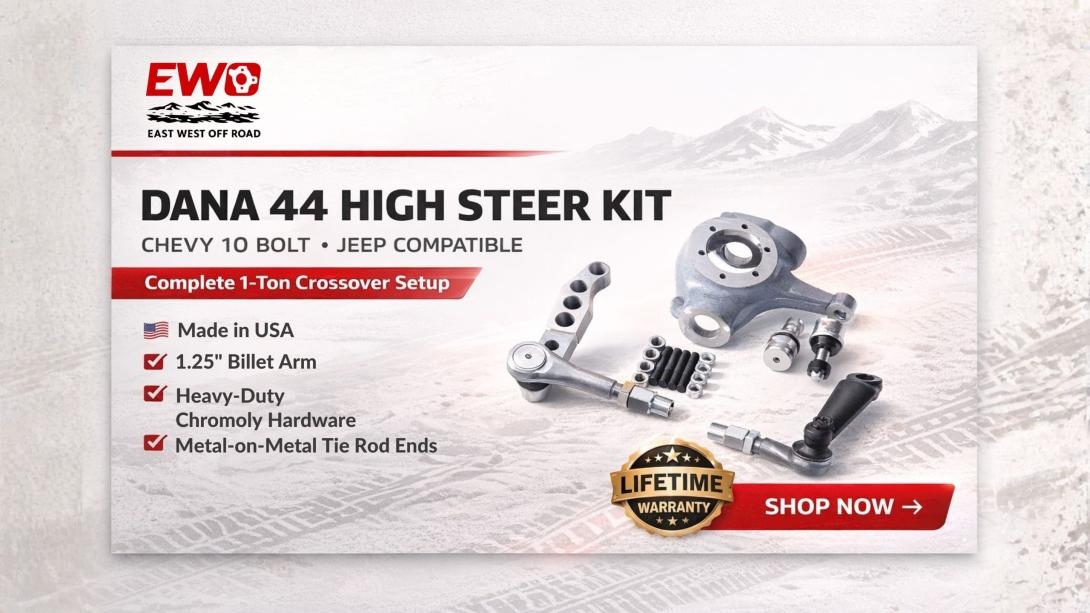
A 1 Ton Steering Upgrade Chevy K5 is a popular modification for classic K5 Blazers that run larger tires, suspension lifts, and demanding off-road setups. As a K5's suspension and tire size increase, the original steering components and factory linkage geometry may become less suitable for the vehicle's new configuration. A properly matched 1-ton crossover/high-steer system can provide stronger steering components while creating a cleaner linkage arrangement for a modified front axle.
Why Upgrade the Steering on a Chevy K5?
The classic Chevrolet K5 Blazer is a popular platform for rock crawling, trail riding, hunting rigs, and custom 4x4 builds.
Many K5s have been modified over the years with:
- Larger tires
- Suspension lifts
- Dana 44 front axles
- GM Corporate 10-bolt axles
- Lockers
- Long-travel suspension
- Hydro-assist steering
- Custom suspension components
- Increased vehicle weight
These modifications can place substantially different demands on the steering system than the original factory configuration.
A 1-ton steering upgrade is therefore often considered as part of a larger front-end build rather than as an isolated steering-part replacement.
What Does “1 Ton Steering” Mean?
The phrase “1 ton steering” generally refers to the class or configuration of heavy-duty aftermarket steering components being used.
It does not automatically mean that the K5 itself has a 1-ton GVWR.
A 1-ton steering system may use larger steering ends, heavier linkage, stronger steering arms, and other components designed around heavy-duty GM applications.
The important consideration is whether those components are correctly matched to your K5's axle, steering box, suspension and intended use.
Chevy K5 Steering: Stock vs. 1-Ton Crossover
The original steering arrangement on many classic GM solid-axle trucks uses a steering linkage configuration that can become less desirable after a significant suspension lift.
A crossover system changes the steering layout by connecting the steering box to a steering arm positioned across the axle.
The result can be a more suitable drag-link angle and improved linkage clearance when properly engineered.
MotorTrend's coverage of a Dana 44 high-steer conversion documented a GM build where the upgraded steering placed the tie rod and drag link above the leaf springs and significantly improved the previous bump-steer and clearance issues.
The exact result on your K5 will depend on suspension height, axle location, steering box, pitman arm and other geometry.
Dana 44 and GM 10-Bolt Compatibility
One of the most important things to determine before buying a steering kit is which front axle your K5 actually has.
Classic Chevy K5 Blazers can be found with different front axle configurations, including Chevy Dana 44 and GM Corporate 10-bolt applications.
East West Off Road's current 1-ton high-steer product listing states compatibility with Chevy Dana 44 front axles and Chevy 10-bolt/GM Corporate 10-bolt axles. Its compatibility chart includes K5 Blazer applications from 1969–1991, along with several other classic Chevy and GMC 4WD models.
That makes axle identification the first step in selecting a 1 ton steering upgrade for a Chevy K5.
What Components Are Important in a K5 1-Ton Steering Upgrade?
A complete steering conversion may include several components that need to work together.
Flat-Top Steering Knuckle
A flat-top knuckle provides the mounting surface required for an aftermarket high-steer arm.
This is particularly important when converting a compatible Dana 44 or GM 10-bolt front axle to crossover steering.
High-Steer Arm
The steering arm mounts to the flat-top knuckle and provides the elevated attachment point for the steering linkage.
The mounting pattern, hardware and taper must match the rest of the system.
Drag Link
The drag link transfers steering input from the pitman arm to the steering arm.
Its length and angle should be selected based on the actual K5 suspension and axle position.
Tie Rod
The tie rod connects the steering knuckles and transfers steering movement across the front axle.
Its location depends on the selected knuckles, steering arms and overall steering configuration.
Steering Ends
Heavy-duty steering ends need to match the linkage, threads and taper of the steering arms and knuckles.
Pitman Arm
The pitman arm connects the steering box to the drag link.
A dropped or otherwise application-specific pitman arm may be required depending on the K5's steering box, suspension height and desired geometry.
Why High Steer Makes Sense for a Lifted K5
A significant suspension lift changes the relationship between the axle and steering box.
As the axle moves farther away from the chassis, the factory drag-link angle can become more severe.
A crossover/high-steer configuration can reposition the steering linkage higher and create a more appropriate relationship between the axle and steering box.
This can provide:
- Improved linkage clearance
- Higher steering-link position
- Better compatibility with lifted suspension
- Reduced exposure of steering components to obstacles
- More flexibility when building custom steering geometry
However, high steer should not be viewed as a guaranteed fix for every steering problem.
1 Ton Steering Upgrade Chevy K5 for Larger Tires
Larger tires increase the loads placed on steering components.
A K5 running 35-inch tires may have very different steering requirements from a nearly stock truck, while a heavily modified vehicle running larger tires and rock-crawling terrain places even greater demands on the front end.
The steering upgrade should therefore be selected around:
- Tire diameter
- Tire weight
- Wheel backspacing
- Vehicle weight
- Suspension lift
- Intended terrain
- Steering-assist system
- Axle configuration
The goal is not simply to install the biggest steering parts available. The goal is to build a correctly matched system.
How a 1-Ton Steering Upgrade Can Improve K5 Clearance
Clearance is a major consideration on an off-road K5.
Low-mounted steering components can become vulnerable when the front axle encounters rocks, ruts and uneven terrain.
Moving the steering linkage higher can provide additional clearance around the axle and suspension components.
It can also help reduce the likelihood of the linkage contacting leaf springs in certain configurations.
However, final clearance must always be checked on the actual vehicle.
Choosing Between Dana 44 and 10-Bolt Steering Components
If your K5 has an axle swap, do not select steering parts based solely on the original truck model.
For example, a K5 originally equipped with one front axle may now have a Dana 44 or GM 10-bolt from another vehicle.
Before ordering a Dana 44 and GM 10-bolt high-steer system, verify:
- Actual front axle
- Knuckle configuration
- Ball-joint arrangement
- Steering-arm mounting
- Tie-rod taper
- Drag-link taper
- Steering-box type
- Pitman-arm spline
- Wheel clearance
- Suspension configuration
This prevents the common problem of purchasing parts based on the K5's model year rather than its current axle configuration.
1 Ton Steering Upgrade Chevy K5: Installation Considerations
Steering is a safety-critical system, so installation requires more than simply bolting on new parts.
Step 1: Identify the Current Steering System
Document the existing:
- Steering box
- Pitman arm
- Drag link
- Tie rod
- Knuckles
- Steering arms
- Axle
- Suspension lift
This provides a baseline before disassembly.
Step 2: Verify Kit Compatibility
Confirm that the selected components match the axle and steering configuration.
If the K5 has previously been modified, physically inspect the axle rather than relying on factory specifications.
Step 3: Install the Knuckle and Steering Arm
The steering arm must sit correctly against the knuckle's mounting surface.
Use the manufacturer's specified studs, washers, nuts and installation procedures.
Step 4: Install the Drag Link and Tie Rod
Verify thread engagement and taper seating.
Do not force a mismatched tapered joint into a steering arm or knuckle.
Step 5: Check Steering Lock
Turn the steering fully left and right.
Check the steering arm, tie rod and drag link for interference.
Step 6: Cycle the Suspension
Check the steering system at:
- Normal ride height
- Full compression
- Full droop
- Left steering lock
- Right steering lock
Look for contact with the frame, leaf springs, differential, wheels, tires, shocks and other components.
Step 7: Verify Final Geometry
Check caster, toe, steering-center position and drag-link relationship after installation.
A professional inspection is recommended if you are uncertain about any part of the steering setup.
Does a 1-Ton Steering Upgrade Fix Bump Steer on a K5?
It can help address bump-steer-related geometry problems, but it should not be described as an automatic cure.
Bump steer is caused by the relationship between suspension movement and steering-link movement.
Factors that can influence it include:
- Drag-link angle
- Steering-arm height
- Axle movement
- Suspension design
- Lift height
- Steering-box position
- Caster
- Ride height
A crossover steering system can create a more favorable drag-link arrangement, but the complete suspension and steering geometry still needs to be evaluated.
Choosing a Complete K5 Steering Kit vs. Individual Parts
Building a steering system from individual components can work for experienced fabricators, but it requires careful compatibility checking.
You may need to match:
- Knuckles
- Steering arms
- Studs
- Tie-rod ends
- Drag-link ends
- Tube adapters
- Pitman arm
- Steering box
A matched kit can simplify the process because the major components are designed around the same application.
For a K5 using a compatible Chevy Dana 44 or GM 10-bolt axle, an EWO 1-ton crossover high-steer kit provides a starting point for a complete steering-system upgrade.
Common Mistakes to Avoid
Buying Parts Based Only on the K5 Year
The current axle may not be the original axle.
Always identify the actual front axle before ordering.
Choosing a Pitman Arm Without Checking the Steering Box
The pitman arm needs to match the steering box and steering configuration.
Ignoring Taper Direction
Different steering ends and mounting locations can use different taper orientations.
Forgetting Wheel Clearance
High-steer arms can change the relationship between steering components and the wheel.
Check actual wheel and tire clearance before finalizing the setup.
Assuming High Steer Automatically Fixes Steering Problems
Worn ball joints, loose steering boxes, incorrect caster and poor suspension geometry can still cause problems after a steering conversion.
Maintenance After a 1-Ton Steering Upgrade
A heavy-duty steering system still needs regular inspection.
After installation and after hard trail use, inspect:
- Steering-arm studs
- Knuckle mounting hardware
- Tie-rod ends
- Drag-link ends
- Jam nuts
- Pitman-arm connection
- Steering-box mounting
- Ball joints
- Steering stops
- Wheels and tires
- Linkage clearance
Look for loose hardware, unusual play, damaged threads, bent components or contact marks.
If any steering component is damaged or loose, repair it before operating the vehicle.
Is a 1 Ton Steering Upgrade Right for Your Chevy K5?
A 1-ton crossover/high-steer upgrade can be worth considering if your K5 has:
- A significant suspension lift
- Larger tires
- A Chevy Dana 44
- A GM Corporate 10-bolt
- Frequent off-road use
- Rock-crawling modifications
- Steering-linkage clearance issues
- An axle swap
- Custom suspension geometry
- A need for heavier-duty steering components
For a mostly stock K5 used primarily on pavement, the benefits may be less significant than they are on a heavily modified trail vehicle.
Final Thoughts
A 1 Ton Steering Upgrade Chevy K5 can be an important part of building a stronger and more practical steering system for a lifted classic Blazer.
The most important part is selecting a complete system around the actual vehicle configuration. Start with the front axle, then verify the knuckle, steering arm, drag link, tie rod, steering ends, pitman arm and steering box.
For K5 Blazers equipped with compatible Chevy Dana 44 or GM Corporate 10-bolt front axles, a crossover/high-steer configuration can provide a higher steering-link position and improved clearance when properly designed. East West Off Road currently lists compatible high-steer applications for K5 Blazers and other classic GM 4WD platforms.
Most importantly, don't treat steering as a simple bolt-on cosmetic upgrade. Verify taper, hardware, steering geometry, suspension cycling and clearance before putting the K5 back on the road or trail.
FAQ
What is a 1 Ton Steering Upgrade Chevy K5?
It is an upgrade that replaces or supplements the factory steering configuration with heavier-duty steering components, often using a crossover/high-steer layout suitable for modified K5 Blazers.
Can I install 1-ton steering on a Chevy K5 Blazer?
Yes, compatible K5 Blazers can be converted to a 1-ton crossover/high-steer configuration. The exact parts depend on the front axle, steering box, suspension and existing modifications.
Does the K5 need a Dana 44 for a 1-ton steering upgrade?
No. Compatible GM Corporate 10-bolt front axles can also be used with certain crossover/high-steer systems. EWO lists both Chevy Dana 44 and GM Corporate 10-bolt compatibility for its applicable high-steer kits.
Is 1-ton steering better for lifted K5 Blazers?
It can be beneficial for modified K5s because heavier-duty steering components and a properly designed crossover configuration can provide improved linkage clearance and more suitable steering geometry.
Does high steer eliminate bump steer?
Not automatically. A properly designed crossover system can improve steering geometry, but bump steer also depends on suspension movement, drag-link angle, axle position, caster and steering-box geometry.
What size tires justify a 1-ton steering upgrade?
There is no universal tire-size cutoff. Tire weight, vehicle weight, suspension lift, terrain and steering-assist configuration all affect the required steering capacity.
Do I need a different steering box?
That depends on the K5's existing steering system and the selected crossover configuration. Verify the steering box and pitman-arm requirements before purchasing the conversion components.
What should I check after installation?
Check steering lock-to-lock, suspension cycling, steering-arm hardware, tie-rod and drag-link joints, pitman-arm connection, steering-box mounting, wheel clearance, tire clearance and final steering geometry.