

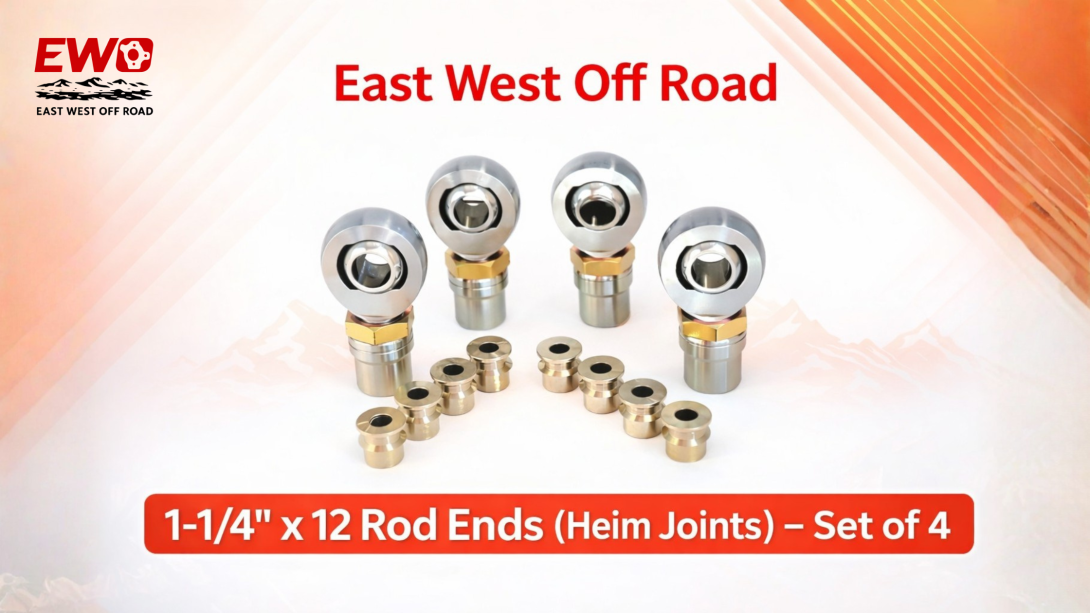
Buy Now: https://www.eastwestoffroad.com/product/1-14%22-x-12-rod-ends-(heim-joints)-set-of-4
Building a dependable off-road vehicle means selecting parts that can handle massive torque, extreme articulation, and punishing impacts. In custom vehicle fabrication, factory rubber bushings and light-duty steering links are the first components to bind, tear, or snap under pressure. For maximum reliability, custom fabricators choose heavy-duty 1.25 Rod Ends. These oversized mechanical links provide the structural foundation needed to handle extreme terrain without failure.
Choosing premium 1.25 Rod Ends requires a clear understanding of material sciences, thread design, and support components. This guide covers how to select and integrate these heavy-duty spherical joints into your next off-road fabrication project.
The Materials Inside Heavy-Duty 1.25 Rod Ends
Heavy-duty rod ends are defined by their incredible load-carrying capacity and premium material makeup. When buying a high-strength 1-1/4 Heim Joint Kit for a custom suspension rebuild, these structural elements ensure your parts outlast trail abuse.
Heat-Treated Chromoly Bodies
The outer shank of a premium 1.25" rod end kit is forged from high-tensile 4130 chromoly steel. Through uniform heat-treatment, these bodies achieve an immense yield strength that easily withstands severe bending forces. This advanced metallurgical composition yields an incredible 76,200 lb radial load heim capacity, with specialized race car heim joints hitting up to a 76800 lbs radial load rod end rating.
Precision 52100 Steel Bearing Inner Ball
At the absolute center of the pivot point sits a high-carbon 52100 steel bearing heim core. This hardened ball is precision ground and finished with a mirror-smooth hard chrome finish rod end coat. This hard chrome layer serves a dual purpose: it drops mechanical friction to near-zero levels while creating an impenetrable defense against moisture, rust, and trail grit.
Teflon/Kevlar Self-Lubricating Liners
High-end off-road suspension parts feature an advanced teflon lined heim joint matrix. By chemically bonding a woven teflon kevlar lined heim joint directly to the inner race, the joint achieves continuous self-cleaning action.
- Zero Maintenance: This self-lubricating rod end technology completely wipes away stone dust, meaning you never use messy grease that acts like sandpaper inside the housing.
- Tight Tolerances: It eliminates sloppy play, keeping steering feedback instantaneous and completely stopping annoying suspension clunks.
Deciphering Thread Layouts and Hardware Sizes
Standardizing your 4x4 suspension parts around clear dimensions makes trail maintenance and track-side adjustments straightforward.
Sizing Up the Dimensions: 1-1/4-12 x 1 Inch Bore
When buying a matching 1-1/4 x 12 rod ends set of 4, you are interacting with three specific size dimensions:
- 1.25 Inch Shank: The exterior mounting thread diameter provides massive shear protection where the joint meets the control arm.
- 12 TPI (Threads Per Inch): A fine 1-1/4-12 right hand thread design provides high thread surface area contact for unmatched clamping hold.
- 1" Bore Center: A true 1 inch bore 1-1/4 thread heim houses a 1-inch diameter hole directly through the inner ball, leaving ample room for beefy hardware or heavy-duty clearance reducers.
Combining Right and Left-Hand Thread Joint Sets
To build fully adjustable suspension links, you must buy a combined left and right heim joint kit. Using a right hand heim joint on one side of your DOM steel tube and a left-hand joint on the other side creates a turnbuckle effect. When you spin the physical link tube, it simultaneously draws both ends inward or pushes them outward, allowing you to square your axle or adjust your pinion angle without unbolting a single bracket. Don't forget to lock the link in place with matching 1.25 heim jam nuts.
Maximize Suspension Travel with Misalignment Spacers
A raw spherical joint mounted cleanly between parallel tabs can only pivot a handful of degrees before the suspension tube strikes the bracket face. To get maximum wheel travel out of your rock crawler 4 link kit, you must use heim joints with misalignment spacers.
By sliding specialized 1.25 heim misalignment spacers into the center ball, you achieve two primary objectives:
- Massive Articulation Angles: The narrow, extended neck design keeps the main joint body safely clear of the mounting bracket faces, expanding rotation clearance significantly.
- Precision Bolt Reduction: It bridges the gap between giant fab gear and standard grade-8 hardware, typically stepping a 1" inner diameter down via a 1 to 9/16 stainless misalignment spacers kit to accept standard 9/16" suspension bolts.
Selecting Weld Adapters for Custom Fabrication
Transforming raw DOM steel tubing into high-strength control links requires heavy-duty weld bungs to house the threaded shanks of your new 1.25 rod ends.
Matching Tube Adapters to Wall Thickness
Your choice of a weld-in tube adapter is decided by the inner diameter of your DOM tube. For top-tier trail rock crawlers, a 2-inch Outer Diameter (OD) tube with a 0.250" wall thickness is the industry standard. This requires a 1-1/4 tube adapters for 2 inch od dom configuration, which acts as a perfect 1.5" inner diameter tube adapter bung. For lighter steering link joints or track bars, you can step down to a .120 wall dom tube adapter.
Round vs. Hex Head Tube Bungs
Consider upgrading to a hex head tube adapter (or 1.5" hex tube bung). Standard round adapters force you to use pipe wrenches that scar your links. A hex head provides flat, machined surfaces so you can easily slip an open-ended wrench onto the link to complete alignment adjustments seamlessly.
Always select inserts CNC-machined from heavy-grade carbon steels, such as a 1020 steel tube adapter or 1045 steel tube adapters. Sourcing a verified USA made tube adapter guarantees clean thread accuracy and predictable metallurgy when completing heavy passes with structural welding equipment.
Suspension and Steering Application Profiles
Where should you deploy these heavy-duty 1.25" components? Due to their immense size and extreme load ratings, they are primarily used in high-stress chassis positions across custom 1.25 Rod Ends suspension setups.
- Custom 4 Link Suspension Arms: Lower control arms constantly scrape over jagged boulders and bear the massive thrust loads of low-range crawling. Using a rugged 1.25 inch suspension joint lineup on lower links provides bulletproof defense against structural bending.
- Heavy-Duty Crossover Steering: Upgrading a custom off-road steering kit with 1.25" joints completely eliminates steering deflection under load. Using them as heavy duty tie rod ends ensures your front tires stay perfectly aligned even when wedged tightly in deep rock ruts.
Frequently Asked Questions (FAQs)
Why should I choose 1.25" rod ends over smaller 7/8" options for my control arms?
A 1.25" rod end provides over double the load capacity of a 7/8" joint. The massive 1-1/4" shank resists bending and snapping under extreme structural loads, making it the safety standard for lower links on heavy trail rigs running 37-inch to 42-inch tires.
Can I weld a tube adapter into my DOM tube with the rod end threaded in?
No, you should never do this. High welding heat will quickly transfer through the threads of the tube insert and permanently warp or melt the delicate internal Teflon/Kevlar self-lubricating matrix. Always thread out and remove your rod ends completely before completing final structural weld passes.
How do I know if I need a right-hand or left-hand thread joint?
For stationary linkages like a track bar, you can use two right-hand joints. However, for adjustable suspension links or steering tie rods, you must use one right-hand joint and one left-hand joint. This allows you to adjust the link length simply by rotating the main tube, without having to unbolt the link from the vehicle.
Buy now - https://www.eastwestoffroad.com/product/1-14%22-x-12-rod-ends-(heim-joi…