

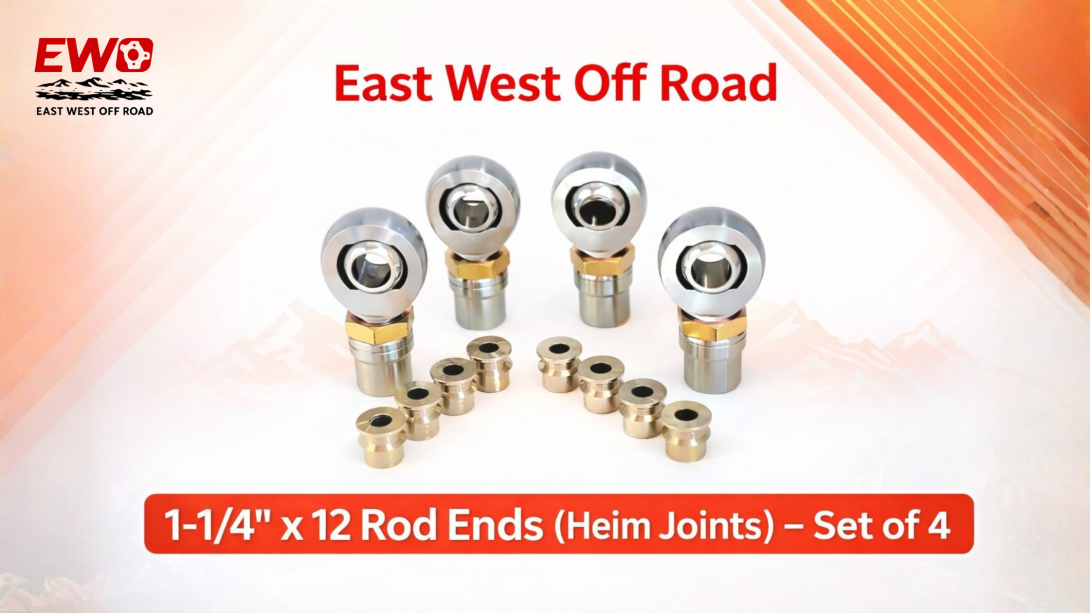
Buy Now: https://www.eastwestoffroad.com/product/1-14%22-x-12-rod-ends-%28heim-joints%29-set-of-4
When you're building a serious off-road suspension, the quality of your joints matters just as much as the tubing, brackets, and geometry. 1.25 Rod Ends are a popular choice for custom 4-link suspension, rock crawlers, and other high-load fabrication projects because their large threaded shank and robust construction are designed for demanding applications. Whether you're upgrading an existing suspension or fabricating a completely custom setup, choosing the right 1-1/4-inch rod ends can make a major difference in durability, articulation, and serviceability.
What Are 1.25 Rod Ends?
1.25 Rod Ends, commonly called 1-1/4-inch rod ends or Heim joints, are spherical rod-end bearings used to create controlled articulation between suspension components.
Unlike a conventional rubber bushing, a Heim joint allows angular movement while maintaining a strong mechanical connection. This makes it especially useful in custom suspension systems where link movement and suspension articulation need to be carefully controlled.
For off-road applications, 1-1/4 rod ends are commonly selected when builders need a heavy-duty connection between suspension links, steering components, or other fabricated assemblies.
Why Choose 1-1/4 Inch Rod Ends for Off-Road Builds?
Off-road vehicles experience forces that can be significantly different from those seen during normal street driving. Rock crawling, uneven terrain, suspension articulation, and large tires can place substantial loads on suspension components.
A properly selected 1.25 rod end offers several advantages:
- Large threaded shank for heavy-duty fabrication
- Strong connection between links and brackets
- Excellent articulation potential
- Adjustable link length
- Easy service and replacement
- Compatibility with custom 4-link suspension designs
- Availability of high-misalignment spacers and tube adapters
For builders creating a custom 4-link suspension, these characteristics make large rod ends a practical solution.
1.25 Heim Joints for 4-Link Suspension
A 4-link suspension relies on multiple links to control axle movement relative to the chassis. Because these links move through different angles as the suspension cycles, the joints need to accommodate articulation.
This is where a quality 1-1/4 Heim Joint Kit can be valuable.
Large rod ends can provide the articulation needed for custom suspension links while allowing builders to fine-tune link length during fabrication.
The correct combination of rod ends, spacers, adapters, tubing, and brackets should always be selected according to the vehicle's actual suspension geometry and intended use.
Chromoly Rod Ends for Heavy-Duty Applications
Material selection is an important consideration when purchasing Chromoly Rod Ends.
Chromoly is commonly used in performance and off-road components because it offers a useful combination of strength and durability. For a custom suspension system, the rod end should be considered as part of the complete link assembly rather than as an isolated component.
The tubing, threaded adapter, jam nut, mounting bolt, misalignment spacers, and brackets all contribute to the strength and performance of the finished assembly.
That's why choosing a complete, properly matched system can simplify the fabrication process.
Understanding 1-1/4-12 Rod Ends
Thread specifications are critical when building suspension links.
A 1-1/4-12 rod end uses a 1-1/4-inch nominal thread size with 12 threads per inch. The thread must match the corresponding tube adapter or threaded insert used in the suspension link.
Before fabrication, verify:
- Thread diameter
- Threads per inch
- Right-hand or left-hand thread
- Shank length
- Mounting width
- Bolt diameter
- Required misalignment
- Tube adapter compatibility
Using mismatched components can create installation problems and may compromise the finished assembly.
Right-Hand and Left-Hand 1.25 Rod Ends
Custom suspension builders may use both right-hand and left-hand threaded components.
Using opposite thread directions on a link assembly can allow the link length to be adjusted by rotating the tube without completely removing the suspension link.
This can make setup and adjustment easier, particularly on custom 4-link systems.
However, thread direction should always be planned before fabrication so the correct components are installed in the correct positions.
Misalignment Spacers for Heim Joints
Misalignment spacers are another important part of a Heim joint suspension system.
A spherical rod end can articulate, but the mounting hardware and bracket geometry determine how much usable angular movement is available. Misalignment Spacers can help position the rod end correctly inside a mounting bracket while providing the required clearance.
Depending on the application, builders may choose different spacer configurations for different bolt sizes.
The correct spacer setup should provide adequate articulation without creating unnecessary side loading or interference.
Tube Adapters for 1.25 Rod Ends
Connecting a large rod end to suspension tubing requires the correct threaded tube adapter or insert.
For example, EWO offers 1.25 Rod Ends with selectable tube-adapter configurations for 1.5-inch inside-diameter tubing, including hex and round adapter options.
This gives fabricators flexibility when choosing the tubing and link design for a custom project.
The adapter should be properly fitted and welded according to the manufacturer's requirements and the builder's fabrication practices.
1.25 Rod Ends and DOM Tubing
DOM tubing is commonly used in custom off-road suspension fabrication because it provides a strong and consistent tube structure.
When using 1.25 Rod Ends with DOM tubing, the tube's inside diameter must match the selected threaded adapter.
Before cutting the tubing, determine the finished link length by accounting for:
- Rod-end thread engagement
- Tube adapter dimensions
- Jam-nut position
- Required suspension travel
- Bracket mounting width
- Misalignment spacer configuration
Taking these measurements before fabrication can prevent expensive rework.
Choosing Heavy-Duty Rod Ends for Rock Crawlers
Rock crawlers place demanding loads on suspension components. Large tires, axle articulation, steep obstacles, and repeated suspension cycling can all increase the importance of properly engineered link assemblies.
For a Rock Crawler 4 Link Kit, builders should consider more than simply choosing the largest available rod end.
Evaluate the complete system, including:
- Rod-end size
- Thread engagement
- Tube diameter and wall thickness
- Bracket design
- Bolt size
- Misalignment spacers
- Link geometry
- Suspension travel
- Clearance throughout the suspension cycle
A larger joint is only one part of a properly engineered suspension.
1.25 Rod Ends vs. Smaller Heim Joints
Smaller rod ends can work well for many applications, but a 1-1/4-inch rod end is often selected for custom heavy-duty builds where the builder wants a larger threaded connection.
The choice should be based on the actual loads, link design, available space, and intended vehicle use.
For a serious off-road build, simply increasing component size isn't a substitute for correct suspension geometry and fabrication.
Installing 1.25 Rod Ends
Installation should begin with careful measurement and suspension planning.
Step 1: Determine Link Length
Measure the required link length based on the suspension design and desired geometry.
Step 2: Select the Correct Tube
Choose tubing with the correct inside diameter for the selected adapter or threaded insert.
Step 3: Install the Tube Adapter
Position the threaded adapter correctly inside the tube and follow appropriate welding and fabrication procedures.
Step 4: Install the Heim Joint
Thread the 1.25 rod end into the adapter while maintaining adequate thread engagement.
Step 5: Install Jam Nuts
Tighten the jam nuts against the adapter to secure the adjustment.
Step 6: Install Misalignment Spacers
Use the correct spacers for the mounting bolt and bracket configuration.
Step 7: Cycle the Suspension
Before finalizing the installation, cycle the suspension through its expected range of movement and check for contact, binding, excessive joint angle, and interference.
Common Mistakes When Using 1.25 Rod Ends
Even high-quality rod ends can perform poorly if the surrounding suspension is incorrectly designed.
Common mistakes include:
- Insufficient thread engagement
- Incorrect tube-adapter size
- Wrong spacer configuration
- Poor bracket placement
- Excessive joint angle
- Inadequate suspension clearance
- Incorrect bolt sizing
- Failure to cycle the suspension
- Poor welding practices
- Ignoring steering or driveline clearance
A professional inspection is recommended for critical suspension and steering fabrication.
Why EWO 1-1/4 Rod Ends Are Worth Considering
EAST WEST OFF ROAD offers a 1-1/4 Heim Joint Kit designed for builders working on heavy-duty suspension and off-road fabrication projects.
The available configuration includes 1-1/4-inch rod ends with options for stainless-steel misalignment spacers and 1.5-inch ID tube adapters. Buyers can select the appropriate spacer and adapter configuration for their build.
For builders who need 1.25 Rod Ends, having the rod ends, jam nuts, spacers, and compatible tube adapters available together can make component selection easier.
You can explore the available 1.25 Rod Ends and configuration options before starting your fabrication project.
Maintenance and Inspection
Heim joints should be inspected regularly, especially on vehicles that are frequently used for rock crawling or other demanding off-road activities.
Check for:
- Excessive play
- Damaged races
- Worn mounting surfaces
- Loose jam nuts
- Damaged threads
- Cracked brackets
- Loose bolts
- Corrosion
- Abnormal movement
If a rod end develops excessive play or visible damage, replace it before continued use.
Frequently Asked Questions
What are 1.25 Rod Ends used for?
1.25 Rod Ends are commonly used for custom 4-link suspension, off-road vehicles, rock crawlers, steering components, and other fabrication projects requiring articulated mechanical connections.
Are 1.25 Rod Ends good for 4-link suspension?
Yes. Their large threaded shank and ability to articulate make 1-1/4-inch rod ends a popular option for custom 4-link suspension systems when properly sized and installed.
What does 1-1/4-12 mean on a rod end?
1-1/4-12 refers to a 1-1/4-inch nominal thread diameter with 12 threads per inch. The mating tube adapter or threaded insert must use the compatible thread specification.
Do I need misalignment spacers with 1.25 Rod Ends?
The required spacer configuration depends on the mounting bracket, bolt size, joint width, and desired articulation. Proper spacers should be selected based on the complete suspension design.
Can 1.25 Rod Ends be used with DOM tubing?
Yes, when the DOM tubing has the appropriate inside diameter for the selected threaded adapter or insert. Always verify dimensions before fabrication.
Are Chromoly Rod Ends suitable for rock crawlers?
Chromoly rod ends are commonly used in performance and off-road fabrication because of their strength and durability characteristics. However, the complete link assembly must be properly engineered for the intended application.
Final Thoughts
Choosing the right 1.25 Rod Ends is an important step when building a heavy-duty 4-link suspension or custom off-road vehicle. Rod-end size, thread specification, tube adapters, misalignment spacers, tubing, brackets, and suspension geometry all need to work together.
For builders looking for a robust connection for a custom suspension project, a properly configured 1-1/4-inch Heim joint system can provide the adjustability and articulation needed for demanding off-road applications.