

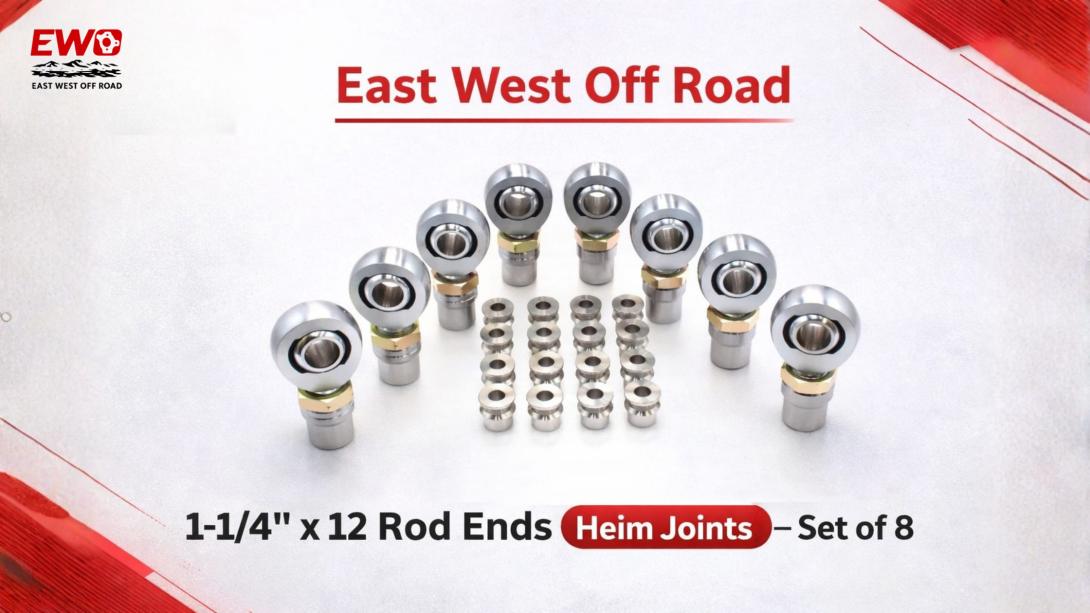
Buy Now: https://www.eastwestoffroad.com/product/1-14%22-x-12-rod-ends-(heim-joints)-set-of-8
When you are fabricating a custom suspension or high-clearance steering linkage, your choice of pivot points will dictate how long your rig survives on the trail. Standard factory bushings simply lack the strength and angular deflection required for extreme trail duty. For fabricators who refuse to compromise on durability, upgrading to 1.25 Rod Ends is the definitive answer.
These massive spherical joints are engineered to provide maximum articulation while enduring relentless punishment from high-horsepower rock crawlers, desert racers, and heavy-duty trail trucks. Let's break down the technical specifications, material advantages, and fabrication tips you need to know when integrating a premium 1.25" Rod End Kit into your next custom build.
The Technical Specs Behind a 1-1/4-12 Rod End Set
To appreciate why a 1.25 rod ends configuration is the industry standard for hardcore off-road fabrication, you have to look closely at the mechanical engineering behind the sizing. A standard 1-1/4" joint features a massive 1-1/4-12 thread adapter footprint, ensuring the shank has plenty of cross-sectional mass to resist severe bending forces.
Anatomy of an Ultra-Strong Spherical Joint
Not all rod ends are created equal. A premium 1-1/4 Heim Joint Kit consists of three precisely matched components built to withstand extreme mechanical stress:
- The Housing: True heavy-duty links rely on a heat-treated chromoly joint body forged from premium 4130 chromoly rod ends steel. This specialized alloy prevents the housing from stretching or cracking when under immense tensile load.
- The Ball: The inner pivot consists of a precision-ground 52100 steel bearing heim ball. This sphere is treated with a rugged hard chrome finish rod end layer to prevent scratching, pitting, and corrosion over time.
- The Liner: High-end kits discard old-school grease fittings in favor of a Teflon lined heim joint or a heavy-duty Teflon Kevlar lined heim joint. This creates a completely self-lubricating rod end that pushes dirt away from the inner bearing surface naturally.
Mind-Boggling Load Capacities
When you wedge a massive tire between two rocks, the localized forces transmitted through your steering or control arms are staggering. This is why high-grade race car suspension parts use 1.25" hardware. A premium 1-1/4 x 12 rod ends set of 4 or 8 typically boasts an incredible 76,800 lbs radial load rod end capacity. With some variations handling up to a 76,200 lb radial load heim force, these heavy duty link ends provide an exceptional safety factor that protects your chassis from catastrophic failure.
Fabricating with 1.25" Rod Ends: Tube Adapters and Links
Integrating a complete heim joint suspension kit into your vehicle requires matching the joints with the correct structural tubing and thread adapters.
Choosing the Right Tube Adapter
To install these oversized joints into your control arms or steering links, you will need matching fabrication tube adapters. Most hardcore builders construct their links out of thick-walled DOM (Drawn Over Mandrel) steel tubing. Your adapter selection will depend entirely on your tubing dimensions:
- 2-Inch OD DOM Tubing: The standard for lower control arms on a rock crawler 4 link kit is 2" Outer Diameter tubing paired with a 1-1/4 tube adapters for 2 inch OD DOM insert. This typically utilizes 1/4 inch wall thickness DOM tube adapters to ensure the arm can support the full weight of the vehicle during a hard rock scrape.
- Hex vs. Round Bungs: You can choose a smooth weld-in tube adapter or opt for a specialized hex head tube adapter (1.5" hex tube bung). The major advantage of a hex head design is that it gives you flat wrench surfaces, making it effortless to lock down your 1.25 heim jam nuts without scarring the link tube.
- Material Reliability: Ensure your weld-in bung for 1.5 ID tubing or tube adapter for 1.5 ID tubing is machined from highly weldable steel, such as a 1045 steel tube adapters standard or a premium 1020 steel tube adapter (like the E 60102 tube adapter profile). Opting for a certified USA made tube adapter guarantees clean thread tolerances and easier welding.
Setting Up Adjustability
When building your suspension links, always pair a right hand heim joint (like a 1.25x1 right hand heim featuring a 1-1/4-12 right hand thread) on one end of the tube with a left-hand thread joint on the other. This configuration turns your linkages into fully adjustable suspension links. You can easily dial in your alignment, track width, or pinion angles while the arms are bolted to the vehicle simply by spinning the center tube, locking it in place afterward with a matching right-hand thread rod end jam nut.
Maximizing Articulation with Misalignment Spacers
A raw 1" bore heim joint provides incredible raw strength, but if you bolt a standard 1-inch bolt directly through the ball into a flat bracket, your suspension travel will be severely limited. The outer housing will quickly bind against your brackets as the axle flexes.
Achieving Bind-Free Articulation
To solve this, professional Chromoly Heim Joints packages utilize custom heim joints with misalignment spacers.
By inserting a 1.25 heim misalignment spacers kit into a 1-3/8 inch ball width heim joint, you extend the physical pivot surface outward away from the bracket walls. This downsizes the inner bore hole to a manageable off-road size—such as using a 1 to 9/16 stainless misalignment spacers setup—giving your 1.25 inch suspension joint the high-clearance rotation needed to handle maximum axle articulation without binding.
Versatile Applications Across Your Build
While 1.25" hardware is the ultimate core for a custom 4 link suspension, these premium components are equally critical across other high-stress points on a modified 4x4:
- Off-Road Steering Kits: Eliminate the flex and dead zones in your steering wheel by converting your linkage into a heavy-duty off-road steering kit utilizing high-strength heavy duty steering joints.
- Steering Link Joints: Heavy trucks running massive tires put incredible side-load stress on steering linkages. Upgrading to 1.25" steering link joints keeps your alignment dead-on over punishing terrain.
- Heavy Duty Tie Rod Ends: Swap out weak factory tie rod configurations for custom links built from a heim joint kit for DOM tubing to keep your front tires tracking true through deep ruts and rock fields.
From fine-tuning a 4 link kit to sourcing premium off-road fabrication supplies like a .250 wall DOM tube adapter or a .120 wall DOM tube adapter, choosing 1.25" rod ends gives you the ultimate mechanical advantage.
Frequently Asked Questions (FAQs)
What makes a Teflon-Kevlar liner better than a standard grease fitting?
A Teflon Kevlar lined heim joint requires absolutely zero maintenance and provides a completely self-lubricating barrier. Greaseable joints easily attract trail dust, sand, and moisture, creating a gritty compound inside the housing that quickly ruins the bearing. Teflon-lined options wipe away debris naturally as they pivot, extending the life of the joint.
Why do fabricators use both left and right-hand threads on a single link?
Using a 1-1/4-12 right hand thread joint on one side of a link and a left-hand thread on the opposite side allows you to adjust the total length of the link simply by turning the main tube. If you used right-hand threads on both ends, you would be forced to completely unbolt one end from the axle bracket every single time you needed to adjust your suspension geometry.
What size bolt do I use with a 1.25" rod end with misalignment spacers?
While a standard 1.25" rod end features a 1" bore heim joint, adding high-clearance misalignment spacers typically reduces that inner bore to accept a 3/4" or 9/16" high-grade bolt (like a 1 to 9/16 stainless misalignment spacers setup). This safely narrows the bolt diameter while providing the physical clearance required for the housing to flex without binding against your brackets.
Which DOM tubing wall thickness should I select for my lower suspension links?
For heavy-duty lower suspension links that are highly prone to sliding directly over rocks, a 1/4 inch wall thickness DOM tube adapters configuration paired with 2" OD DOM tubing is the gold standard. For upper links that experience less direct ground impacts, a lighter .120 wall DOM tube adapter setup can be used to keep unsprung weight down.