

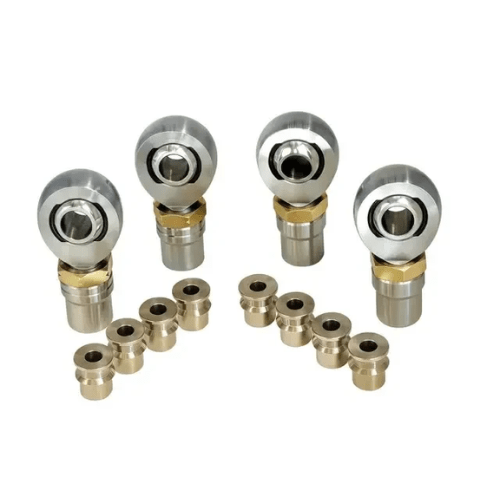
Buy Now: https://www.eastwestoffroad.com/product/1-14%22-x-12-rod-ends-(heim-joints)-set-of-4
A 4 Link Kit is one of the most popular ways to build a highly adjustable suspension system for a rock crawler, trail rig, race vehicle, or custom 4x4. A properly designed four-link suspension uses upper and lower links to control axle movement while allowing the builder to tune suspension geometry, articulation, ride characteristics, and axle positioning. The right combination of link joints, brackets, tube adapters, and DOM tubing can turn a collection of off-road suspension parts into a strong and serviceable custom suspension system.
For builders using large-format spherical joints, 1.25 Rod Ends are a common choice for demanding custom suspension applications. EWO offers 1-1/4" x 12 Chromoly Heim Joints in different set configurations with tube adapter and misalignment-spacer options.
What Is a 4 Link Kit?
A 4 Link Kit is a collection of suspension components used to construct a four-link suspension system.
A typical four-link arrangement uses:
- Two upper suspension links
- Two lower suspension links
- Frame-side mounting brackets
- Axle-side mounting brackets
- Spherical rod ends or other suspension joints
- Jam nuts
- Tube adapters or weld-in bungs
- Misalignment spacers
- Link tubing
- Mounting hardware
The exact components depend on whether the system is parallel, triangulated, single-triangulated, or another custom configuration.
Some commercial kits provide only brackets, while others include rod ends, tube adapters, hardware, or complete link assemblies. For example, current 4-link products from major off-road suppliers range from bracket-only builder kits to packages containing chromoly rod ends, weld-in adapters, misalignment spacers, and other hardware.
How Does a Four-Link Suspension Work?
A four-link suspension uses four links to control the axle relative to the chassis.
The lower links generally control much of the axle's fore-and-aft movement, while the upper links work with the lower links to control axle rotation and establish the suspension's geometry.
The important point is that a four-link system is not simply four pieces of tubing attached to an axle.
Link length, mounting height, separation, angle, and chassis location all influence how the suspension behaves.
Upper and Lower Links
The upper and lower links perform different jobs within the suspension geometry.
Lower links are often longer and positioned to control the axle's primary movement. Upper links work with them to control axle rotation and help establish the vehicle's anti-squat or related geometry.
The exact arrangement should be calculated for the specific vehicle rather than copied from another build without considering wheelbase, ride height, tire size, axle location, and intended use.
4 Link Kit vs. Factory Suspension
Factory suspension systems are designed around a specific vehicle's original dimensions, weight, ride height, and intended operating conditions.
A custom 4 Link Kit gives the builder significantly more control over suspension geometry.
This can be especially useful when a vehicle has:
- A significant suspension lift
- Larger-than-stock tires
- A swapped axle
- Coilovers or air shocks
- A custom chassis
- Increased suspension travel
- A rock-crawling setup
- A modified wheelbase
The advantage of a four-link system is adjustability, but that adjustability also means the builder has to establish the geometry correctly.
Choosing the Right 4 Link Kit
Not every four-link kit is designed for the same vehicle or application.
Before purchasing a kit, determine what type of suspension you are building and which components are included.
Complete Kit vs. Builder Kit
A complete kit may include brackets, joints, adapters, hardware, and other components.
A builder kit may provide only selected components and allow the fabricator to choose the tubing and suspension joints separately.
This distinction matters because a kit that appears inexpensive may require additional parts before the vehicle can be completed.
Parallel vs. Triangulated 4-Link
A parallel four-link generally uses links that run more closely parallel to the vehicle's longitudinal direction and may use a separate lateral locating device such as a Panhard bar.
A triangulated four-link uses angled links to provide lateral axle location.
The correct layout depends on packaging, suspension travel, steering requirements, drivetrain clearance, chassis dimensions, and desired geometry.
1.25 Rod Ends for 4-Link Suspension
Large 1.25 Rod Ends are popular for heavy-duty custom suspension systems because they provide a substantial threaded connection and spherical articulation.
EWO's current 1-1/4" x 12 Chromoly Heim Joint Kit is offered as a set of four with tube adapters and jam nuts, while a larger set of 16 is also available for custom four-link applications.
A 1.25" Rod End Kit can be especially useful when fabricating links individually rather than purchasing preassembled control arms.
The important specifications include:
- Thread diameter
- Thread pitch
- Ball bore
- Shank design
- Bearing construction
- Available articulation
- Load rating
- Misalignment-spacer requirements
- Mounting width
- Tube-adapter compatibility
Why Use Chromoly Heim Joints?
Chromoly Heim Joints are widely used in performance suspension and off-road fabrication.
The term "chromoly" refers to chromium-molybdenum steel, but material designation alone does not determine the performance of a complete rod end.
The bearing race, spherical ball, heat treatment, thread design, manufacturing quality, and joint dimensions all matter.
A properly selected Heat-Treated Chromoly Joint can be a useful choice for a demanding suspension system, but the joint still needs to be sized according to the actual application and load direction.
Heim Joints with Misalignment Spacers
Heim Joints with Misalignment Spacers allow a spherical rod end to connect to a mounting bolt while accommodating the required angular movement.
The spacer also adapts the rod end's bore to the bolt size.
EWO's current 1-1/4" x 12 Heim Joint offerings provide stainless-steel misalignment spacer options including 1-inch-to-3/4-inch, 1-inch-to-5/8-inch, and 1-inch-to-9/16-inch configurations.
The correct spacer should be selected according to:
- Rod-end bore
- Mounting bolt diameter
- Bracket width
- Required articulation
- Suspension travel
- Available clearance
A spacer should never be selected simply because it fits the bolt.
Tube Adapters and Weld-In Bungs
A rod end needs a secure connection to the suspension link.
That is where a Weld-In Tube Adapter or threaded bung becomes important.
The adapter is installed into the end of the suspension tube and provides the threaded connection for the rod end.
1.5" Inner Diameter Tube Adapter
A 1.5" Inner Diameter Tube Adapter is commonly used with large suspension links when the tube's actual internal diameter matches the adapter specification.
EWO currently offers 1.5" I.D. Hex Tube Adapter and 1.5" I.D. Round Tube Adapter configurations with its 1-1/4" x 12 Heim Joint Kit.
Always measure the actual tube ID before ordering.
Hex Head Tube Adapter
A Hex Head Tube Adapter can make installation and adjustment easier because the hex section provides a convenient wrenching surface.
This is particularly helpful on adjustable suspension links where access may be limited after the link is installed.
DOM Tubing Weld Adapter
A DOM Tubing Weld Adapter is designed to create a threaded connection between a rod end and a fabricated DOM suspension link.
The tube, adapter, weld, and rod end should be treated as one structural assembly.
Link Tubing Selection
The tubing used for a four-link system needs to be selected according to the vehicle's weight, suspension design, link length, load direction, and intended use.
Common fabrication materials include DOM tubing and chromoly tubing.
Tube diameter and wall thickness both matter.
For example, current commercial four-link systems use tubing specifications ranging from smaller DOM link tubes to larger heavy-duty designs, depending on the kit's intended application.
.120 Wall vs. .250 Wall DOM
A .120 Wall DOM Tube Adapter and .250 Wall DOM Tube Adapter should not be treated as interchangeable specifications.
Thicker tubing can provide additional section strength and resistance to deformation, but the correct wall thickness depends on the complete link design.
Consider:
- Vehicle weight
- Link length
- Tube diameter
- Wall thickness
- Mounting configuration
- Load direction
- Material
- Expected impact loads
For a serious rock crawler, fabrication decisions should be based on the entire suspension design rather than one specification in isolation.
1-1/4-12 Rod End Set for Custom Links
The 1-1/4-12 specification is particularly important when matching rod ends to tube adapters.
A 1-1/4-12 Right Hand Thread uses a 1-1/4-inch thread with 12 threads per inch.
A Right-Hand Thread Rod End can be paired with a left-hand version in an adjustable link design.
Why Use Left and Right-Hand Threads?
A Left and Right Heim Joint Kit can make suspension-link adjustment much easier.
With opposing thread directions, rotating the link can change its effective length without necessarily removing both ends from their mounting locations.
This is one of the most useful features of adjustable suspension links.
However, the link must be designed so the adjustment mechanism can be safely accessed and locked using the appropriate jam nuts.
4 Link Kit Geometry
Suspension geometry is arguably the most important part of a four-link build.
A strong collection of components cannot compensate for poorly designed geometry.
Important variables include:
- Link length
- Link angle
- Vertical separation
- Horizontal separation
- Instant center
- Anti-squat
- Pinion angle
- Ride height
- Wheelbase
- Axle position
- Shock position
- Driveshaft clearance
Anti-Squat
Anti-squat describes how suspension geometry influences the vehicle's response to acceleration.
Changing upper- and lower-link mounting points can significantly change anti-squat characteristics.
There is no single anti-squat number that is ideal for every vehicle. A rock crawler, trail rig, drag-style vehicle, and race vehicle can have very different suspension requirements.
Link Separation
The vertical separation between upper and lower links affects the loads carried by the links and brackets.
Greater separation can influence axle control and bracket loading, but available packaging space, driveshaft clearance, differential clearance, and chassis design must all be considered.
Rock Crawler 4 Link Kit Applications
A Rock Crawler 4 Link Kit needs to handle a particularly demanding environment.
Rock crawling can expose suspension components to:
- High articulation
- Sudden impacts
- Side loads
- Axle torque
- Uneven terrain
- Repeated compression and extension
- Rocks and trail obstacles
This is why many rock-crawler builders choose large spherical joints, heavy-wall tubing, strong brackets, and properly designed mounting points.
A high-strength Heim Joint can be useful in this environment, but strength depends on the entire assembly.
Custom 4 Link Suspension for Jeeps, Trucks, and 4x4s
Custom 4 Link Suspension is commonly used on Jeeps, Toyota 4x4s, Ford trucks, Chevy/GMC builds, rock racers, Ultra4 vehicles, and other off-road platforms.
The exact design should be customized around the vehicle.
A kit that works on one chassis may require significant changes on another.
Before welding brackets permanently, mock up the suspension and verify:
- Ride height
- Full compression
- Full droop
- Steering clearance
- Driveshaft clearance
- Differential clearance
- Exhaust clearance
- Shock travel
- Tire clearance
- Link articulation
Off-Road Suspension Parts to Consider
A four-link conversion normally involves more than rod ends.
Depending on the build, Off-Road Suspension Parts may include:
- 1-1/4 Heim joints
- Weld-in tube adapters
- Misalignment spacers
- Jam nuts
- DOM tubing
- Axle brackets
- Frame brackets
- Link towers
- Coilover mounts
- Shock tabs
- Hardware
- Bump stops
- Track-bar components
Planning all of these components before fabrication can prevent expensive rework later.
1.25 Heim Misalignment Spacers and Mounting Width
Mounting width is often overlooked when designing custom links.
The finished joint assembly must fit correctly between the mounting tabs while allowing the required articulation.
For example, the rod-end bore may be larger than the mounting bolt. Misalignment spacers reduce the effective bore and create the correct interface with the bolt.
The spacer width also influences the overall joint assembly width.
Always verify the actual dimensions of the rod end, spacer, bolt, and bracket before finalizing tab spacing.
Installation Tips for a 4 Link Kit
Installing a four-link system requires careful measurement and fabrication.
Step 1: Establish Ride Height
Set the chassis and axle at the intended ride height before determining final link locations.
Step 2: Position the Axle
Set wheelbase, axle centerline, pinion angle, and lateral position.
Step 3: Mock Up the Links
Use temporary supports or fixtures to establish link locations before permanent welding.
Step 4: Check Suspension Travel
Move the axle through compression and droop.
Check for contact between the links, brackets, axle housing, driveshaft, differential, tires, shocks, and chassis.
Step 5: Confirm Joint Articulation
Verify that the Heim joints can move through the required range without binding.
Step 6: Verify Thread Engagement
Make sure the rod ends have sufficient thread engagement inside the tube adapters.
Step 7: Weld the Brackets
Only permanently weld brackets after the complete suspension has been mocked up and checked.
Step 8: Inspect the Finished Assembly
Inspect welds, brackets, tube adapters, rod ends, spacers, jam nuts, and mounting hardware before operating the vehicle.
Common 4 Link Kit Mistakes
Copying Another Vehicle's Geometry
A suspension setup that works on one vehicle may not work correctly on another.
Wheelbase, ride height, axle location, tire diameter, chassis dimensions, and drivetrain packaging all change the geometry.
Welding Brackets Too Early
Permanent welding before cycling the suspension can result in clearance problems and expensive fabrication changes.
Using the Wrong Tube Adapter
A tube adapter must match the actual tube ID and thread specification.
Ignoring Misalignment
A spherical joint still has a finite operating range. Incorrect spacers or bracket positioning can limit articulation.
Insufficient Thread Engagement
Threaded rod ends should have adequate engagement in the adapter based on the joint and fabrication design.
Forgetting Driveshaft Clearance
The axle moves through an arc as the suspension cycles. Driveshaft clearance can change significantly between ride height and full compression.
Treating a 4-Link Kit as a Bolt-On Suspension
Many custom four-link systems require cutting, welding, measuring, and suspension-geometry calculations.
A kit containing brackets and joints does not necessarily mean the entire conversion is bolt-on.
How to Choose a 4 Link Kit for Your Build
Before ordering, create a complete parts checklist.
Ask yourself:
- Is the system parallel or triangulated?
- Are the joints included?
- What size rod ends are required?
- Do you need 1-1/4 Rod Ends?
- Are tube adapters included?
- What tube ID is required?
- Do you need misalignment spacers?
- Are jam nuts included?
- Is DOM tubing included?
- What brackets are required?
- What mounting bolt size will be used?
- How much suspension travel is planned?
- Will the system use coil springs, coilovers, ORI struts, or air shocks?
- Has the suspension geometry been calculated?
- Can the entire suspension be safely cycled before final welding?
This checklist can prevent many of the problems that occur when builders purchase components individually without planning the complete system.
EWO 1-1/4 Heim Joint Components for Custom 4-Link Builds
For builders fabricating their own suspension links, EWO's 1-1/4" x 12 Chromoly Heim Joint Kit provides a useful foundation.
The current EWO E63002 package contains four 1-1/4" x 12 Chromoly Heim Joints with tube adapters and jam nuts, with selectable stainless-steel misalignment spacer configurations and 1.5-inch ID hex or round tube adapter options.
For larger custom systems, EWO also lists a set of 16 1-1/4" x 12 Chromoly Heim Joints with tube adapters and jam nuts, making that configuration more appropriate for builds requiring a larger number of suspension joints.
You can shop the 1-1/4 Heim Joint Kit when sourcing rod ends for a custom four-link suspension or other off-road fabrication project.
Maintenance of Heim Joint 4-Link Systems
Even high-quality spherical joints require inspection.
Off-road vehicles expose suspension components to dirt, water, mud, vibration, and impact loads.
Inspect your joints periodically for:
- Excessive radial play
- Damaged bearing races
- Liner wear
- Corrosion
- Cracked housings
- Damaged threads
- Loose jam nuts
- Spacer wear
- Bent mounting hardware
- Elongated mounting holes
A worn Heim joint should be replaced rather than reused simply because it still appears functional.
Self-Lubricating Rod Ends
A Self-Lubricating Rod End may use a liner designed to reduce friction without conventional grease.
A Teflon Lined Heim Joint is one example of a spherical rod end design using a low-friction liner.
Maintenance requirements depend on the specific bearing design, so follow the manufacturer's instructions rather than applying generic lubrication procedures.
4 Link Kit for Off-Road Steering Applications
Although four-link suspension is the primary subject here, large rod ends are also found in custom steering and linkage systems.
An Off-Road Steering Kit should be treated differently from a suspension-link application because steering components are safety-critical.
If rod ends are used in steering, verify that the specific joint is appropriate for steering loads and that the complete steering system has adequate strength, articulation, clearance, and fastener retention.
Never assume that a suspension Heim joint is automatically suitable for every steering application.
Frequently Asked Questions (FAQs)
What is a 4 Link Kit?
A 4 Link Kit is a group of components used to construct a four-link suspension system. Depending on the product, it may include brackets, rod ends, tube adapters, jam nuts, misalignment spacers, hardware, or other components.
What are 1-1/4 Heim joints used for?
1-1/4 Heim joints are commonly used for large custom suspension links, four-link systems, off-road fabrication, and selected steering or linkage applications where the joint is appropriately engineered for the intended load.
Are 1.25 Rod Ends good for rock crawling?
Large rod ends can be well suited to custom rock-crawler suspension when correctly sized and installed. Vehicle weight, suspension geometry, load direction, articulation, tube design, and mounting structure all matter.
What does 1-1/4-12 mean?
It identifies a 1-1/4-inch thread size with 12 threads per inch.
Why are left-hand and right-hand Heim joints used together?
Using opposing thread directions can allow a suspension link's effective length to be adjusted by rotating the link while the joints remain installed.
What do misalignment spacers do?
Misalignment spacers adapt the rod-end bore to the mounting bolt while helping provide the required range of angular movement.
What is a weld-in tube adapter?
A weld-in tube adapter is a threaded insert designed to be installed into the end of a suspension tube, creating a threaded connection for a rod end.
What tubing is used for four-link suspension?
DOM tubing is commonly used for fabricated suspension links. The appropriate diameter and wall thickness depend on the vehicle, link length, loads, material, and overall suspension design.
Does every 4 Link Kit include tubing?
No. Some kits include brackets and suspension joints but require the builder to purchase and cut tubing separately. Always check the exact contents before ordering. Current competitor kits demonstrate both approaches, with some specifically excluding tubing.
Is a 4 Link Kit bolt-on?
Not necessarily. Many custom four-link systems require welding brackets to the frame or axle and fabricating links to specific dimensions.
What is a triangulated four-link?
A triangulated four-link uses angled suspension links to help control the axle laterally, potentially reducing or eliminating the need for a separate lateral locating device depending on the design.
What is anti-squat in a four-link suspension?
Anti-squat is a suspension-geometry characteristic describing how the suspension reacts to acceleration forces. Link mounting positions and angles influence the vehicle's anti-squat behavior.
How often should Heim joints be inspected?
Inspection frequency depends on vehicle use. A vehicle that regularly sees rock crawling, racing, mud, or heavy trail use should receive frequent suspension inspections, especially after hard impacts.
Can Heim joints be used for steering?
Some rod ends are designed for steering applications, but not every suspension Heim joint should be used for steering. Always confirm the manufacturer's intended application and evaluate the complete steering system.
Final Thoughts
A well-designed 4 Link Kit can give an off-road vehicle a high level of suspension adjustability and control. But the quality of the final suspension depends on much more than the parts themselves.
The rod ends, misalignment spacers, tube adapters, DOM tubing, mounting brackets, link geometry, axle position, shock configuration, and chassis structure all need to work together.
For custom builders, 1-1/4 Heim joints provide a practical solution for creating large adjustable suspension links. EWO's 1-1/4" x 12 Chromoly Heim Joint offerings provide different set sizes and configuration options, including tube adapters, jam nuts, and selectable misalignment spacers.
Whether you are building a rock crawler, custom 4x4, race vehicle, or fabricated suspension system, take the time to calculate the geometry, mock up the suspension, cycle it through its complete travel, and inspect every structural connection before putting the vehicle into service.