

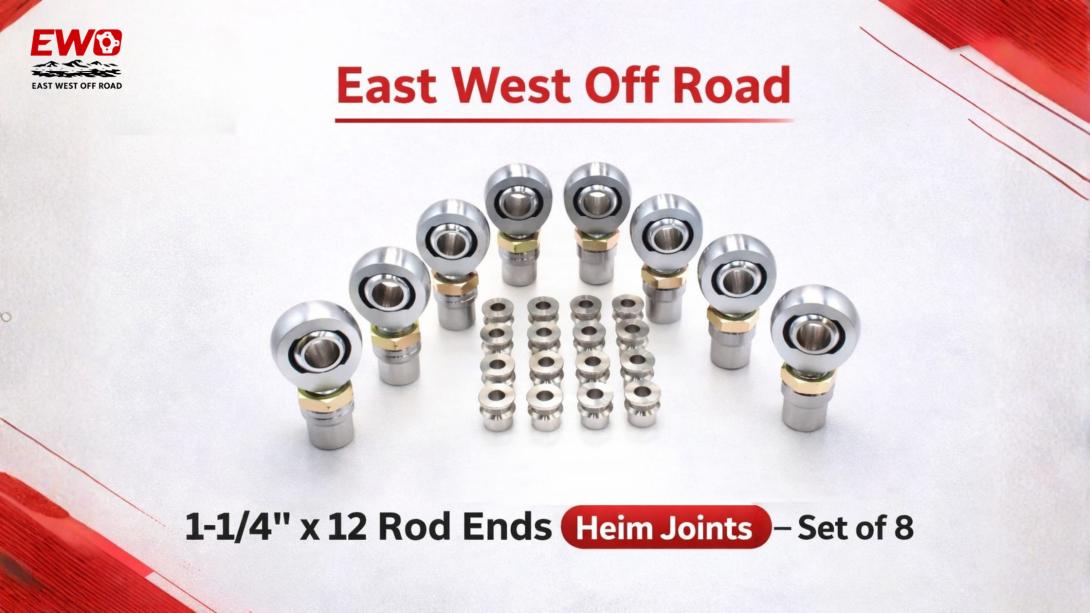
Buy Now: https://www.eastwestoffroad.com/product/1-14%22-x-12-rod-ends-(heim-joints)-set-of-8
When it comes to building an elite trail rig, rock bouncer, or desert racer, factory leaf springs or basic short-arm setups simply won't cut it. To achieve extreme axle articulation, eliminate wheel hop, and maintain perfect pinion angles during hard acceleration, upgrading to a custom 4 Link Kit is the absolute gold standard. A well-engineered multi-link suspension transforms how your rig handles both high-speed washouts and vertical rock faces.
However, building a suspension system that can take massive abuse requires more than just correct geometry—it demands indestructible components. By pairing a high-clearance link design with a heavy-duty 1-1/4 Heim Joint Kit, you create a bulletproof setup ready for the harshest terrain. Let’s break down everything you need to know to select, design, and assemble the perfect link system for your vehicle.
What is a Rock Crawler 4 Link Kit and How Does it Work?
A rock crawler 4 link kit replaces your vehicle's stock suspension brackets and springs with four heavy-duty control arms (two upper links and two lower links) that locate the axle. Unlike leaf springs, which try to handle both weight distribution and axle positioning simultaneously, a link system completely separates these jobs. This allows your coilover springs or air shocks to focus solely on dampening while the links control axle movement.
Triangulated vs. Parallel Setups
When designing a custom 4 link suspension, you generally have two choices for layout geometry:
- Triangulated 4-Link: In this configuration, either the upper or lower links are angled inward toward the center of the frame or axle. This clever angling completely eliminates the need for a track bar or Panhard rod, as the triangles naturally prevent side-to-side axle shift.
- Parallel 4-Link: Here, all four bars run parallel to the frame rail. Because parallel links offer no lateral stability on their own, this setup requires an additional track bar built with heavy duty steering joints or heavy-duty link ends to keep the axle centered under the chassis.
Anatomy of a Hardcore Link Kit: Materials and Components
A suspension link is only as strong as its weakest point. When you are dropping a 5,000-pound rig hard onto a boulder, every component—from the chromoly suspension parts to the tiny spacers—must be engineered to survive.
The Foundation: Heavy-Duty Links and Tube Adapters
Most fabricators build their main suspension arms out of thick-walled DOM (Drawn Over Mandrel) steel tubing. To connect your massive joints to these tubes, you need specialized fabrication tube adapters.
- Tubing Choice: For lower links that constantly slide over rocks, builders prefer 2-inch Outer Diameter (OD) DOM tubing paired with 1/4 inch wall thickness DOM tube adapters or a thick .250 wall DOM tube adapter. For lighter upper links, a .120 wall DOM tube adapter is often sufficient.
- Bung Options: You can choose a standard rounded weld-in tube adapter or a hex head tube adapter (also known as a 1.5" hex tube bung). A hex head tube adapter provides flat wrench flats, making it incredibly easy to hold the link steady when tightening down your jam nuts.
- Thread Patterns: High-quality setups utilize robust 1045 steel tube adapters or a 1020 steel tube adapter (such as the E 60102 tube adapter profile). Ensure you select a 1-1/4-12 thread adapter that matches a USA made tube adapter standard to guarantee precise thread tolerances for your massive joints.
The Pivot Points: 1.25 Rod Ends
At the ends of your control arms, you need joints that offer both high strength and fluid movement. Ditch the rubber bushings and step up to a heavy-duty 1-1/4-12 rod end set.
For ultimate reliability, choose a 1-1/4 Heim Joint Kit utilizing a heat-treated chromoly joint housing (4130 chromoly rod ends). These housings are paired with a 52100 steel bearing heim ball finished with a polished, hard chrome finish rod end coating. Look for a Teflon lined heim joint or a premium Teflon Kevlar lined heim joint to get a self-lubricating rod end that keeps trail dust out without needing messy grease.
With an incredible 76,800 lbs radial load rod end rating (and options reaching a 76,200 lb radial load heim limit), these spherical rod ends deliver the same high-strength durability relied on by race car suspension parts.
Tuning Your Suspension for Maximum Flex
Achieving massive suspension travel requires your links to pivot through severe angles without binding. Using raw joints alone won't provide enough clearance, which is why a professional link kit relies heavily on specialized hardware.
Utilizing Misalignment Spacers
A bare 1" bore heim joint offers incredible strength, but its physical rotation is limited. By adding heim joints with misalignment spacers, you extend the pivot point away from the mounting brackets.
Sliding a 1.25 heim misalignment spacers set into a 1-3/8 inch ball width heim joint safely downsizes the mounting bolt to a standard off-road size (like a 1 to 9/16 stainless misalignment spacers kit). This design provides your 1.25 inch suspension joint with the crucial clearance needed to twist, flex, and crawl over steep obstacles without binding the metal brackets.
The Adjustability Advantage
When assembling your arms, always opt for a left and right heim joint kit. By running a right hand heim joint (such as a 1.25x1 right hand heim with a 1-1/4-12 right hand thread) on one end of the link and a left-hand thread on the other, you create fully adjustable suspension links.
You can easily dial in your axle center, wheelbase, and pinion angles simply by spinning the link tube. Once adjusted, lock everything securely in place with heavy-duty 1.25 heim jam nuts paired with a matching right-hand thread rod end nut.
Beyond the Chassis: Other Vital Uses for Heavy-Duty Joints
The same rugged components that make up a premium heim joint suspension kit are equally vital for upgrading other high-stress areas of your vehicle's steering and axle assemblies:
- Off-Road Steering Kits: Take the slop out of your front end by building a rugged off-road steering kit using heavy duty steering joints.
- Steering Link Joints: Utilizing a 1.25" rod end kit for your steering link joints ensures your front wheels stay pointed exactly where you want them, even when wedged in tight rock fissures.
- Heavy Duty Tie Rod Ends: Swap out weak factory steering links for custom-fabricated tie rods equipped with oversized heavy duty tie rod ends to eliminate bent steering links forever.
Whether you are gathering individual off-road fabrication supplies, sourcing a weld-in bung for 1.5 ID tubing, or purchasing a full 1-1/4 x 12 rod ends set of 4 for your links, building your suspension right the first time guarantees flawless performance on the trail.
Frequently Asked Questions (FAQs)
What is the advantage of a 4 link kit over leaf springs?
A link kit completely separates the job of holding the axle in place from the job of supporting the vehicle's weight. This eliminates common leaf spring issues like axle wrap and wheel hop. Additionally, link kits offer drastically superior axle articulation, smoother suspension cycling, and allow you to precisely tune your suspension geometry.
Why do I need both left and right-hand threads on my suspension links?
Using a right-hand thread joint on one end and a left-hand thread joint on the other makes your suspension links fully adjustable while mounted on the vehicle. You can lengthen or shorten the control arm simply by turning the main tube. If you used right-hand threads on both ends, you would have to completely unbolt one end of the link from the vehicle every time you needed to adjust your alignment.
Should I use a triangulated or parallel 4-link setup?
A triangulated setup is highly preferred for custom off-road fabrication because the angled links naturally center the axle, allowing you to completely remove the track bar and eliminate suspension binding. However, if your chassis has limited clearance around the oil pan, exhaust, or frame rails, a parallel link setup paired with a track bar may be your only viable option.
What size DOM tubing should I use to build my 4-link arms?
For heavy-duty off-road rigs, the industry standard for lower control arms is 2" Outer Diameter (OD) DOM steel tubing with a 1/4" wall thickness, which pairs perfectly with a tube adapter for 1.5 ID tubing. Upper links experience less direct impact and can be safely built using lighter wall thicknesses to save unsprung weight.