

Introduction
Starting a cybersecurity career can feel challenging because the field includes networking, operating systems, security tools, threat analysis, and incident response. Beginners may wonder which topics to learn first and how to gain practical experience without previous cybersecurity employment.
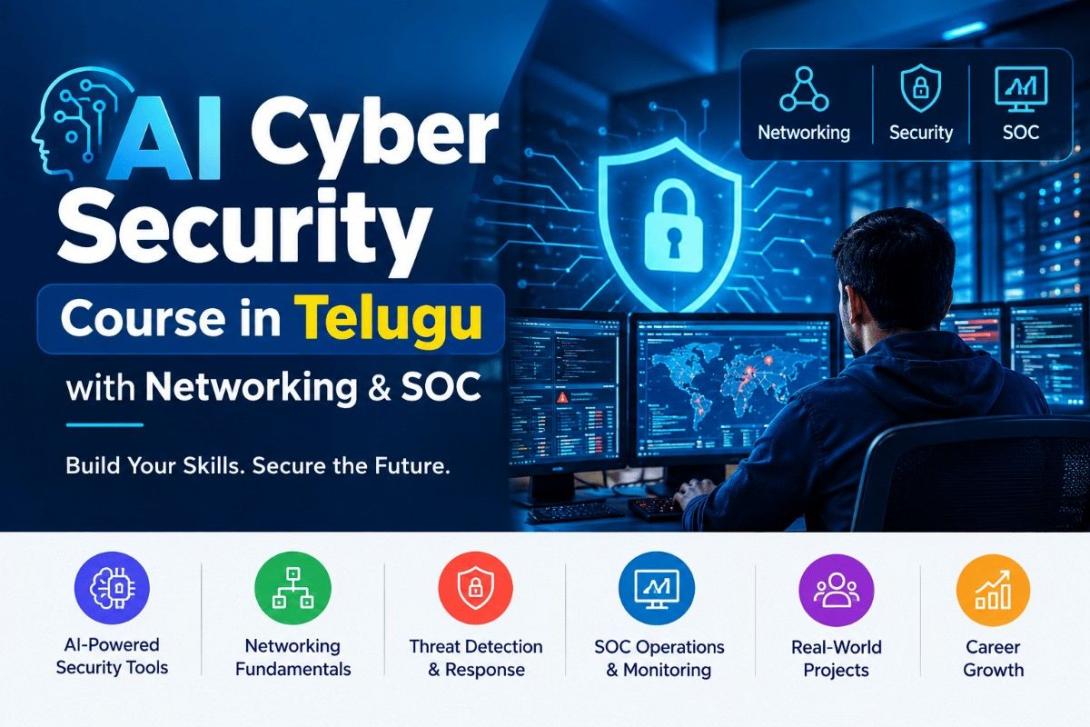
A structured cybersecurity career roadmap helps learners build knowledge step by step instead of trying to master every tool at once. An AI Cyber Security Course in Telugu with Networking & SOC can support this journey by introducing technical concepts and showing how security teams monitor and investigate threats.
Step 1: Learn Computer and IT Fundamentals
Before studying advanced security topics, understand how computers and operating systems function. Learn about files, processes, users, permissions, applications, and basic troubleshooting.
Develop familiarity with Windows and Linux, as security professionals often investigate events from both environments. Practice using the command line to navigate directories, inspect running processes, and examine system information.
These fundamentals make later cybersecurity concepts easier to understand.
Step 2: Build Networking Knowledge
Networking is essential for understanding how devices communicate and how attacks move across systems.
Focus on the following concepts:
- IP addresses: Identify devices on a network.
- TCP and UDP: Understand common transport protocols.
- DNS: Learn how domain names resolve to IP addresses.
- HTTP and HTTPS: Understand web communication.
- Ports and services: Identify how applications communicate.
- Routing and switching: Learn how network traffic moves between devices.
Use Wireshark in an authorized lab to observe basic traffic and identify DNS lookups, TCP connections, and HTTP-related activity where appropriate.
Step 3: Understand Cybersecurity Fundamentals
Next, learn the core principles of protecting systems and information. Study confidentiality, integrity, and availability, commonly known as the CIA triad.
Explore common threats such as phishing, ransomware, credential theft, malicious software, and denial-of-service attacks. Learn about authentication, multi-factor authentication, access control, encryption, patching, and security policies.
Understanding these concepts helps learners recognize why different security controls are needed.
Step 4: Learn SOC Operations and SIEM
A Security Operations Center (SOC) monitors security events and investigates potential incidents. Beginners interested in SOC roles should learn how analysts receive alerts, examine logs, validate suspicious activity, and document investigations.
Study the basics of Security Information and Event Management (SIEM) platforms. Learn how logs are collected from endpoints, servers, firewalls, and authentication systems.
Practice investigating simulated alerts, such as repeated failed logins or unexpected connections. Focus on identifying relevant evidence rather than simply memorizing tool commands.
Step 5: Practice Firewall and Network Monitoring
Firewalls enforce rules that control network traffic, while monitoring tools help identify suspicious communication.
Learn how firewall rules work, why unnecessary services should be restricted, and how logs support investigations. Use a lab environment to review sample firewall events and investigate unusual traffic patterns.
Practice distinguishing legitimate activity from potentially malicious behavior. Keep notes explaining what you observed, what evidence you collected, and what additional checks would be required.
Step 6: Explore AI-Powered Security Tools
Artificial intelligence in cybersecurity can support anomaly detection, alert prioritization, threat intelligence analysis, and investigation summaries.
Beginners should understand both the benefits and limitations of AI-based tools. An alert generated by a model is not automatically proof of an attack. Analysts must verify findings using logs, system context, and established investigation procedures.
Learn how to use AI responsibly without sharing confidential organizational data or sensitive security information with unauthorized services.
Step 7: Build a Practical Portfolio
A portfolio helps demonstrate technical ability to potential employers. Include small projects such as:
- A network traffic analysis report using Wireshark.
- A simulated SOC alert investigation.
- A firewall rule review in a lab.
- A phishing email analysis exercise.
- A sample incident report based on fictional events.
Explain the objective, tools used, findings, and lessons learned for each project. Use only authorized environments and avoid publishing real credentials or sensitive data.
Step 8: Prepare for Entry-Level Jobs
Once you have a foundation and practical projects, prepare a resume highlighting networking knowledge, security tools, lab experience, and analytical skills.
Apply for suitable positions such as SOC Analyst Trainee, Junior SOC Analyst, IT Security Support, or Security Operations Intern. Review common interview topics, practice explaining your projects, and continue strengthening areas where you need improvement.
Certifications may support your learning, but they should complement practical skills rather than replace them.
Frequently Asked Questions
1. Can beginners learn cybersecurity without coding?
Yes. Many introductory security and SOC tasks do not require advanced programming. Basic scripting can become useful as you progress.
2. How should I start learning cybersecurity?
Begin with computer fundamentals, networking, operating systems, and security basics before moving into SIEM and incident investigation.
3. Is a portfolio important for freshers?
Yes. Well-documented lab projects can demonstrate practical understanding when professional experience is limited.
4. Does an AI cybersecurity course guarantee employment?
No. Career outcomes depend on skills, practical experience, interview performance, and employer requirements.
Conclusion
A successful cybersecurity journey begins with strong fundamentals and develops through consistent practice. By learning networking, operating systems, security monitoring, firewall management, and AI-assisted investigation, beginners can build a foundation for entry-level roles. An AI Cyber Security Course in Telugu with Networking & SOC can guide this learning process, while hands-on projects and continuous improvement help learners become better prepared for the industry.