
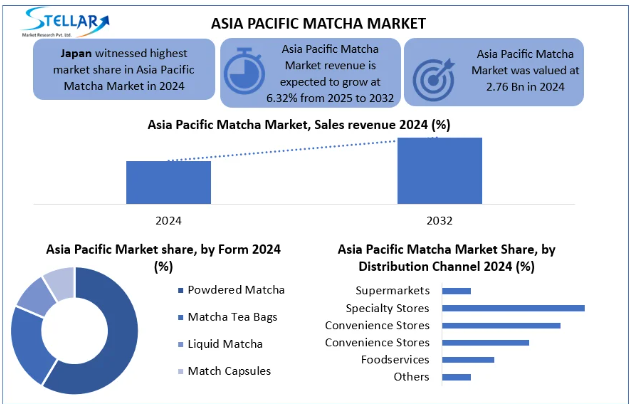
Asia Pacific Matcha Market size was valued at USD 2.76 Bn in 2024 and the total Asia Pacific Matcha Market revenue is expected to grow at a CAGR of 6.32% from 2025 to 2032, reaching nearly USD 4.25 Bn by 2032.
Market Estimation & Definition
The Asia Pacific Matcha Market refers to the regional economic landscape for matcha, a finely ground green tea powder made from shade-grown tea leaves. Known for its vibrant green color, rich flavor, antioxidant properties, and cultural significance, matcha is consumed in traditional tea ceremonies and widely incorporated into modern beverages, foods, and health products across the Asia Pacific region.
In 2024, the market was valued at approximately USD 2.76 billion. Over the forecast period from 2025 to 2032, the market is expected to expand steadily, reaching about USD 4.25 billion by 2032, with a compound annual growth rate (CAGR) of around 6.3%.
Matcha’s popularity stems from both traditional consumption — particularly in countries with deep tea heritage — and rapid adoption in contemporary applications across food, beverages, nutraceuticals, cosmetics, and personal care products.
Secure your sample copy of this report immediately! https://www.stellarmr.com/report/req_sample/asia-pacific-matcha-market/…
Market Growth Drivers & Opportunities
Cultural Legacy and Everyday Consumption
The rich tea culture of the Asia Pacific region — especially in countries like Japan and Korea — underpins stable long-term demand for matcha. Traditional tea ceremonies and daily consumption habits keep premium, ceremonial-grade matcha at the forefront of regional consumption. At the same time, matcha consumption is increasingly becoming part of regular diets in other regional markets.
Health and Wellness Trend
Consumers in the Asia Pacific region are increasingly health-conscious, driving demand for products perceived as beneficial. Matcha is widely associated with antioxidants, energy enhancement, metabolism support, and cognitive benefits, contributing to its adoption in beverages like lattes, smoothies, and functional foods.
Integration with Modern Beverages and Foods
Matcha’s use in bubble tea, ready-to-drink beverages, and contemporary café menus has grown rapidly. Its versatility — from traditional hot tea to matcha-infused lattes and desserts — supports broader market appeal, especially among younger consumers and urban populations.
E-Commerce Expansion
Online retail platforms play a significant role in market growth by offering broader availability, variety, and convenience. E-commerce allows brands to reach niche audiences with premium, organic, and specialty matcha products across the Asia Pacific region.
Emerging Applications in Beauty and Personal Care
Matcha’s high antioxidant and anti-inflammatory properties have led to its incorporation into skincare and beauty products. This emerging segment provides new opportunities beyond traditional food and beverage consumption.
Market Segmentation Analysis
By Product Form
• Powdered Matcha: This remains the dominant format, accounting for the majority of market sales due to its authenticity and suitability for traditional and modern applications.
• Matcha Tea Bags: Convenient for quick consumption, especially among new users.
• Liquid Matcha: Used in ready-to-drink beverages and café servings.
• Matcha Capsules: Popular in nutraceutical and supplement applications.
Powdered matcha continues to be the most preferred form because of its cultural authenticity, ease of use in various product formulations, and strong acceptance among traditional consumers.
By Distribution Channel
• Supermarkets and Hypermarkets: Capture a large share due to broad product offerings and consumer preference for quality inspection in store.
• Online Retail: Rapidly expanding as consumers seek convenience and access to specialty and premium products.
• Specialty Stores: Offer curated matcha selections and higher-end experiences.
• Convenience Stores: Provide quick purchase options for everyday consumption.
• Foodservice Outlets: Include cafés, tea shops, and restaurants that serve matcha beverages and dishes.
Supermarkets and hypermarkets currently lead distribution due to their extensive reach, while online retail is the fastest-growing channel as digital shopping habits strengthen.
By Application
Matcha is used in multiple applications across the Asia Pacific region:
• Food & Beverages: Matcha is widely used in teas, lattes, smoothies, baked goods, desserts, and snack products.
• Nutraceuticals & Supplements: Matcha is incorporated into functional supplements due to its health attributes.
• Cosmetics & Personal Care: Matcha serves as a key ingredient in skincare and beauty products because of its antioxidant benefits.
• Other Uses: Include culinary ingredients, health foods, and specialty consumer products.
The food and beverages segment remains the largest revenue contributor, driven by both traditional and modern product innovations.
To explore further details about this research, please go to: https://www.stellarmr.com/report/asia-pacific-matcha-market/2725
Regional & Country Analysis
Japan
Japan dominates the Asia Pacific matcha market in terms of both cultural heritage and production scale. The country is the primary source of premium ceremonial-grade matcha, and its traditional tea culture supports consistent domestic demand. Japan is also a key supplier of high-quality matcha to regional and global markets. The presence of renowned production regions and established brands contributes significantly to regional market leadership.
China
China’s matcha market is expanding quickly, driven by rising consumer interest in health-oriented beverages, urban café culture, and increased local production capabilities. Matcha is widely used in tea drinks, desserts, and lifestyle products, making it an important growth engine within the Asia Pacific region.
South Korea and Other ASEAN Countries
South Korea and various ASEAN nations, including Thailand, Vietnam, Malaysia, and Indonesia, show rising matcha consumption trends. These markets are shaped by younger, health-focused consumers who embrace matcha in drinks, baked goods, and ready-to-drink offerings.
India
India’s matcha market is emerging as consumer awareness around health benefits grows. Urban consumers show increasing interest in matcha beverages and wellness products, supported by expanding online access and product availability.
Competitive Landscape
The Asia Pacific matcha market includes a mix of established producers and emerging regional players. Key companies engage in strategic collaborations, acquisitions, and product diversification to expand their market footprint. Leading producers leverage heritage, processing expertise, and brand recognition to maintain competitive advantage, while newer entrants focus on innovation and catering to contemporary consumer preferences.
Major market participants span Japan, China, South Korea, India, Australia, and Southeast Asia, reflecting broad regional engagement in matcha production, branding, and distribution.
Market Challenges
Despite strong growth prospects, the Asia Pacific matcha market faces several challenges:
• Shelf-Life Sensitivity: Matcha is sensitive to light, moisture, and oxidation, which can shorten shelf life and create logistical challenges, particularly in humid climates.
• Storage and Handling Issues: Improper storage can lead to degradation, affecting product quality and increasing waste.
• Price Dynamics: Premium ceremonial-grade matcha commands higher prices, which may limit accessibility among price-sensitive consumers.
Addressing these challenges requires improved supply chain solutions, packaging innovations, and enhanced consumer education around proper storage and usage.
Conclusion
The Asia Pacific Matcha Market is poised for consistent growth through 2032, driven by its strong cultural roots, rising health consciousness, expanding use in contemporary food and beverage applications, and growing online retail presence. Japan remains a dominant market, supported by its heritage and premium production capabilities, while China and other regional markets contribute significantly to broader growth patterns.
Emerging applications in nutraceuticals and personal care products further expand the market’s potential. While logistical and quality challenges persist, ongoing innovation and increasing consumer engagement with matcha as both a traditional and modern lifestyle product are expected to sustain healthy market momentum.
Discover trending insights :
Nigeria Plywood Market https://www.stellarmr.com/report/Nigeria-Plywood-Market/614
Slovakia Steel Market https://www.stellarmr.com/report/Slovakia-Steel-Market/624
About Stellar Market Research:
Stellar Market Research is a global leader in market research and consulting services, specializing in a wide range of industries, including healthcare, technology, automobiles, electronics, and more. With a team of experts, Stellar Market Research provides data-driven market insights, strategic analysis, and competition evaluation to help businesses make informed decisions and achieve success in their respective industries.
For more information, please contact:
Stellar Market Research:
S.no.8, h.no. 4-8 Pl.7/4, Kothrud,
Pinnac Memories Fl. No. 3, Kothrud, Pune,
Pune, Maharashtra, 411029
+91 20 6630 3320, +91 9607365656