
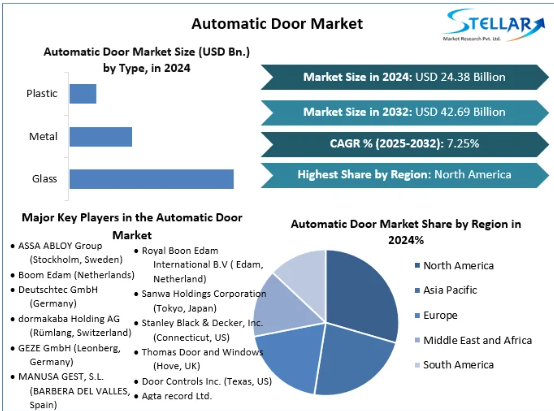
Automatic Door Market was valued at USD 24.38 billion in 2024. Global Automatic Door Market size is estimated to grow at a CAGR of 7.25 % over the forecast period.
Market Estimation & Definition
The Automatic Door Market comprises the global industry engaged in the manufacturing, installation, and maintenance of doors that open and close automatically using sensors, motion detectors, or control systems. These doors eliminate the need for manual operation and are widely used in high-traffic areas such as shopping malls, hospitals, airports, office buildings, hotels, industrial facilities, and increasingly in residential settings.
Automatic doors improve accessibility for elderly individuals and people with disabilities while enhancing operational efficiency and hygiene by reducing physical contact. They also contribute to building energy efficiency by limiting air exchange between indoor and outdoor environments.
In 2024, the global automatic door market was valued at approximately USD 24.38 billion. The market is projected to grow at a compound annual growth rate (CAGR) of around 7.2%, reaching an estimated value of USD 42.69 billion by 2032. This strong growth trajectory reflects rising construction activity, increasing adoption of smart building technologies, and heightened focus on accessibility and safety standards worldwide.
Download your complimentary sample copy of this report! https://www.stellarmr.com/report/req_sample/Automatic-Door-Market/875
Market Growth Drivers & Opportunities
Market Growth Drivers
Expansion of Commercial and Public Infrastructure:
Rapid development of commercial complexes, airports, healthcare facilities, hotels, and transportation hubs has significantly boosted demand for automatic door systems. These environments require seamless movement of people, making automated entry solutions essential.
Rising Demand for Accessibility and Convenience:
Automatic doors support universal access and ease of movement, making them a preferred choice in public buildings, hospitals, and government facilities. Growing awareness of accessibility standards and inclusive infrastructure has further accelerated adoption.
Energy Efficiency and Climate Control Benefits:
Automatic doors help maintain indoor temperatures by opening only when necessary and closing immediately afterward. This reduces heating and cooling losses, lowering energy consumption and operational costs for building owners.
Increased Focus on Hygiene and Touchless Solutions:
Growing concerns around hygiene, especially in healthcare and high-traffic public environments, have increased demand for touchless entry systems. Automatic doors minimize physical contact, supporting cleaner and safer spaces.
Integration with Smart Building Technologies:
Advancements in automation, sensors, and building management systems have enabled automatic doors to integrate seamlessly into smart building ecosystems. These systems offer enhanced control, monitoring, and security.
Market Opportunities
Residential and Smart Home Adoption:
While traditionally dominant in commercial settings, automatic doors are increasingly being adopted in luxury residential properties and smart homes. Rising disposable incomes and growing interest in home automation present new growth opportunities.
Smart City and Infrastructure Projects:
Government investments in smart city initiatives and modern public infrastructure are expected to drive large-scale adoption of automated door systems in transportation hubs, public buildings, and urban facilities.
Retrofit and Renovation Projects:
Renovation and retrofitting of older buildings offer opportunities for customized automatic door solutions that improve accessibility and energy performance without major structural changes.
Customized and High-Performance Solutions:
Demand is rising for customized doors designed for specific applications, including high-security facilities, industrial environments, and clean rooms.
Segmentation Analysis
The automatic door market is segmented by type, operating mechanism, end-user, and region, highlighting diverse demand patterns across applications.
By Type
Glass Automatic Doors:
Widely used in commercial and retail spaces due to their modern appearance, transparency, and ability to enhance natural lighting.
Metal Automatic Doors:
Preferred in industrial and high-security environments for durability and strength.
Plastic Automatic Doors:
Utilized where lightweight, cost-effective, and corrosion-resistant solutions are required.
Glass automatic doors hold a significant share of the market, particularly in commercial and institutional applications.
By Operating Mechanism
Sliding Automatic Doors:
The largest segment due to space efficiency and ease of installation, commonly used in airports, hospitals, shopping malls, and office buildings.
Swinging Automatic Doors:
Common in residential and small commercial settings where design flexibility is required.
Folding Automatic Doors:
Used in areas with limited space or specialized layout requirements.
Other Mechanisms:
Including revolving and custom-designed automatic doors for specific architectural needs.
Sliding automatic doors continue to dominate the market due to their versatility and widespread acceptance.
By End-User
Commercial Sector:
Accounts for the largest share of market revenue, driven by high footfall, customer convenience requirements, and compliance with accessibility standards.
Industrial Sector:
Growing steadily as manufacturing facilities and logistics centers adopt automated doors for safety, efficiency, and environmental control.
Residential Sector:
Emerging as a fast-growing segment with increased adoption in smart homes and premium housing projects.
By Region
North America:
Holds a leading share of the global market, supported by advanced infrastructure, widespread adoption of automation technologies, and strong construction activity.
Asia Pacific:
The fastest-growing region due to rapid urbanization, expanding construction projects, and rising demand for modern building solutions.
Europe:
A mature market driven by established construction industries, strong emphasis on energy efficiency, and adoption of smart building technologies.
Other regions, including Latin America and the Middle East & Africa, are experiencing gradual growth supported by infrastructure development and urban expansion.
For in-depth information on this study, visit the following link: https://www.stellarmr.com/report/Automatic-Door-Market/875
Country-Level Analysis
United States
The United States represents a major market for automatic doors, supported by robust commercial construction, widespread healthcare infrastructure, and strong adoption of smart building technologies. Strict accessibility regulations and growing demand for energy-efficient solutions further drive market growth. Automatic doors are increasingly installed across retail, healthcare, transportation, and office environments.
Germany
Germany is a key European market characterized by high engineering standards and strong focus on sustainability and energy efficiency. The country’s emphasis on advanced building technologies and compliance with accessibility norms has resulted in steady demand for automatic door systems across commercial, industrial, and public facilities.
Commutator (Customer) Analysis
The automatic door market serves a diverse range of customers:
Commercial Property Developers and Owners:
Focus on enhancing customer convenience, accessibility, and energy efficiency in shopping centers, offices, and public buildings.
Healthcare Institutions:
Hospitals and clinics require automatic doors to support hygiene, patient mobility, and smooth flow of staff and visitors.
Industrial Operators:
Manufacturing plants and warehouses use automatic doors to improve safety, environmental control, and operational efficiency.
Residential Buyers:
Homeowners adopting smart home technologies increasingly invest in automated entry systems for convenience and modern aesthetics.
Across all segments, customers prioritize reliability, safety, energy efficiency, and integration with automated systems.
Explore Our Top Trends :
Mea External Blinds Market https://www.stellarmr.com/report/MEA-External-Blinds-Market/832
South America External Blinds Market https://www.stellarmr.com/report/South-America-External-Blinds-Market/8…
North America Spa Service Market https://www.stellarmr.com/report/North-America-Spa-Service-Market/1235
Europe Toothpaste Market https://www.stellarmr.com/report/Europe-Toothpaste-Market/1332
Press Release Conclusion
The global Automatic Door Market is poised for robust growth, expanding from USD 24.38 billion in 2024 to an estimated USD 42.69 billion by 2032. Growth is fueled by rising infrastructure development, increased emphasis on accessibility and hygiene, energy efficiency benefits, and the rapid adoption of smart automation technologies.
Commercial applications continue to dominate market demand, while residential and industrial segments offer emerging growth opportunities. With strong momentum across developed and developing regions, the automatic door market is set to remain a vital component of modern building design and smart infrastructure worldwide.
About Stellar Market Research:
Stellar Market Research is a global leader in market research and consulting services, specializing in a wide range of industries, including healthcare, technology, automobiles, electronics, and more. With a team of experts, Stellar Market Research provides data-driven market insights, strategic analysis, and competition evaluation to help businesses make informed decisions and achieve success in their respective industries.
For more information, please contact:
Stellar Market Research:
S.no.8, h.no. 4-8 Pl.7/4, Kothrud,
Pinnac Memories Fl. No. 3, Kothrud, Pune,
Pune, Maharashtra, 411029
+91 20 6630 3320, +91 9607365656