
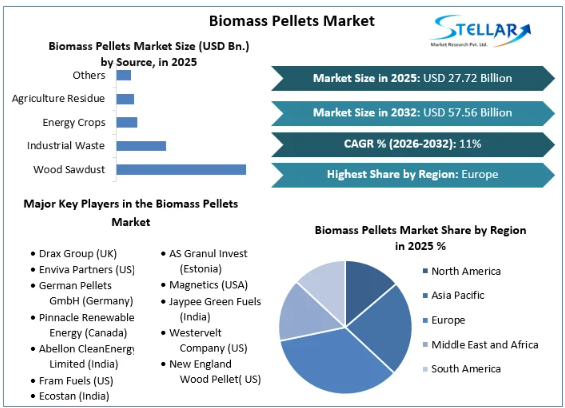
Biomass Pellets Market was valued at USD 27.72 billion in 2025. Global Biomass Pellets Market size is estimated to grow at a CAGR of 11% over the forecast period.
Market Definition
Biomass pellets are compressed biofuels produced from organic feedstock including sawdust, industrial waste (crop stalks, straw material, rice husk, cotton stalk, coffee husk, alfalfa straw), energy crops, and agricultural residues such as sawmill waste, bark, and branches. These pellets are widely used for heat and power generation due to their low moisture content, high calorific value, and minimal pollutant emissions.
The market is segmented by:
Source
Wood Sawdust
Industrial Waste (Crop stalk, Straw Material, Rice Husk, Cotton stalk, Coffee Husk, Alfalfa straw, others)
Energy Crops
Agricultural Residues (Sawmill residue, branches, bark, leaves, others)
Others
Application
Building Heating (Industrial heating, Commercial heating, Residential heating)
Power Generation (Power plants, Wind & turbine integration, Others)
Animal Bedding
Others
Geography
North America
Europe
Asia-Pacific
South America
Middle East & Africa
Market sizing and forecasts are calculated in value terms (USD Billion), providing stakeholders with comprehensive insights into growth potential across segments and regions.
To get more insights: Request Free Sample Report https://www.stellarmr.com/report/req_sample/Biomass-Pellets-Market/706
Market Overview
Biomass pellets have emerged as one of the most sustainable long-term energy solutions as fossil fuel reserves decline and global carbon emission regulations tighten. They are widely used in coal-fired power plants for co-firing and in converted mono-fired power plants to significantly reduce greenhouse gas emissions.
The market’s expansion is further supported by rising environmental awareness, supportive renewable energy policies, and increasing investments in clean energy infrastructure.
Market Dynamics
Market Drivers
The growing adoption of biomass pellets is driven by:
Carbon Emission Reduction Goals: Industries and governments are actively replacing coal with biomass pellets to meet decarbonization targets.
Renewable Energy Expansion: Biomass pellets generate both heat and electricity, making them versatile energy carriers.
Ease of Storage & Transportation: Compared to raw biomass, pellets offer higher energy density and logistical efficiency.
Agricultural Residue Utilization: Surplus agricultural waste provides abundant feedstock for pellet production.
Biomass feedstock availability is expected to increase significantly by 2030–31, with biomass availability projected to reach 283 million tonnes. The associated CO₂ mitigation potential from coal replacement is estimated at 209 million tonnes, strengthening the long-term outlook for pellet adoption.
Market Challenges
Despite positive growth prospects, several challenges restrain market expansion:
Low energy density of raw biomass, requiring significant land for storage.
High pre-treatment and processing costs.
Expensive raw materials such as wood pallets.
Limited affordability for small-scale fuel producers.
COVID-19 Impact
The COVID-19 pandemic negatively affected the biomass pellets market due to temporary shutdowns of manufacturing facilities and reduced energy demand. End-use sectors including power generation, industrial heating, and commercial heating experienced operational disruptions, leading to short-term demand contraction.
However, post-pandemic recovery and renewed focus on sustainable energy have restored growth momentum.
Segment Analysis
By Source
In 2025, the wood sawdust segment dominated the biomass pellets market. Wood sawdust has become increasingly significant as industries seek cost-effective methods to recycle waste materials. It is considered one of the most affordable and efficient renewable energy sources.
Wood sawdust pellets are widely used to generate steam for power production and provide heat to commercial and residential establishments. Their low moisture content and strong binding properties contribute to superior combustion efficiency.
Agricultural residues also represent a growing segment. Materials such as straws and husks contain lignin and cellulose that aid pellet binding. These residues offer sustainable energy generation without additional environmental pollution.
By Application
The building heating segment dominated the market in 2025 and is projected to grow at a CAGR of 9.2% from 2026 to 2032.
Building heating applications include:
Industrial heating
Commercial heating
Residential heating
Biomass pellets are increasingly used in co-firing industrial heating systems as a replacement for coal and fossil fuels, reducing operational costs and emissions.
Residential heating pellet use increased significantly, reaching 15.9 million units in 2021 compared to 14.3 million in 2020. Commercial heating pellet consumption also rose to 6.1 million units from 5.5 million during the same period, reflecting growing acceptance in both household and commercial environments.
Power generation remains another critical segment, with pellets used in dedicated power plants and combined heat and power (CHP) systems.
To find more information about this research, please visit: https://www.stellarmr.com/report/Biomass-Pellets-Market/706
Regional Insights
Europe
Europe dominated the biomass pellets market in 2025, accounting for approximately 30% market share. The region’s leadership is driven by strong renewable energy mandates and extensive use of wood pellets in CHP and dedicated power plants.
Pellet consumption in Europe is distributed as follows:
65% Residential heating
23% Commercial heating
12% CHP heat generation
Supportive policies and carbon neutrality targets continue to drive demand across European countries.
North America – United States
The biomass pellets market in the United States is projected to grow by 5.1% year-over-year in 2025, reaching a total market valuation of US$ 1,527.8 million by the end of the year.
The U.S. is among the top developed economies in energy usage and remains a major buyer of biomass pellets. Growing environmental awareness and federal initiatives promoting renewable energy adoption are expected to further boost demand.
Asia-Pacific
Asia-Pacific is expected to witness the highest growth rate during the forecast period. Rapid industrialization, rising energy demand, and increasing adoption of renewable heating systems in industrial sectors are key growth contributors.
Competitive Landscape
The biomass pellets market is moderately consolidated, with several established players controlling a significant share of the market. These companies benefit from extensive global distribution networks and diversified product portfolios.
Key Players Include:
Drax Group
Enviva Partners
German Pellets GmbH
Pinnacle Renewable Energy
Abellon CleanEnergy Limited
Fram Fuels
Ecostan
AS Graanul Invest
The Westervelt Company
New England Wood Pellet
Major players are focusing on strategic initiatives including acquisitions, partnerships, and new product launches to strengthen market position and expand global reach.
Strategic Analysis
The report incorporates:
Porter’s Five Forces Analysis
Evaluates competitive rivalry
Assesses supplier and buyer bargaining power
Examines threat of substitutes and new entrants
PESTEL Analysis
Political: Government renewable energy mandates
Economic: Energy price fluctuations and infrastructure investments
Social: Increasing environmental awareness
Technological: Advancements in pellet production efficiency
Environmental: Carbon emission regulations
Legal: Compliance with renewable energy and environmental laws
These frameworks assist stakeholders in developing effective long-term business strategies.
Find the Latest Buzz :
Pulp And Paper Market https://www.stellarmr.com/report/Pulp-and-Paper-Market/1817
Pervaporation Market https://www.stellarmr.com/report/Pervaporation-Market/2157
Conclusion
The Global Biomass Pellets Market is positioned for sustained growth as the global energy ecosystem shifts toward cleaner, renewable solutions. Strong policy support, rising biomass feedstock availability, and increasing adoption in heating and power generation applications will continue to drive expansion.
While challenges such as high raw material costs and processing expenses remain, favorable regulatory environments and increasing awareness of carbon reduction benefits provide lucrative opportunities for industry participants.
As the world intensifies its commitment to decarbonization and sustainable development, biomass pellets are set to play a crucial role in the global renewable energy transition.
About Stellar Market Research:
Stellar Market Research is a global leader in market research and consulting services, specializing in a wide range of industries, including healthcare, technology, automobiles, electronics, and more. With a team of experts, Stellar Market Research provides data-driven market insights, strategic analysis, and competition evaluation to help businesses make informed decisions and achieve success in their respective industries.
For more information, please contact:
Stellar Market Research:
S.no.8, h.no. 4-8 Pl.7/4, Kothrud,
Pinnac Memories Fl. No. 3, Kothrud, Pune,
Pune, Maharashtra, 411029
+91 20 6630 3320, +91 9607365656