

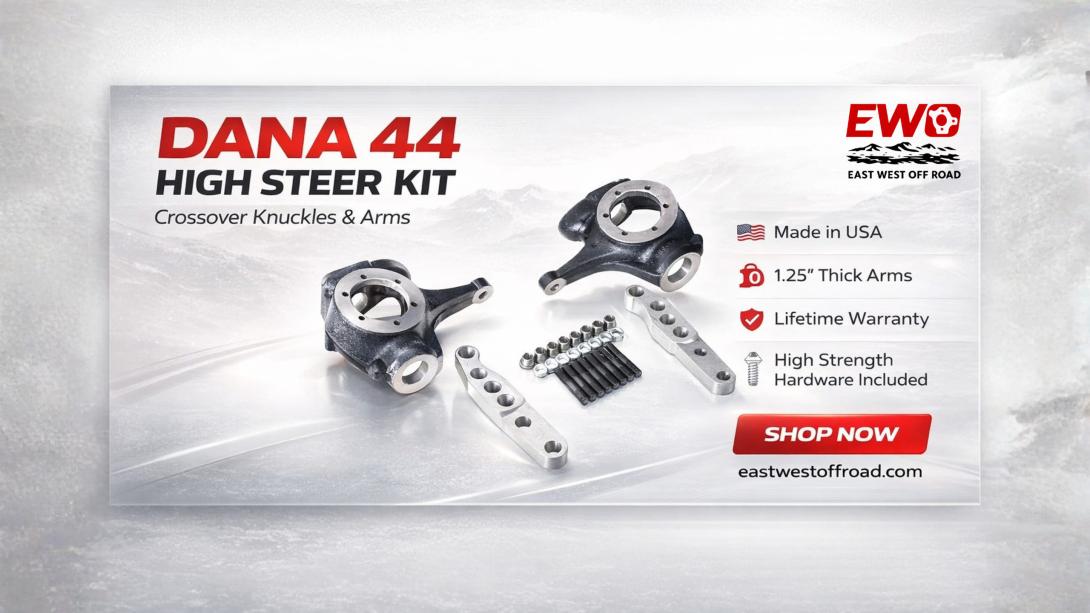
Buy Now: https://www.eastwestoffroad.com/product/dana-44-high-steer-crossover-knuckles-and-arms-kit
If you're building a lifted Chevy 4x4, upgrading the steering system can become just as important as upgrading the suspension. A Chevy Dana 44 Crossover Steering Kit changes the steering-linkage layout to create a crossover and high-steer configuration that can work better with modified suspension geometry. For classic Chevy and GMC trucks, K5 Blazers, Suburbans, and custom off-road builds, the right combination of flat-top knuckles, high-steer arms, tie-rod ends, studs, and steering linkage can provide a cleaner and more serviceable steering setup.
What Is a Chevy Dana 44 Crossover Steering Kit?
A crossover steering system moves the steering linkage from the traditional factory arrangement to a configuration where the drag link crosses over the axle and connects to the steering arm on the opposite side.
When combined with high-steer arms, the steering linkage can also be positioned higher than the original factory location.
This configuration is particularly popular on lifted trucks because raising the steering linkage can provide additional clearance between the linkage and the terrain.
A complete Chevy Dana 44 Crossover Steering Kit typically involves several components working together, including:
- Flat-top steering knuckles
- High-steer arms
- Steering-arm mounting hardware
- Tie-rod ends
- Drag link
- Tie rod
- Misalignment or mounting components where required
- Compatible steering-box and pitman-arm configuration
The exact components required depend on the axle and vehicle configuration.
Why Upgrade a Chevy Dana 44 Steering System?
A stock steering arrangement may work well at factory ride height, but suspension modifications can change the relationship between the steering linkage and axle.
A lifted truck may develop concerns such as:
- Increased steering-linkage angles
- Reduced ground clearance
- Linkage contact with obstacles
- Unwanted steering movement during suspension travel
- Limited space around the front axle
A crossover configuration can address some of these packaging and geometry challenges.
However, the steering system still needs to be designed around the vehicle's actual suspension geometry. Simply installing high-steer components does not automatically correct every steering issue.
Dana 44 High Steer Kit vs. Factory Steering
The major difference is where the steering linkage operates.
Factory steering typically places the linkage according to the original axle and suspension configuration. A Dana 44 High Steer Kit moves the steering connection higher on the knuckle, depending on the design.
For an off-road vehicle, this can provide additional clearance and can make the steering linkage better suited to a modified suspension.
A high-steer conversion can also change the drag-link angle, so the entire steering and suspension system should be evaluated together.
Chevy Dana 44 Flat Top Knuckles
Flat-top knuckles are one of the most important components of a high-steer conversion.
A Dana 44 Flat Top Knuckles Pair provides the mounting surfaces required for compatible high-steer arms.
Not every Dana 44 knuckle is interchangeable, so axle identification should happen before purchasing a steering kit.
Verify:
- Axle manufacturer
- Axle generation
- Knuckle configuration
- Ball-joint arrangement
- Spindle pattern
- Steering-arm mounting pattern
- Steering taper
- Driver- and passenger-side configuration
This is particularly important when buying parts for older Chevy and GMC trucks because previous owners may have swapped axles or steering components.
EWO Dana 44 Crossover Knuckles and Arms
The EWO system is designed as a knuckle-and-arm package for compatible Chevy and GM axle applications.
The manufacturer's product information identifies the kit as a Dana 44 High Steer Crossover Knuckles and Arms Kit for Chevy GM Axles and lists compatibility with Chevy Dana 44 front axles and Chevy 10-bolt/GM Corporate 10-bolt applications.
Listed vehicle applications include various Chevy and GMC K-series trucks, K5 Blazers, Suburbans, and GMC Jimmy models within the applicable year ranges.
For builders considering an EWO Dana 44 crossover knuckles setup, confirming the exact axle configuration before ordering is essential.
1.25 Inch Billet High Steer Arms
The steering arm is the connection point between the flat-top knuckle and the steering linkage.
EWO's kit uses 1.25 Inch Billet High Steer Arms designed for the corresponding knuckle configuration.
A billet high-steer arm can provide a substantial mounting structure for the steering linkage while positioning the connection higher on the axle.
The arm should be evaluated together with its mounting hardware.
Important considerations include:
- Arm thickness and design
- Number of mounting holes
- Stud size
- Knuckle compatibility
- Steering-link taper
- Linkage clearance
- Tire and wheel clearance
Four-Hole Billet High Steer Arms
Many high-steer systems use multiple mounting points between the steering arm and knuckle.
4 hole billet high steer arms provide four mounting locations for the associated hardware. This design is intended to create a secure connection between the arm and compatible flat-top knuckle.
The quality of the installation remains critical. The mounting surface should be clean and properly prepared, and the studs, washers, and nuts should be installed according to the manufacturer's specifications.
Dana 44 High Strength 9/16 Studs
High-steer arms transfer steering loads through their mounting hardware, making stud selection and installation important.
The Dana 44 high strength 9/16 studs used in a compatible system should be installed using the manufacturer's specified procedure and torque requirements.
Before assembly, inspect the knuckle mounting surface for:
- Damage
- Cracks
- Corrosion
- Contamination
- Damaged threads
- Irregular mounting surfaces
Do not install high-steer arms over a damaged or questionable mounting surface.
Understanding Steering Taper
Steering taper is one of the most commonly overlooked details when selecting components.
A tie-rod end or drag-link end must match the taper machined into the steering arm or knuckle.
The EWO configuration is designed around a Dana 44 bottom down taper knuckle arrangement for the specified application.
Before ordering steering linkage, verify the taper direction and dimensions of every connection point.
A steering component that looks physically compatible may still be incorrect if the taper does not match.
7/8 Inch Chevy 3/4 Ton Tie Rod Arms
The terminology surrounding Chevy steering components can become confusing because several different steering configurations have been used across GM truck platforms.
The 7/8 inch Chevy 3/4 ton tie rod arms specification should therefore be matched to the actual steering components being used rather than assumed from the truck's model name.
Check the tie-rod-end thread, taper, bore, and mounting dimensions before purchasing replacement linkage.
1 Ton Steering Upgrade Dana 44
A 1 Ton Steering Upgrade Dana 44 is often considered by builders running larger tires, increased suspension travel, and demanding off-road terrain.
A heavy-duty steering upgrade can be useful when the original steering components no longer fit the vehicle's intended application.
However, “1-ton” is commonly used in the aftermarket to describe a heavy-duty steering component class. It should not be interpreted as a guarantee that every component is suitable for every vehicle.
The complete system should be evaluated based on:
- Vehicle weight
- Tire size
- Suspension design
- Steering geometry
- Intended terrain
- Steering-box capacity
- Linkage dimensions
- Mounting hardware
How Crossover Steering Can Improve Clearance
One major reason off-road builders choose high-steer configurations is clearance.
The steering linkage can be vulnerable to rocks and other obstacles when it sits low on the axle.
Moving the steering connection higher can create additional space below the linkage.
This can be especially useful on a rock crawler where the front axle frequently passes over uneven terrain.
Clearance should still be checked around the entire steering system, including the differential housing, springs, shocks, tires, wheels, and chassis.
Can Crossover Steering Reduce Bump Steer?
Bump steer occurs when suspension movement causes unintended steering movement.
A properly designed crossover system can help reduce bump steer when the drag-link geometry is correctly matched to the suspension.
However, a Chevy Dana 44 Crossover Steering Kit should not be treated as an automatic bump-steer solution.
The final result depends on:
- Lift height
- Drag-link angle
- Drag-link length
- Axle location
- Suspension-link geometry
- Steering-box position
- Pitman-arm design
- Track-bar or other suspension components
For a search such as Eliminate Bump Steer K5 Blazer, the more accurate approach is to inspect and correct the complete steering and suspension geometry.
Steering Box and Pitman Arm Compatibility
The axle-side components are only half of a crossover steering system.
The steering box determines where the steering input originates, while the pitman arm determines how that input reaches the drag link.
Some Chevy/GMC crossover conversions require a compatible steering-box configuration and pitman arm.
Before purchasing a kit, verify the steering box currently installed in the vehicle and determine whether it matches the planned crossover layout.
This step can prevent a situation where the new knuckles and high-steer arms fit the axle but the steering linkage cannot be correctly connected to the steering box.
Dana 44 Crossover Steering Installation
A successful Dana 44 Crossover Steering Installation starts with identifying every component that will be reused and every component that will be replaced.
Step 1: Identify the Front Axle
Confirm whether the vehicle uses a compatible Chevy Dana 44 or GM/Chevy 10-bolt configuration.
Step 2: Verify Knuckle Compatibility
Confirm the ball-joint, spindle, brake, and steering configurations before installation.
Step 3: Prepare the Mounting Surfaces
Clean and inspect the knuckle mounting surfaces before installing the high-steer arms.
Step 4: Install the High-Steer Arms
Install the arms using the supplied or specified studs and mounting hardware.
Step 5: Install Steering Linkage
Connect the appropriate drag link and tie rod to the high-steer configuration.
Step 6: Check Taper and Thread Engagement
Verify that every steering end is properly seated and that the threaded connections have sufficient engagement.
Step 7: Check Steering Box Operation
Turn the steering from lock to lock and verify that the pitman arm and drag link operate correctly.
Step 8: Cycle the Suspension
Check steering and suspension movement at ride height, compression, and droop.
Step 9: Inspect Clearances
Look for contact with the differential, wheels, tires, springs, shocks, chassis, and other components.
Step 10: Perform a Final Safety Inspection
Verify all fasteners, steering connections, and mounting hardware before operating the vehicle.
For safety-critical steering fabrication, professional installation or inspection is recommended.
Common Installation Mistakes
Even a high-quality crossover system can create problems if installed incorrectly.
Common mistakes include:
- Installing the wrong knuckle configuration
- Using incompatible steering tapers
- Incorrect steering-arm hardware
- Improper stud installation
- Insufficient thread engagement
- Incorrect pitman-arm configuration
- Ignoring steering-box compatibility
- Excessive drag-link angle
- Failing to check wheel clearance
- Failing to cycle the suspension
- Not verifying steering stops
Taking time to verify each component before final assembly can prevent expensive rework.
Reid Racing Knuckles Alternative
Builders researching a Reid Racing Knuckles Alternative may compare different Dana 44 and GM 10-bolt high-steer knuckle solutions.
Reid Racing is one established option in this segment, while other manufacturers offer complete knuckle-and-arm configurations for Chevy/GM applications.
The best comparison should focus on:
- Axle compatibility
- Knuckle material
- Mounting design
- Steering-arm pattern
- Taper configuration
- Stud hardware
- Brake and spindle compatibility
- Overall kit contents
This gives a more meaningful comparison than simply comparing brand names.
USA Made Dana 44 Steering Kit
Manufacturing location can also be an important factor for off-road builders.
A USA Made Dana 44 Steering Kit may appeal to customers who prioritize domestic manufacturing when selecting steering components.
However, manufacturing location should be evaluated alongside machining quality, materials, fitment, hardware, product support, and application compatibility.
For a steering system, proper fitment and installation are ultimately critical to safe operation.
Why Choose an EWO High-Steer System?
The EWO system brings the flat-top knuckles and high-steer arms together as a purpose-built configuration for compatible Chevy and GM axles.
The East West Off Road steering kit is intended for builders working on classic Chevy and GMC 4x4s and other compatible custom applications.
The product configuration provides a starting point for a crossover high-steer conversion rather than requiring the builder to source every major knuckle and arm component separately.
Before purchasing, confirm that your axle and steering configuration match the manufacturer's application information.
Maintenance After a Crossover Steering Conversion
Steering components should be inspected regularly, especially after demanding trail use.
Check for:
- Loose high-steer-arm hardware
- Stud movement
- Damaged washers
- Tie-rod-end play
- Drag-link-end wear
- Cracked knuckles or arms
- Damaged threads
- Loose fasteners
- Steering interference
- Abnormal steering behavior
After the first few drives, recheck the complete installation and confirm that the steering system remains secure.
Frequently Asked Questions (FAQs)
What does a Chevy Dana 44 Crossover Steering Kit do?
It changes the factory steering arrangement to a crossover configuration, typically connecting the drag link to a steering arm on the opposite side of the axle. A high-steer design positions the steering connection higher on the knuckle.
What is required for a Dana 44 high-steer conversion?
The exact requirements depend on the axle and vehicle. A typical conversion can involve compatible flat-top knuckles, high-steer arms, mounting studs, steering linkage, and a compatible steering-box and pitman-arm configuration.
Are Chevy Dana 44 flat-top knuckles necessary for high steer?
Many bolt-on high-steer systems require flat-top knuckles because they provide the mounting surface for the high-steer arms.
Can crossover steering eliminate bump steer?
It can help reduce bump steer when the complete steering and suspension geometry is correctly designed. It does not automatically eliminate bump steer on every lifted vehicle.
Is crossover steering good for a K5 Blazer?
Crossover steering can be a useful upgrade for a lifted K5 Blazer, particularly when additional steering-linkage clearance or revised steering geometry is needed. The axle, steering box, pitman arm, and suspension geometry must all be compatible.
What are 1.25-inch billet high-steer arms?
They are large high-steer arms designed to mount to compatible flat-top knuckles and provide elevated steering-link mounting points.
Why are four-hole high-steer arms used?
Four-hole arms use four mounting locations to secure the arm to the compatible flat-top knuckle. Proper hardware installation and knuckle compatibility remain essential.
What should I check before buying a Chevy Dana 44 crossover kit?
Verify the axle type, knuckle configuration, ball-joint setup, steering taper, steering-box configuration, pitman arm, wheel clearance, suspension lift, and intended steering linkage.
Can this type of kit be used with a 1-ton steering upgrade?
A high-steer knuckle-and-arm system can be part of a heavy-duty steering build, but the complete steering system should be evaluated to ensure all components are compatible and appropriately sized.
What makes the EWO kit different?
The EWO configuration combines compatible Chevy/GM Dana 44 high-steer knuckles and billet high-steer arms into a single kit, with the product designed for specified Chevy and GM axle applications.
Final Thoughts
A Chevy Dana 44 Crossover Steering Kit is more than a simple steering-arm upgrade. It changes the relationship between the steering box, drag link, axle, and suspension, which makes component compatibility and geometry especially important.
For a successful conversion, start by identifying the exact front axle. Then verify the flat-top knuckles, high-steer arms, steering taper, mounting studs, tie-rod ends, steering box, pitman arm, and wheel clearance.
For builders working on compatible Chevy and GM Dana 44 or 10-bolt applications, the EWO knuckle-and-arm configuration provides a purpose-built foundation for a crossover high-steer setup.
Most importantly, don't stop the inspection at ride height. Cycle the suspension and steering through their complete range of movement, check every clearance point, verify fasteners, and have the finished steering system professionally inspected when appropriate.