

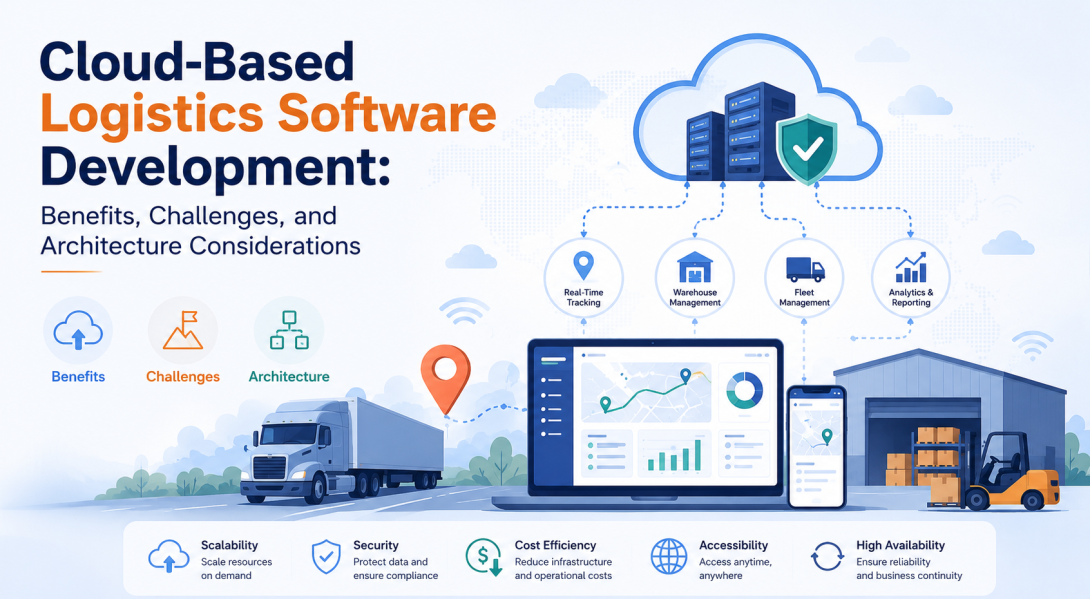
Cloud-based logistics software development is reshaping how freight, fleet, and fulfillment companies build and operate their core systems. As global supply chains grow more complex and customer expectations for real-time visibility rise, logistics businesses are abandoning on-premise monoliths in favour of elastic, cloud-native platforms.
This guide covers every layer of that transition from solution types and core architecture to security design, cost planning, and the technical challenges engineering teams face along the way.
What Is Cloud-Based Logistics Software?
Cloud-based logistics software is a category of operational platforms spanning transportation, warehousing, fleet management, and supply chain visibility delivered via cloud infrastructure rather than installed on local servers. Instead of managing hardware, patching servers, and scaling databases in-house, logistics operators access these capabilities through a browser, mobile app, or API.
The shift eliminates per-server licensing and enables continuous feature updates, multi-region deployments, and real-time data sharing across the entire logistics network.
Types of Cloud-Based Logistics Solutions
Transportation Management Systems (TMS)
A cloud TMS manages shipment planning, carrier selection, freight audit, and rate management across all transport modes. Cloud deployment lets shippers connect to carrier APIs in real time and share shipment status with customers without a VPN or EDI setup.
Warehouse Management Systems (WMS)
A cloud WMS controls inventory positioning, pick-pack-ship workflows, and labour allocation inside distribution centres. Modern platforms integrate directly with e-commerce storefronts and carrier networks.
Fleet Management Platforms
Fleet platforms track vehicle location, driver behaviour, fuel consumption, and maintenance schedules. Cloud hosting allows real-time telematics ingestion at scale.
Companies offers dedicated fleet management software development services for transport operators building custom platforms.
Last-Mile Delivery Software
Last-mile platforms handle route assignment, driver dispatch, proof-of-delivery capture, and customer notification. Their cloud backbone enables dynamic re-routing as traffic and order volumes shift mid-day. A practical guide to building an on-demand delivery and last-mile logistics mobile app covers the full development lifecycle.
Supply Chain Visibility Platforms
Supply chain visibility platforms aggregate data from suppliers, carriers, customs brokers, and warehouse systems into a single operational dashboard. Powered by event streaming and IoT integrations, they give procurement and operations teams a live picture of inventory in motion across the entire network.
Why Logistics Companies Are Moving to Cloud-Based Software in 2026
Need for Real-Time Operational Visibility
Shippers and 3PLs now compete on fulfilment speed, and that requires sub-minute data freshness across every node in the network. On-premise systems with nightly batch updates simply cannot support same-day delivery commitments or dynamic carrier allocation. Cloud platforms built on event-driven microservices and real-time databases deliver the low-latency data pipelines that modern logistics SLAs demand.
Scaling Operations Without Infrastructure Constraints
Peak season can multiply order volumes by five to ten times within days. Cloud auto-scaling policies allow compute and database capacity to expand automatically and contract once demand normalises, eliminating the capital expenditure of provisioning for peak in advance. Engineering teams focus on feature work rather than rack capacity planning.
Improving Data Accessibility Across Stakeholders
Cloud logistics platforms expose standardised REST and webhook APIs that allow customers, carriers, ERP systems, and analytics tools to consume operational data without custom integration for each partner. Role-based portals replace email-based status updates, reducing manual exception handling and improving on-time performance across the board.
Core Architecture of a Cloud-Based Logistics Platform
Frontend Layer
The frontend layer spans browser-based web portals for operations managers and dispatchers, as well as native or cross-platform mobile applications for drivers, warehouse staff, and field agents.
Portals handle complex task management and reporting while mobile apps focus on scan-based workflows, GPS tracking, and push notifications. Both consume the same backend APIs, ensuring consistent data across devices.
Backend Services Layer
The backend is structured as a set of independently deployable microservices, each owning its own database and communication channel. Core services in a production logistics platform include:
- Order Management Service: Ingests orders from e-commerce platforms, EDI feeds, and manual entry; normalises them into a canonical order model and routes them to fulfilment.
- Route Optimization Service: Applies constraint-based algorithms — vehicle capacity, time windows, traffic data — to generate optimal multi-stop routes for delivery or pickup runs.
- Fleet Management Service: Maintains vehicle and driver records, tracks live telematics, and triggers maintenance workflows based on mileage or engine diagnostics.
- Tracking Service: Consumes GPS and IoT events from vehicles and packages, maintains a live position store, and publishes location updates via WebSockets or SSE.
- Notification Service: Orchestrates email, SMS, push, and in-app alerts for shipment milestones, exception events, and driver communications.
- Billing and Invoicing Service: Calculates freight charges based on contracted rate cards, generates carrier invoices, and integrates with AR/AP systems for automated reconciliation.
- Analytics Service: Aggregates operational events into a time-series warehouse, powers BI dashboards, and feeds ML models for demand forecasting and carrier performance scoring.
Data Layer
The data layer uses three complementary persistence tiers. Transactional databases (PostgreSQL, MySQL) store orders, shipments, and billing records with ACID guarantees.
Real-time databases (Redis, DynamoDB) handle high-throughput position updates and session data at low latency. A cloud data warehouse (BigQuery, Redshift, Snowflake) accumulates historical operational data for analytics, reporting, and model training.
Cloud Infrastructure Layer
The infrastructure layer provisions compute instances or container clusters (ECS, GKE, AKS) for long-running services, serverless functions (Lambda, Cloud Run) for event-triggered processing, object storage (S3, GCS) for documents and media, and CDN integration for global API acceleration.
Robust cloud architecture consulting ensures these components are composed into a resilient, cost-efficient topology from day one.
Key Benefits of Cloud-Based Logistics Software
- Real-Time Supply Chain Visibility: Event-driven architecture streams position and status updates to all stakeholders within seconds, replacing batch-updated spreadsheets and manual carrier calls.
- Elastic Scalability: Auto-scaling policies expand and contract compute capacity automatically, letting platforms handle Black Friday volumes without pre-provisioned hardware.
- Seamless Third-Party Integrations: Standardised REST, GraphQL, and EDI adapters connect ERP systems (SAP, Oracle), e-commerce platforms (Shopify, Magento), carrier APIs (FedEx, UPS, DHL), and payment gateways without bespoke middleware for each partner.
- Reduced Infrastructure and Maintenance Costs: Cloud-managed databases, load balancers, and monitoring services eliminate the capital expenditure and ongoing ops overhead of self-hosted infrastructure.
- Improved Business Continuity and Reliability: Multi-AZ deployments, automated failover, and managed backup services deliver the 99.9%+ uptime that mission-critical logistics operations require.
- Faster Feature Delivery: CI/CD pipelines and containerised deployments allow engineering teams to ship route optimisation improvements, new carrier connectors, and mobile features on a weekly cadence.
- Global Multi-Region Expansion: Cloud regions across North America, Europe, and APAC allow platforms to serve international markets with low-latency APIs and data residency compliance from a single codebase.
Technical Challenges in Cloud-Based Logistics Software Development
1. Managing Real-Time Data at Scale
Logistics platforms ingest GPS pings, IoT sensor events, and order state changes at high frequency from thousands of concurrent sources. Designing Kafka or Kinesis pipelines to ingest, deduplicate, and route this stream without lag while keeping consumer services decoupled is a significant architectural challenge that requires careful partition strategy and consumer group tuning.
2. Building Low-Latency Tracking Systems
Customers and dispatchers expect sub-second position refresh rates on live maps. Achieving this at scale requires a write-optimised real-time store (Redis with geospatial indexing), a WebSocket or SSE layer for push delivery, and a CDN-cached read path for historical trail queries all designed to degrade gracefully under network partitions.
3. Integrating Multiple Logistics Systems
Most enterprise logistics environments include legacy TMS, ERP, and WMS systems with incompatible data schemas and transport protocols. Building a reliable integration layer requires idempotent message processing, schema versioning, and dead-letter queue handling.
For context on the breadth of systems involved, the supply chain management software development landscape highlights the range of vendor ecosystems teams must navigate.
4. Ensuring Security and Regulatory Compliance
Logistics platforms process personally identifiable information (PII), financial transaction data, and cross-border customs records subject to GDPR, CCPA, and country-specific trade regulations.
Engineering teams must implement data residency controls, audit logging, and encryption at every layer, often under tight delivery timelines.
5. Designing for Scalability and High Availability
A platform that handles 10,000 daily shipments today may need to support 500,000 within two years after a major customer win.
Designing stateless services, horizontal database sharding, and multi-region active-active topologies from the outset prevents expensive re-architecture later and protects the SLAs that enterprise logistics contracts demand.
Security Architecture for Cloud-Based Logistics Platforms
Identity and Access Management
Role-Based Access Control (RBAC) maps user roles dispatcher, driver, finance manager, customer to precise API permission scopes, preventing privilege escalation across organisational boundaries.
Multi-Factor Authentication (MFA) is mandatory for admin and finance roles, while Single Sign-On (SSO) integration with enterprise identity providers (Okta, Azure AD) streamlines access for large carrier and shipper organisations.
Data Security
All data at rest is encrypted using AES-256 via cloud-managed key services (AWS KMS, GCP CMEK). Data in transit uses TLS 1.3 across all service-to-service and client-to-API communication.
A centralised Key Management System enforces automated key rotation policies and maintains audit trails for compliance reporting.
API Security
All external-facing APIs authenticate via OAuth 2.0 with short-lived JWT tokens, validated at the API gateway before requests reach any backend service. API gateway policies enforce rate limiting per client and per endpoint to prevent abuse and protect upstream services during traffic spikes. Webhook endpoints include HMAC signature verification to block spoofed event delivery.
Infrastructure Security
Network segmentation isolates public-facing services, internal microservices, and data stores into separate VPC subnets with explicit ingress/egress rules. Web Application Firewall (WAF) rules filter malicious payloads at the edge, while DDoS mitigation services (AWS Shield, Cloudflare) absorb volumetric attacks before they reach application infrastructure. Security event logs feed a SIEM platform for anomaly detection and incident response.
Cloud-Based Logistics Software Development Cost: Infrastructure, Dev, and Hidden Fees
Infrastructure Costs
Core infrastructure spend covers compute (EC2, GKE node pools), managed database instances, object storage, and egress networking. A mid-scale logistics platform with 50,000 daily shipments typically spends $8,000–$25,000 per month on cloud infrastructure depending on region, redundancy tier, and data transfer volume. Monitoring and observability tooling (Datadog, New Relic) adds a further $1,500–$5,000 monthly.
Development Costs
Full-cycle development of frontend portals, backend microservices, mobile driver apps, and third-party integrations typically ranges from $150,000 to $600,000 for a production-grade logistics platform, depending on feature scope and team composition.
Partnering with a specialist logistics software development company provides pre-built accelerators for common integrations and reduces custom build time.
Hidden Costs Often Overlooked
Several cost categories are routinely underestimated during scoping. Data transfer (egress) charges accumulate quickly on platforms processing continuous GPS streams and large document exports.
Log storage and retention in managed logging services (CloudWatch, Cloud Logging) can reach thousands of dollars monthly at high event volumes. Backup and disaster recovery storage costs for multi-region setups, and per-call charges on carrier and mapping APIs, must be modelled into the total cost of ownership from day one.
Best Practices for Building Cloud-Based Logistics Software
Adopt a Cloud-Native Architecture
Design services to run as containers in an orchestrated environment (Kubernetes) rather than porting on-premise patterns to VMs. Cloud-native architectures take full advantage of managed services eliminating operational toil and enabling the auto-scaling, rolling deployments, and self-healing capabilities that logistics platforms require.
Design for Scalability from Day One
Stateless services, horizontal sharding strategies, and event-driven decoupling are far less expensive to implement at greenfield than to retrofit into a live platform.
Refer to scalable web application development principles for architecture patterns that translate directly to logistics backends.
Implement Event-Driven Processing
Route all high-volume operational events position updates, order state changes, exception triggers through a managed message broker (Kafka, Pub/Sub) rather than synchronous API chains. Event-driven processing decouples producers and consumers, allows independent scaling, and provides a durable audit trail for every state transition in the system.
Prioritise Security and Compliance Early
Retrofitting encryption, audit logging, and access controls into a live platform is expensive and disruptive.
Embed security requirements into sprint definitions from the first iteration: encrypt all data stores at creation, implement RBAC before the first user is onboarded, and run SAST/DAST scans in CI pipelines from day one.
Build API-First Integrations
Define OpenAPI specifications for every service interface before writing implementation code.
API-first development ensures that carrier connectors, ERP adapters, and customer portals are built against a stable contract, reducing integration rework and enabling parallel frontend and backend development tracks.
Establish Strong Observability and Monitoring
Instrument every service with structured logs, distributed traces (OpenTelemetry), and business-level metrics (orders per second, route optimisation latency, carrier API error rate).
Alert on SLO breaches not just infrastructure thresholds so on-call engineers are notified when customer-visible performance degrades, not only when CPU spikes.
Plan for Multi-Region Expansion
Design the data model and deployment pipeline for multi-region operation from the start, even if the initial launch is single-region. This means active-active or active-passive database replication, region-aware CDN routing, and data residency controls for GDPR compliance. Sound cloud infrastructure consulting helps teams design the right regional topology before it becomes a migration challenge.
Conclusion
Cloud-based logistics software development is no longer a modernisation initiative reserved for enterprise carriers it is the baseline architecture for any logistics platform that must scale, integrate, and comply with confidence. From event-driven microservices and real-time tracking infrastructure to layered security and transparent cost modelling, the decisions made in the architecture phase determine the platform's long-term operational resilience.
Teams that get these foundations right build systems that scale without re-architecture and adapt to new carrier networks, regulations, and market demands without costly rewrites.