

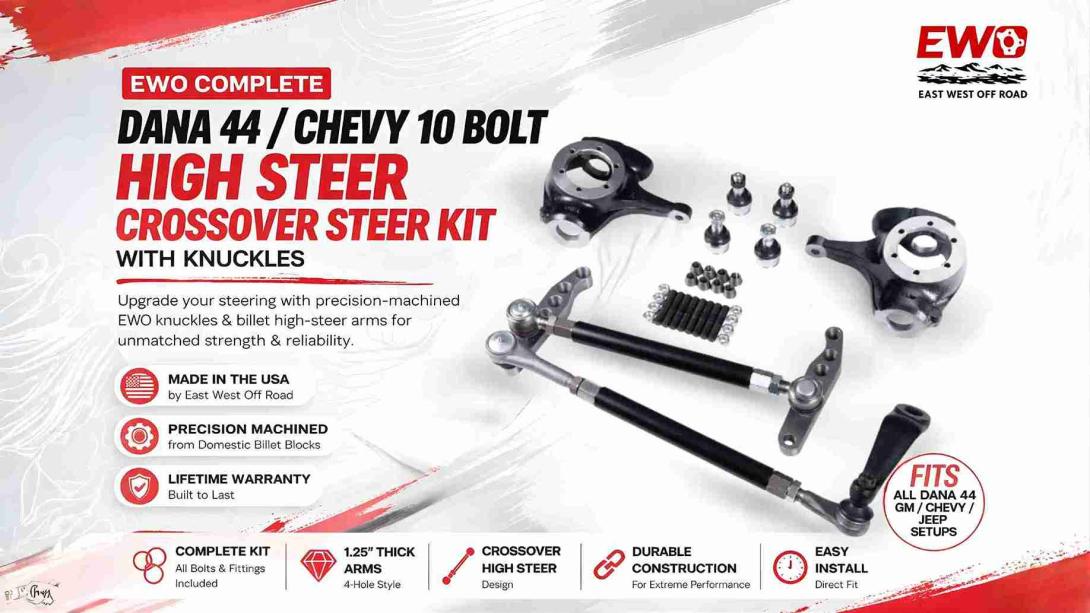
Buy Now: https://www.eastwestoffroad.com/product/ewo-complete-dana-44-chevy-10-b…
A Dana 44 flat top knuckle conversion gives a high steer system a rigid, accurately machined place to mount its steering arms. The knuckles do not improve geometry by themselves; they enable a builder to position a drag link and, depending on the design, a tie rod at selected points above the factory linkage location. The arms, studs, tapered hardware, steering ends, pitman arm, and fabricated tubes must then create a workable system. Because knuckles carry wheel and steering loads, identification, machining, assembly, and inspection deserve the same attention as the more visible linkage.
What “Flat Top” Means in a Steering Build
A flat top knuckle has an upper surface designed or prepared to accept a bolt-on steering arm. That surface and its mounting pattern give the arm a stable interface. The arm then supplies one or more tapered attachment locations for the drag link or tie rod.
Not every knuckle that appears flat is ready for an arm. Surface condition, machining, hole placement, threads, casting integrity, and the intended arm pattern must agree. Using a matched knuckle-and-arm package reduces the uncertainty involved in identifying and modifying unrelated used parts.
The EWO system supplies both driver-side and passenger-side flat top knuckles. Having a coordinated pair is useful for high steer layouts that use steering arms on both sides, while also replacing unknown or mismatched knuckles that may have accumulated through previous axle work.
How Knuckles Support Crossover and High Steer
In crossover steering, the drag link runs from the steering-box pitman arm toward the passenger side. The passenger-side high steer arm provides a mounting point for that link. A driver-side arm can support the selected tie-rod arrangement in a two-arm high steer design.
Raising those mounting points is intended to improve steering-component clearance around rocks and trail obstacles. It can also help a builder establish more suitable steering geometry on a lifted vehicle. The actual result depends on the drag-link angle, pitman-arm position, suspension design, axle movement, and joint operating angles.
For readers sorting out the two terms, the Dana 44 crossover steering system overview explains how link direction differs from link height. A flat top conversion is the hardware foundation; the full linkage layout determines how the steering behaves.
The Components Around the Knuckle Matter
Knuckles cannot be evaluated apart from their ball joints, arms, and mounting hardware. The complete EWO package includes upper and lower Dana 44 ball joints, driver- and passenger-side arms, high-strength Dana 44 studs, conical washers, lock nuts, and installation hardware.
Conical washers are more than simple spacers. In a properly designed assembly, their tapered interface contributes to locating and clamping the arm on the stud arrangement. The mounting surfaces must seat as intended, and hardware should be installed to verified specifications supplied for the actual components. Do not invent a torque value from a different knuckle or arm.
The arms in the complete Dana 44 flat top steering package are 1.25 inches thick, made from USA domestic billet blocks, and precision-machined in-house. The steering arms carry a lifetime warranty. These details address the arm, but correct knuckle preparation and assembly remain essential.
Geometry Questions to Answer Before Assembly
Before final installation, draw or mock up the path from the pitman arm to the passenger-side steering arm. The drag link must operate without binding and without contacting the frame, springs, shocks, differential, or other components. Its ends need adequate angular movement throughout steering and suspension travel.
The tie rod also needs a clear path between the driver and passenger sides. Moving it upward may increase obstacle clearance but decrease clearance to the wheel, leaf spring, or other chassis parts. The installer should check:
● Ride height with wheels straight
● Full left and right steering lock
● Driver-side compression with passenger-side droop
● Passenger-side compression with driver-side droop
● Tire and wheel clearance at each relevant position
● Steering-end housing and boot clearance
● Differential-cover and spring clearance
Geometry should be judged on the actual vehicle. Lift height, spring design, axle position, wheel backspacing, and previous frame or steering modifications can change the result.
Identifying a Suitable Dana 44 Application
Dana 44 axles exist in multiple configurations, and vehicles can contain swapped housings or mixed knuckles. Confirm the axle rather than relying on a grille badge, registration year, or seller’s description. Inspect the differential, inner “C” and ball-joint arrangement, spindle and brake configuration, and existing steering tapers.
The EWO product is designed for applicable GM, Chevy, and Jeep Dana 44/Chevy 10 Bolt builds. Promotional material references Dana 44, K10, K20, and K5 Blazer applications from 1973–1991. That does not mean every vehicle in those groups automatically fits. Jeep owners in particular should avoid assuming an exact model or year without confirming the installed Dana 44 configuration.
A matched pair can simplify component selection, but it does not establish compatibility with the rest of the axle. The spindle, brakes, shafts, ball joints, and steering layout still must be verified.
Fitment and Installation Considerations
Knuckle replacement involves disassembling safety-critical wheel-end and steering components. Condition checks should extend to the ball-joint bores, axle “C” areas, bearings, seals, brakes, and any parts disturbed during the work. Upper and lower ball joints need correct installation using component-specific procedures and verified specifications.
The remaining crossover conversion also requires a 2WD steering box. Final linkage can involve measuring and cutting the supplied 54-inch and 43-inch DOM tubing, installing 7/8-18 weld bungs or tube adapters, and qualified welding. The ES2026R and ES2027L drag-link ends and ES2234L and ES2234R tie-rod ends must be assigned to their intended positions and tapers.
Use this planning sequence:
1. Verify the axle, wheel-end parts, and knuckle compatibility.
2. Confirm arm pattern, steering-end tapers, and linkage orientation.
3. Inspect studs, conical washers, lock nuts, and mounting surfaces.
4. Mock up arms and ends with the actual wheels installed.
5. Cycle steering and suspension before final tube welding.
6. Complete a professional alignment and safety inspection.
Builders working with a modified Jeep axle should also review the Jeep Dana 44 high steer planning guide before assuming wheel-end or steering-box compatibility.
Frequently Asked Questions
Are all Dana 44 knuckles flat top knuckles?
No. Dana 44 configurations vary, and visual flatness alone does not mean a knuckle is machined, drilled, or suitable for a specific high steer arm. The mounting surface, hole pattern, threads, ball-joint fit, steering-end taper, and wheel-end compatibility must all be confirmed. A matched knuckle-and-arm system can reduce guesswork, but the axle and surrounding parts still require identification.
Do flat top knuckles automatically raise both steering links?
No. The final position depends on the selected arms and where the tie rod and drag link attach. A flat top knuckle provides a mounting platform; it does not dictate the whole layout. Some designs raise one link, while others use arms on both sides for a higher tie rod and crossover drag link. Clearance and geometry must be evaluated for the chosen configuration.
Can used flat top knuckles be mixed with new steering arms?
Possibly, but compatibility and condition need professional verification. A used knuckle may have unknown machining, damaged threads, corrosion, distorted mounting surfaces, or altered tapers. The arm pattern and hardware also must match. Never assume that parts fit because both are described as Dana 44. Inspection and precise measurements are necessary before safety-critical assembly.
Does a flat top conversion require reaming?
It depends on the knuckles, steering ends, taper size and direction, pitman arm, and selected linkage orientation. The phrase “flat top conversion” does not answer that question. Confirm each mating pair before removing material. If reaming is required, it should be performed with the correct tool and alignment by someone qualified to modify steering components.
Why replace both driver- and passenger-side knuckles?
A matched pair can provide coordinated mounting surfaces for a two-arm high steer layout and reduce uncertainty from mixed used components. It may also support consistent ball-joint and steering-end planning. However, replacing both is not a universal requirement for every steering design. The intended tie-rod and drag-link positions, axle configuration, and condition of existing components determine what the build needs.
Use the Knuckles as a System Foundation
Flat top knuckles are important because every arm, stud, and steering link depends on their fit and location. Treat the conversion as precision steering work, verify the axle and wheel ends, and validate geometry before final fabrication. Builders who need matched knuckles, billet arms, ball joints, linkage parts, and hardware can review the EWO Dana 44 high steer crossover kit as a coordinated starting point.