
Businesses develop or procure and deploy software applications. They gather data on customer behavior, employee performance, competitor strategies, and macroeconomic threats. Each day, the corporations’ data scope increases. Their in-house innovation efforts demand that. However, a lot of data does not automatically become business-ready. It needs strategic sorting and transformation.
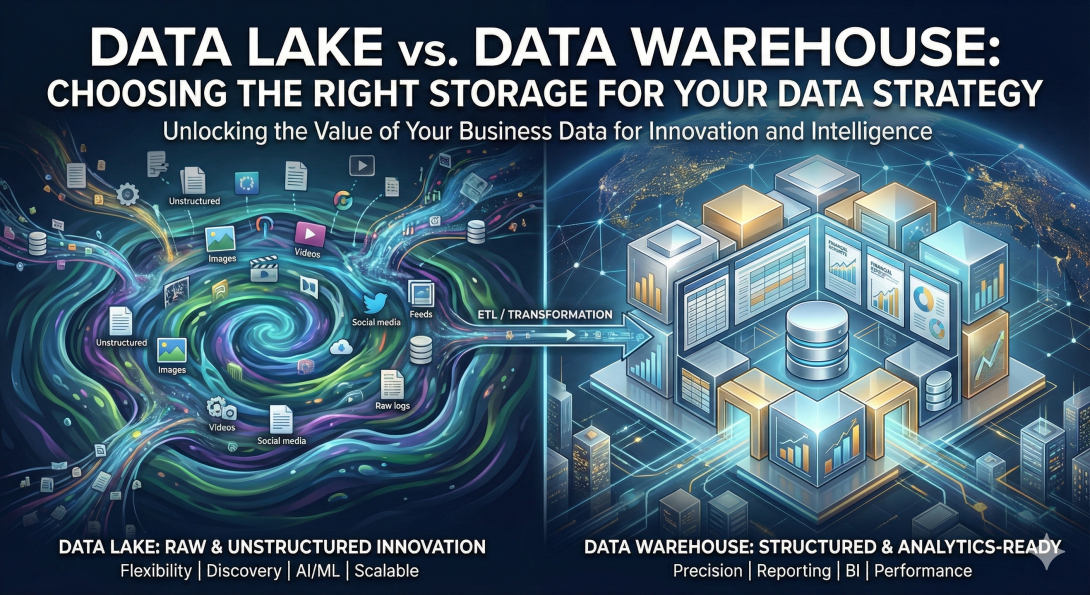
When it comes to storing extensive raw data, data lakes come to businesses’ aid. If structured data repositories are necessary, data warehouses become more sought after. This post will highlight how data lakes and data warehouses serve different stakeholders or outcomes despite being equally essential to modern business development and digital transformation initiatives.
What is a Data Lake?
In the data lake, raw data resides in its original format. Although data lake solutions can include structured data from databases, they also include semi-structured data from JSON files and unstructured data comprising multimedia files. Therefore, the data assets are not schema-bound all the time. Instead, users’ attempt to retrieve specific data objects determines how sorting will effectively reflect the intent behind queries during that process.
The required or shared infrastructure for data lakes is available through Amazon S3, Azure Data Lake Storage, and Google Cloud Storage. Therefore, the leading firms in the technology, healthcare, and media industries use these tools. For instance, a company offering analytics to the healthcare industry can store images, devices, and hospital notes in a data lake. At another point in time, life sciences researchers and healthcare professionals can experiment with synthetic patient profiles once AI models tap into mixed data assets for training purposes.
Data lakes are easy to scale. They are also more suitable for data analytics applications where data science and machine learning serve more scientific, academic, or innovation-centric goals.
What is a Data Warehouse?
A data warehouse is a huge database that significantly differs from a data lake because it prioritizes storing well-organized data. In other words, it does not preserve data in its native format. Instead, it contains processed, organized, and structured data. A standard data warehouse consists of predefined schemas. Therefore, it is more appropriate for analytics, business intelligence, data lifecycle management services, and data visualization, where precision and quick insight discovery are top expectations.
Tools like Snowflake, Amazon Redshift, Google BigQuery, and Azure Synapse Analytics allow firms to leverage data warehouses for in-house enterprise processes. Various sectors, like retail, financial, and manufacturing, use them to evaluate their product sales and inventory turns.
However, data warehouses are most effective when business questions are already available. In other words, there is less chance of unique or dynamic queries. As a result, data warehouses facilitate dashboards, KPIs, and regulatory reports with a great deal of standardization. They embrace and encourage reliability and speed for systematic teamwork.
Which One Does a Business Need?
It depends on the objective.
Case 1: If a business’s main aim involves reporting, compliance, and metrics, a data warehouse is a great solution. For example, organizations, especially those with financial departments using Tableau or Power BI, prioritize data warehouses to ensure precision.
Case 2: A data lake can be more beneficial if the business seeks data-backed innovation, experimentation, and AI-driven insights. As a result, startups and companies with digital transformation roadmaps will leverage data lakes. Although they will eventually invest in implementing data warehouses, that process will be more gradual.
Case 3: Large organizations opt for a hybrid model. They use a data lake for raw data and a data warehouse for analytics. The former helps conduct day-to-day activities while the latter facilitates research and development (R&D) projects. Such organizations employ platforms like Databricks with the help of Snowflake.
Conclusion
Data lakes and data warehouses use unique approaches to how they store, retrieve, and handle data or insights. However, each answers a different set of problems. With the right architecture, leaders will help their teams meet their needs. It will still take some learning, but with a clear data strategy and expert oversight, a business can increase its competitive edge, data processing scale, and decision-making accuracy for long-lasting, data-driven success.