

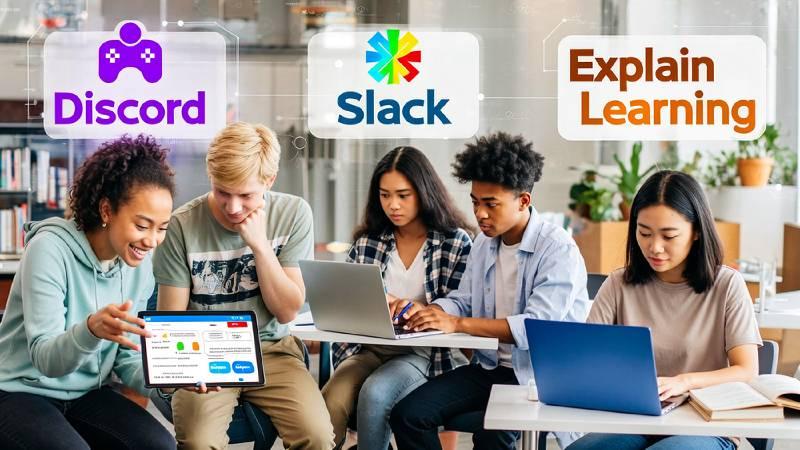
School clubs and extracurricular organizations form the heart of the student experience. Whether it is a debate team, a robotics club, a student council, or an honor society, these groups require a centralized home to share updates, plan projects, and build friendships. As interactions move increasingly online, selecting the right school club communication platform becomes a critical decision for student leaders and faculty advisors.
For a long time, clubs have adapted tools designed for other industries, primarily choosing between Discord and Slack. However, a newer contender built exclusively for education is changing the game. This detailed breakdown analyzes Discord vs. Slack vs. Explain Learning to determine the best platform for school clubs.
Discord: The Casual, Gaming-First Hub
Discord has exploded in popularity among students due to its seamless voice channels and casual interface. Many student leaders lean toward Discord because their members already use the application for gaming and personal socializing.
As a student networking platform, Discord excels at informal hangouts and spontaneous voice chats. It allows clubs to create separate text and voice channels for different committees or projects.
However, Discord has major drawbacks when used in an official academic capacity. The platform is highly casual, making it difficult to maintain professional boundaries. Furthermore, students are frequently exposed to external distractions, such as gaming notifications, public servers, and direct messages from individuals outside the school environment. For official academic organizations, this unstructured environment poses significant oversight challenges.
Slack: The Corporate Project Manager
Slack is the gold standard for professional workspace collaboration. It approaches communication through structured channels, direct messaging, and deep app integrations. If a school club operates like a small business, such as a student newspaper or a competitive engineering team, Slack provides powerful operational tracking.
Despite its strengths, Slack is not naturally tailored to serve as a student networking platform. It was built for corporate teams with generous corporate budgets. The free tier of Slack enforces strict historical limits, automatically hiding older messages and shared files after a set period.
To unlock the full history, clubs face expensive licensing fees that are unrealistic for typical campus budgets. Additionally, Slack lacks intuitive tools for peer-to-peer studying, making it an awkward fit for academic clubs that want to double as collaborative online study groups.
Explain Learning: Built From the Ground Up for Education
Explain Learning approaches student engagement from an entirely academic perspective. Instead of forcing a gaming app or a corporate tool to fit a school environment, it acts as a dedicated space for e-learning communities. Using Explain Learning for school clubs provides an optimized balance between community building and academic collaboration.
The platform provides student clubs with all the necessary communication infrastructure, such as chat spaces and crisp video feeds, while embedding essential educational assets directly into the software. Members have instant access to collaborative workspaces, shared digital notes, and real-time whiteboards. This allows a club meeting to transition smoothly from an administrative update to a deep workspace session without requiring anyone to open external apps.
Know more https://explainlearning.com/blog/discord-vs-slack-vs-explain-learning-school-clubs/