

Buy Now: https://www.eastwestoffroad.com/product/dana-44-dana-60-standard-and-offset-tre
GM 1 ton offset tie rod ends are a popular solution for off-road builders who need heavy-duty steering components with improved clearance around differential covers, axle brackets, and custom steering hardware. Whether you're upgrading a Chevy 4x4, modifying a Dana 44 front axle, building a Dana 60 rock crawler, or replacing worn components in an existing GM-style steering system, selecting the right offset tie rod ends is essential for proper fitment and reliable steering performance.
A heavy-duty steering upgrade involves more than installing larger steering bars. The tie rod ends must match the threaded steering linkage, mounting taper, joint articulation requirements, and physical clearance available around the front axle.
When a standard tie rod end places the steering bar too close to surrounding components, an offset design may provide the additional positioning needed for a compatible custom steering arrangement.
However, not every offset tie rod end has the same dimensions, thread direction, or mounting specifications.
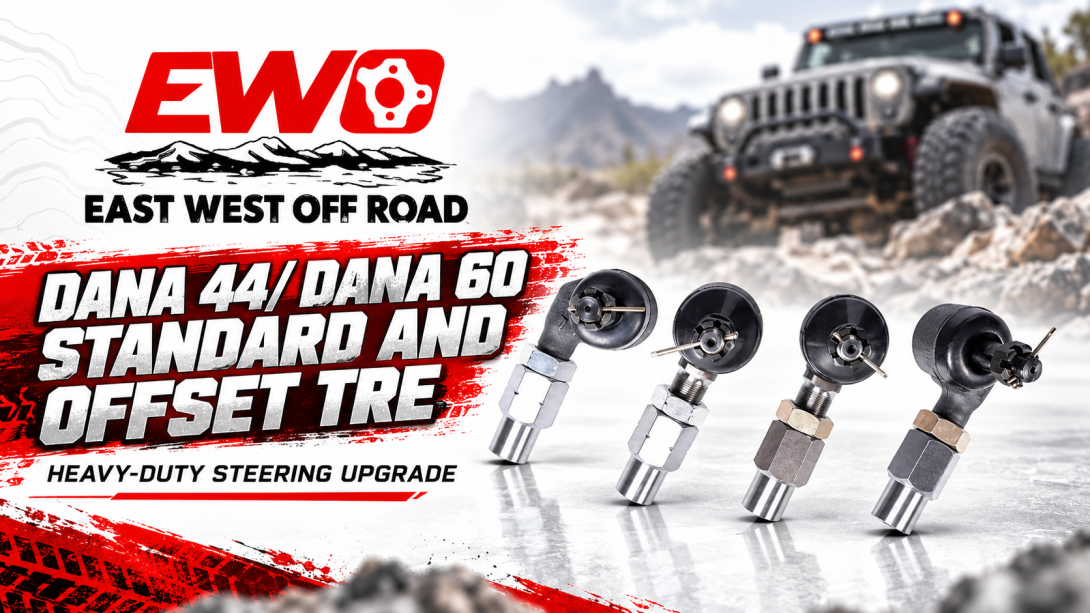
For builders shopping for standard and offset steering components, East West Off Road offers the Dana 44 / Dana 60 Standard and Offset TRE, item number E90063.
This guide explains how GM 1-ton offset tie rod ends work, how to choose between left-hand and right-hand threads, what 7/8"-18 specifications mean, and how to select compatible steering ends for Dana 44 and Dana 60 applications.
What Are GM 1 Ton Offset Tie Rod Ends?
GM 1-ton offset tie rod ends are aftermarket steering joints based on heavy-duty GM-style steering component designs.
Unlike a conventional straight tie rod end, an offset tie rod end positions the threaded shank away from the joint's normal centerline.
This changes the position of the attached steering bar relative to the mounting point.
The primary purpose of an offset design is to accommodate steering layouts that need different component positioning.
How Offset Tie Rod Ends Work
A tie rod end connects a steering bar to a compatible steering arm or knuckle.
The joint allows movement as the front wheels turn and the suspension operates.
On a standard tie rod end, the threaded shank follows a conventional alignment relative to the joint body.
An offset tie rod end uses a displaced connection to change where the attached bar sits.
For example, a steering bar might pass too close to a large aftermarket differential cover.
An appropriately configured offset joint may reposition the bar and create the clearance required by that steering setup.
Why Use an Offset Instead of a Standard Tie Rod End?
Offset steering ends are particularly relevant when a vehicle has:
- A large aftermarket differential cover.
- Modified steering knuckles or arms.
- A custom crossover steering system.
- A high-steer conversion.
- Suspension brackets near the tie rod.
- A solid-axle swap with limited steering space.
- Custom steering linkage that needs additional clearance.
The offset should be selected according to the actual clearance requirement.
Installing offset ends without measuring the steering layout can introduce new interference or alignment problems.
Does GM 1-Ton Mean a Certified Strength Rating?
No.
"GM 1-ton" is a commonly used aftermarket steering-component designation.
It does not establish a standardized load rating for the complete steering system.
Actual strength and serviceability depend on the joint design, material, construction, mounting hardware, and operating conditions.
Why Offset Tie Rod Ends Matter for Heavy-Duty Steering
Off-road vehicles often operate with suspension, axle, and tire combinations that differ substantially from their original factory configurations.
These modifications can create additional clearance and steering-linkage challenges.
Differential Cover Clearance
Larger differential covers are common on modified Dana 44 and Dana 60 axles.
Depending on the cover design and tie rod position, the steering bar may approach or contact the cover during movement.
Offset tie rod ends may help reposition the steering bar when the correct geometry is maintained.
However, an offset should not be chosen solely because the vehicle has an aftermarket cover.
The required clearance must be measured.
Suspension Bracket Clearance
Custom track bar brackets, suspension mounts, and axle brackets can occupy space around the steering linkage.
Some configurations may require a different tie rod position to avoid interference.
Offset ends provide an additional design option when planning those connections.
Custom Crossover Steering
Crossover steering systems use a specific drag link arrangement to transfer steering input across the front axle.
The exact layout depends on the steering knuckles, pitman arm, suspension, and axle configuration.
Certain custom builds may require offset steering ends to accommodate nearby hardware.
Rock Crawling Applications
Rock crawling can expose the steering linkage to significant loads and direct impacts.
Heavy-duty steering components may be appropriate for these applications.
However, offset geometry alone does not guarantee greater strength or impact resistance.
The complete assembly must be suitable for the intended use.
Standard vs. Offset GM 1-Ton Tie Rod Ends
One of the most important decisions when selecting steering components is whether the application requires a standard or offset design.
Both options are used in heavy-duty steering systems.
The difference is their geometry, not simply their appearance.
Standard GM 1-Ton Tie Rod Ends
Standard GM-style 1-ton steering ends use a conventional joint and threaded-shank arrangement.
They are often selected when a steering link already has adequate clearance and the mounting locations are compatible.
Common standard part-number families include ES2234R and ES2234L.
The exact application and specifications should always be checked against the product being purchased.
Offset GM 1-Ton Tie Rod Ends
Offset versions reposition the threaded steering-bar connection.
They are useful when the intended steering layout requires extra clearance around axle-mounted components.
Common offset part-number families include ES23434R and ES23434L, although aftermarket catalogs may also use other identifiers for comparable designs.
Standard vs. Offset Comparison
Feature
Standard GM 1-Ton TRE
Offset GM 1-Ton TRE
Joint configuration
Conventional geometry
Displaced threaded-shank geometry
Main purpose
Standard steering-link fitment
Alternative steering-bar positioning
Differential cover clearance
Depends on linkage layout
May provide additional clearance
Thread direction
RH or LH options
RH or LH options
Thread size
Must match actual component
Must match actual component
Mounting taper
Application-specific
Application-specific
Dana 44 use
Compatible applications
Compatible applications
Dana 60 use
Compatible applications
Compatible applications
Installation
Requires correct mounting and alignment
Requires correct mounting, orientation, and alignment
Neither version should be selected without checking the vehicle.
For builders comparing standard and offset tie rod ends, East West Off Road's E90063 is a relevant product to review for Dana 44 and Dana 60 steering projects.
East West Off Road Dana 44 / Dana 60 Standard and Offset TRE
East West Off Road offers its Dana 44 / Dana 60 Standard and Offset TRE, item number E90063, for customers sourcing steering-end components for Dana axle applications.
The product is relevant to buyers working with conventional and offset heavy-duty steering arrangements.
EWO Product Overview
Product Detail
Information
Product Name
Dana 44 / Dana 60 Standard and Offset TRE
Brand
East West Off Road
Item Number
E90063
Product Category
Tie Rod Ends
Steering Applications
Dana 44 and Dana 60 builds
Steering-End Designs
Standard and offset
Intended Buyers
Off-road builders and steering-replacement customers
The currently accessible E90063 listing identifies the product and its intended steering category.
However, the listing does not provide a complete technical breakdown of every included component.
Buyers should confirm the package quantity, part numbers, thread directions, offset dimensions, tube adapters, jam nuts, and mounting hardware before ordering.
Why This Product Is Relevant to GM 1-Ton Steering
GM-style 1-ton steering ends are frequently used in custom steering systems for Dana axles.
Some builders need standard joints for one part of the steering layout and offset joints for another.
A product focused on both configurations is therefore relevant when planning a compatible steering system.
The important consideration is selecting the correct parts for the actual mounting locations.
Individual EWO Offset Steering Ends
East West Off Road also lists individual GM 1-ton offset steering ends in right-hand and left-hand configurations.
Its individual listings advertise 7/8"-18 threaded shanks and a 1-inch offset.
Those specifications describe the individual components in those listings.
Before assuming every specification applies to the E90063 package, confirm the exact included parts with EWO.
Understanding 7/8"-18 GM 1-Ton Tie Rod Ends
The phrase 7/8-18 tie rod ends appears frequently in heavy-duty GM-style steering products.
This specification describes the threaded portion of the steering end.
What Does 7/8"-18 Mean?
The specification contains two measurements.
7/8 inch: The nominal outside diameter of the threaded shank.
18: The number of threads per inch.
These dimensions must match the compatible steering bar, tube insert, or threaded adapter.
Why Thread Size Matters
A threaded steering-end connection must engage the appropriate mating component correctly.
An incorrect thread specification may prevent proper assembly or create an unsafe connection.
Matching only the nominal diameter is not sufficient.
The pitch and thread direction must also match.
Are All 7/8"-18 Tie Rod Ends Interchangeable?
No.
Two steering ends may both have 7/8"-18 threaded shanks but differ in:
- Right-hand or left-hand threads.
- Ball-stud taper.
- Offset measurement.
- Joint-body dimensions.
- Overall length.
- Joint articulation.
- Intended mounting orientation.
These differences are especially important when replacing steering ends in a custom-built linkage.
Left-Hand vs. Right-Hand Offset Tie Rod Ends
One of the most common purchasing mistakes is confusing right-hand and left-hand threaded steering ends.
The terms refer to thread direction, not automatically to the side of the vehicle where the part is installed.
Right-Hand Threaded Tie Rod Ends
A right-hand threaded end uses the conventional thread direction.
It must connect to a matching right-hand threaded adapter or steering bar.
A common aftermarket designation is RH.
Left-Hand Threaded Tie Rod Ends
A left-hand threaded end uses the opposite thread direction.
It must connect to a matching left-hand threaded component.
A common aftermarket designation is LH.
Why Use Opposite-Hand Threads?
Some adjustable steering systems use one right-hand and one left-hand threaded end.
This arrangement can allow effective steering-link length adjustment through rotation of the appropriate steering bar or adjustment assembly.
However, the exact adjustment method depends on the system design.
Thread-Direction Comparison
Specification
Right-Hand
Left-Hand
Abbreviation
RH
LH
Thread direction
Conventional
Reverse
Matching adapter
RH threaded
LH threaded
Matching jam nut
RH threaded
LH threaded
Common application
Compatible steering-link positions
Compatible steering-link positions
Interchangeable?
No
No
Always record the correct part number and thread direction before replacing a steering end.
ES2234 vs. ES23434: Understanding Common GM Steering-End Numbers
Part numbers are important when purchasing replacement GM-style steering ends.
Two products with similar names may have different geometry.
ES2234R and ES2234L
These designations are associated with common standard GM 1-ton-style steering ends.
The R and L suffixes distinguish thread-hand configurations in the relevant listings.
They should not be treated as universal driver-side or passenger-side labels.
ES23434R and ES23434L
These designations are commonly associated with offset GM 1-ton-style steering ends.
The additional digits matter because they help distinguish the offset family from the standard ES2234-style family.
Why Exact Part Numbers Matter
If your vehicle already uses a particular steering end, identify the installed part before ordering a replacement.
A visual resemblance is not enough.
The replacement needs to match the relevant threads, offset geometry, stud taper, and overall dimensions.
For a custom steering assembly, it is useful to record the exact part number for every connection.
GM 1-Ton Steering Taper: What Buyers Should Know
The tapered connection between the ball stud and steering arm is a critical part of the installation.
Many aftermarket GM 1-ton-style steering ends use a taper commonly described as 1.5 inches per foot, or approximately 7 degrees.
However, that specification must be confirmed for the exact part.
Why the Taper Must Match
The tapered stud must seat properly in the corresponding steering-arm or knuckle opening.
An incorrect taper may prevent secure engagement.
It can also create dangerous loading conditions.
A tie rod end should never be considered compatible simply because the stud fits through the mounting hole.
Does Every Dana 44 or Dana 60 Have the Same Taper?
No.
Different vehicles and aftermarket steering components can use different tapers and mounting dimensions.
Dana 44 and Dana 60 are axle-family names, not universal steering-end specifications.
When Is Reaming Required?
Some steering conversions require a compatible tapered mounting hole to be machined.
Others are designed around existing mounting points.
Machining steering arms or knuckles is a safety-critical procedure and must follow the relevant manufacturer's requirements.
Never enlarge a steering mounting hole without confirming the correct component and machining specification.
GM 1-Ton Offset Tie Rod Ends for Dana 44 Axles
Dana 44 front axles are found in various trucks, Jeeps, and custom off-road builds.
However, the exact steering configuration depends on the axle's original application and any modifications.
Chevy Dana 44 Steering Builds
Older GM/Chevy Dana 44 front-axle builds are common applications for heavy-duty aftermarket steering upgrades.
These vehicles may use conventional or modified steering arms, crossover systems, and larger steering linkage.
Offset ends can become useful when aftermarket components reduce the available space around the tie rod.
Jeep Dana 44 Applications
Jeep Dana 44 axles may use different steering knuckles and mounting points from older Chevy axle assemblies.
A GM 1-ton-style steering end should not automatically be assumed compatible with every Jeep Dana 44.
Exact fitment must be verified.
When Should a Dana 44 Use Offset Ends?
An offset end may be appropriate when the actual steering setup requires a different bar position to clear surrounding components.
Examples include a larger differential cover or a modified axle bracket.
If the steering bar already has adequate clearance, a standard end may remain the more appropriate choice.
Dana 44 Fitment Questions
Before ordering, determine:
- Which Dana 44 axle version is installed?
- Are the steering knuckles factory or aftermarket?
- What steering-end taper is required?
- Does the tie rod need an offset?
- Which thread directions are used?
- Is the assembly designed for the available joint articulation?
These answers help prevent ordering incompatible parts.
GM 1-Ton Offset Tie Rod Ends for Dana 60 Axles
Dana 60 front axles are popular in demanding truck and rock-crawling applications.
Many custom Dana 60 builds use substantial steering components and aftermarket knuckles.
Dana 60 Steering Configuration Matters
Different Dana 60 axles may use different steering knuckles, steering arms, and linkage arrangements.
A kingpin axle configuration may have different requirements from a ball-joint axle configuration.
Aftermarket high-steer arms can also change mounting positions.
Why Offset Ends Are Used on Dana 60 Builds
A Dana 60 with a large differential cover or custom suspension brackets may have limited tie rod clearance.
An offset joint may help position the steering bar away from those obstacles.
However, the exact offset and steering geometry must be checked before installation.
Standard and Offset Dana 60 Steering
A Dana 60 steering system does not automatically need offset joints at every connection.
Some builds use standard ends, some use offset ends, and others may use a mixed configuration.
The appropriate arrangement depends on the steering system's design.
Dana 44 vs. Dana 60 Fitment Comparison
Consideration
Dana 44
Dana 60
GM 1-ton steering conversions
Application-dependent
Application-dependent
Offset steering ends
May be useful
May be useful
Standard steering ends
May be appropriate
May be appropriate
Mounting taper
Must be verified
Must be verified
Steering-knuckle design
Varies by application
Varies by application
High-steer configurations
Available for certain builds
Available for certain builds
Differential-cover clearance
Must be measured
Must be measured
Exact compatibility
Not determined by axle name alone
Not determined by axle name alone
One-Inch Offset vs. Other Offset Designs
When comparing GM 1-ton offset tie rod ends, pay close attention to the actual amount of offset.
An offset end is not defined by one universal displacement measurement.
What Does a One-Inch Offset Mean?
A 1-inch offset design changes the position of the steering-bar connection relative to the joint's conventional centerline by the manufacturer-defined offset dimension.
This can provide useful clearance in certain steering layouts.
East West Off Road's individual offset GM 1-ton steering-end listings advertise a 1-inch offset.
Do All Brands Use One-Inch Offset Designs?
No.
Different aftermarket manufacturers may offer different offset dimensions and joint geometry.
For example, Barnes 4WD advertises 1-inch offset versions of its GM-style steering ends, but other steering manufacturers may use different designs.
Therefore, the product's actual dimensions should be reviewed instead of assuming all offset joints behave identically.
Is More Offset Always Better?
No.
A larger offset is not automatically an improvement.
Excessive displacement or an incorrect orientation may cause interference with other steering or suspension components.
The correct amount of offset is determined by the actual required clearance and the complete steering arrangement.
Offset Tie Rod Ends for Crossover and High-Steer Systems
GM-style steering ends are common components in custom crossover and high-steer projects.
These applications require careful attention to component placement.
Crossover Steering Applications
A crossover steering system transfers steering input through a linkage layout that differs from certain factory configurations.
The exact design depends on the vehicle, front axle, steering arms, and suspension.
Offset tie rod ends may be useful if a steering link needs additional clearance.
High-Steer Applications
High-steer systems relocate certain steering connections to higher mounting positions using compatible components.
The objective may include improving steering-link clearance or creating a suitable arrangement for the vehicle's suspension design.
An offset joint may provide an additional positioning option, but it does not automatically perform a high-steer conversion.
Does an Offset TRE Fix Bump Steer?
Not automatically.
Bump steer occurs when suspension movement creates unintended steering input.
Correcting it requires evaluating steering and suspension geometry, including the relationship between the drag link and track bar where applicable.
An offset end changes the steering-link position, but it should not be treated as a universal geometry-correction part.
How to Choose the Right GM 1-Ton Offset Tie Rod End Kit
A proper purchasing decision starts with the actual steering system rather than a generic product category.
The following checklist can help you select the correct parts.
Step 1: Identify the Existing Steering Components
Determine the exact axle, steering knuckles, steering arms, and linkage arrangement.
If the system is already modified, identify the installed steering-end part numbers.
Step 2: Determine Why an Offset Is Needed
Identify the component creating the clearance issue.
Measure the available space and document the required steering-bar position.
Do not purchase an offset joint based only on the vehicle model.
Step 3: Confirm Thread Dimensions
Check the threaded-shank diameter and pitch.
If the existing steering system uses 7/8"-18 components, confirm that the replacement matches those specifications.
Step 4: Verify Thread Direction
Determine whether each mounting position requires a right-hand or left-hand threaded end.
Use the correct matching adapter and jam nut.
Step 5: Verify the Mounting Taper
Confirm that the new ball stud matches the intended steering arm or knuckle.
Do not assume a GM 1-ton-style designation establishes compatibility.
Step 6: Check Offset Orientation and Articulation
The end must provide adequate clearance in its intended position.
It must also articulate properly throughout steering and suspension movement.
Step 7: Confirm Package Contents
Before ordering a complete kit, verify the included steering ends and hardware.
A product described as a tie rod end kit may not include the steering tubing, reamer, high-steer arms, or other components needed for the entire project.
Buying Checklist
Buying Factor
What to Confirm
Axle
Exact Dana 44 or Dana 60 configuration
Steering type
Standard, crossover, or high-steer
TRE style
Standard or offset
Thread diameter
Exact nominal size
Thread pitch
Threads per inch
Thread hand
RH or LH
Mounting taper
Correct stud and mounting-hole geometry
Offset dimension
Actual displacement needed
Overall length
Compatible steering-link adjustment range
Articulation
Adequate movement without binding
Tube adapter
Correct thread specifications
Jam nut
Correct size and thread hand
Hardware
Required mounting components
Clearance
Differential, brackets, wheels, and suspension
Installation
Product-specific procedures and alignment
Common GM 1-Ton Offset TRE Buying Mistakes
Buying the wrong steering end can delay a project or create unsafe fitment conditions.
Mistake 1: Ordering by the GM 1-Ton Name Alone
The name describes a broad aftermarket component family.
Always verify the exact specifications.
Mistake 2: Confusing Right-Hand and Left-Hand Threads
An RH steering end is not interchangeable with an LH steering end simply because the dimensions appear similar.
Mistake 3: Assuming All Offset Ends Have the Same Offset
Offset measurements vary by product.
Choose the geometry required by your build.
Mistake 4: Ignoring Mounting Taper
A threaded shank may match the steering bar while the ball stud does not fit the steering knuckle correctly.
Both interfaces matter.
Mistake 5: Failing to Check Steering Articulation
The joint must move through the vehicle's required steering and suspension range.
Binding can cause excessive loading or damage.
Mistake 6: Assuming Dana 44 and Dana 60 Parts Are Universally Interchangeable
Axle families include many different steering configurations.
Compatibility must be confirmed at the component level.
Mistake 7: Assuming an Offset End Solves Every Clearance Problem
An offset can change the steering-bar position, but it may not address unrelated interference or geometry problems.
Mistake 8: Skipping Alignment After Installation
Replacing tie rod ends can change steering-link length and front-wheel toe.
Proper adjustment and alignment are important before regular driving resumes.
Installation and Safety Considerations
Steering components directly affect vehicle control.
Installation should follow the manufacturer's instructions for the exact steering ends, axle, and steering-linkage system.
Professional assistance is recommended for custom steering work.
Inspect All Existing Components
Before installation, inspect the tie rod, drag link, steering arms, knuckles, and related hardware.
Replace damaged or worn components as necessary.
Use Matching Threaded Hardware
The steering end, tube adapter, and jam nut must use compatible thread specifications.
Incorrect hardware should never be forced into place.
Confirm Proper Stud Seating
The tapered stud must seat correctly in the mounting point.
Use the fasteners and installation procedures specified for the component.
Check Clearance During Movement
Verify that the tie rod does not interfere with differential covers, suspension brackets, steering stabilizers, wheels, or other components.
The steering system should also maintain appropriate clearance throughout its expected operating range.
Perform a Professional Alignment
Tie rod adjustments affect front-wheel toe.
After replacement, a professional technician should inspect and adjust the front-end alignment as appropriate.
Inspect After Trail Use
Regularly check steering joints for excessive movement, damaged boots, loose hardware, or impact damage.
Follow the manufacturer's lubrication requirements where applicable.
Where to Buy GM 1-Ton Offset Tie Rod Ends
When shopping for heavy-duty steering ends, choose the correct geometry and mounting specifications before comparing prices.
East West Off Road offers the Dana 44 / Dana 60 Standard and Offset TRE, item E90063.
The product is relevant to customers sourcing steering ends for compatible Dana axle and GM-style aftermarket steering applications.
Before ordering, confirm which standard and offset ends are included, the right-hand and left-hand thread requirements, and whether additional hardware is needed for your build.
You can explore GM 1 ton offset tie rod ends through East West Off Road and review the product configuration for your specific steering project.
The best choice is the steering-end combination that fits your actual linkage, mounting points, and clearance requirements.
Frequently Asked Questions (FAQs)
1. What are GM 1 ton offset tie rod ends?
GM 1-ton offset tie rod ends are heavy-duty aftermarket steering joints designed with an offset threaded-shank position. They are used in compatible steering systems where the connected bar needs different positioning or additional clearance.
2. Why are GM 1-ton offset tie rod ends used?
They are commonly used to help provide clearance around differential covers, suspension brackets, steering arms, and other nearby components on modified off-road vehicles.
3. What is the difference between standard and offset GM 1-ton tie rod ends?
Standard ends use conventional joint geometry. Offset ends reposition the threaded steering-link connection relative to the joint, changing the position of the attached steering bar.
4. Are GM 1-ton offset tie rod ends suitable for Dana 44 axles?
They may be suitable for compatible Dana 44 steering configurations. Exact compatibility depends on the knuckles, taper, steering-link dimensions, and mounting arrangement.
5. Will GM 1-ton offset tie rod ends fit a Dana 60?
They can be used in compatible Dana 60 steering applications. However, not every Dana 60 uses the same steering-end dimensions or mounting taper.
6. What does 7/8"-18 mean on a tie rod end?
It describes a threaded shank with a nominal 7/8-inch diameter and 18 threads per inch.
7. Are all 7/8"-18 GM steering ends interchangeable?
No. Thread direction, mounting taper, offset, overall length, and joint articulation can vary.
8. What is a right-hand offset tie rod end?
A right-hand offset tie rod end has a right-hand threaded shank and offset joint geometry. It must connect to compatible right-hand threaded hardware.
9. What is a left-hand offset tie rod end?
A left-hand offset tie rod end has a left-hand threaded shank and offset geometry. It requires matching left-hand threaded components.
10. Do RH and LH mean passenger side and driver side?
Not necessarily. In steering-end product descriptions, RH and LH generally identify thread direction. The intended vehicle position must be confirmed separately.
11. How much offset do GM 1-ton tie rod ends provide?
The offset varies by manufacturer and model. EWO's individual offset GM 1-ton listings advertise a 1-inch offset, but buyers should verify the exact dimensions of the product being ordered.
12. Does a one-inch offset mean the tie rod will clear every differential cover?
No. Clearance depends on the entire steering arrangement, including bar diameter, axle components, offset orientation, and available space.
13. What are ES2234R and ES2234L tie rod ends?
These part-number families are commonly associated with standard GM 1-ton-style right-hand and left-hand threaded steering ends.
14. What are ES23434R and ES23434L tie rod ends?
These part-number families are commonly associated with offset GM 1-ton-style steering ends in right-hand and left-hand thread configurations.
15. Do GM 1-ton tie rod ends use a standard GM taper?
Many aftermarket versions use a taper described as 1.5 inches per foot, but the exact taper must be confirmed for the specific component.
16. Can I install GM 1-ton ends without modifying my steering knuckles?
It depends on the existing mounting taper and the intended steering system. Some applications use compatible existing mounts, while others require appropriately engineered modifications.
17. Do I need to ream the steering knuckles for GM 1-ton ends?
Not always. Reaming requirements depend on the mounting-point dimensions and the exact joint. Any machining must follow manufacturer-approved specifications.
18. Can I use offset tie rod ends with crossover steering?
Yes, in compatible applications where the steering layout requires the offset geometry. The complete system must be checked for fitment and articulation.
19. Are offset tie rod ends suitable for high-steer conversions?
They may be useful in certain high-steer systems. However, they are not a substitute for properly designed steering arms, mounting components, or geometry correction.
20. Are offset tie rod ends stronger than standard tie rod ends?
Not automatically. Offset describes joint geometry, not a standardized strength increase. Actual strength depends on materials, design, manufacturing, and loading.
21. Can I use one standard and one offset steering end?
Some custom steering systems use mixed configurations. The arrangement must be designed for the correct mounting positions, threads, length, and articulation.
22. What does the EWO E90063 product offer?
East West Off Road lists E90063 as the Dana 44 / Dana 60 Standard and Offset TRE. Confirm the exact included components and hardware before ordering.
23. Does E90063 include DOM tubing?
The accessible E90063 listing does not confirm DOM tubing as an included component. Verify the package contents directly with EWO before purchasing.
24. Do offset tie rod ends come with jam nuts or tube adapters?
Included hardware depends on the product. Some manufacturers include jam nuts, while others sell adapters separately. Confirm the contents of the exact kit you are buying.
25. Do GM 1-ton offset tie rod ends require maintenance?
Maintenance depends on joint design. Greaseable ends should be lubricated according to the manufacturer's instructions, and all joints should be inspected regularly for wear or damage.
26. Do I need an alignment after replacing tie rod ends?
Yes. Steering-end replacement can affect toe alignment. A professional steering inspection and alignment are recommended after installation.
27. Can offset tie rod ends fix death wobble?
Not by themselves. Severe front-end oscillation can involve worn steering joints, track bar connections, suspension components, tires, or alignment. A complete diagnosis is necessary.
28. Are GM 1-ton offset tie rod ends suitable for daily-driven vehicles?
They may be appropriate when correctly specified and installed as part of a compatible steering system. Proper joint fitment, alignment, and safe steering operation are essential.
29. How much do GM 1-ton offset tie rod ends cost?
Prices vary by manufacturer, joint design, included hardware, and whether components are purchased individually or as a kit. Check the current retailer listing for accurate pricing.
30. Where can I buy GM 1-ton standard and offset tie rod ends?
East West Off Road offers its Dana 44 / Dana 60 Standard and Offset TRE under item E90063. Verify the exact configuration and compatibility before ordering.
Final Thoughts: Choose the Right GM 1-Ton Steering Ends for Your Build
GM 1 ton offset tie rod ends provide a valuable steering-linkage option for off-road builders working with Dana 44, Dana 60, crossover steering, and custom solid-axle applications.
Their primary advantage is the ability to change steering-bar positioning when a conventional tie rod end does not provide the clearance required by a particular build.
However, selecting the right steering end involves more than choosing a heavy-duty product name.
Thread diameter, thread pitch, thread direction, mounting taper, offset measurement, joint articulation, and steering-link length must all be compatible.
East West Off Road's Dana 44 / Dana 60 Standard and Offset TRE (E90063) is an option to consider when sourcing steering ends for a compatible heavy-duty steering project.
Before purchasing, identify your axle and mounting configuration, measure the available clearance, and verify the exact included components.
With careful planning, correctly matched parts, professional installation, and proper alignment, your steering system can be better prepared for the demands of your off-road build.