

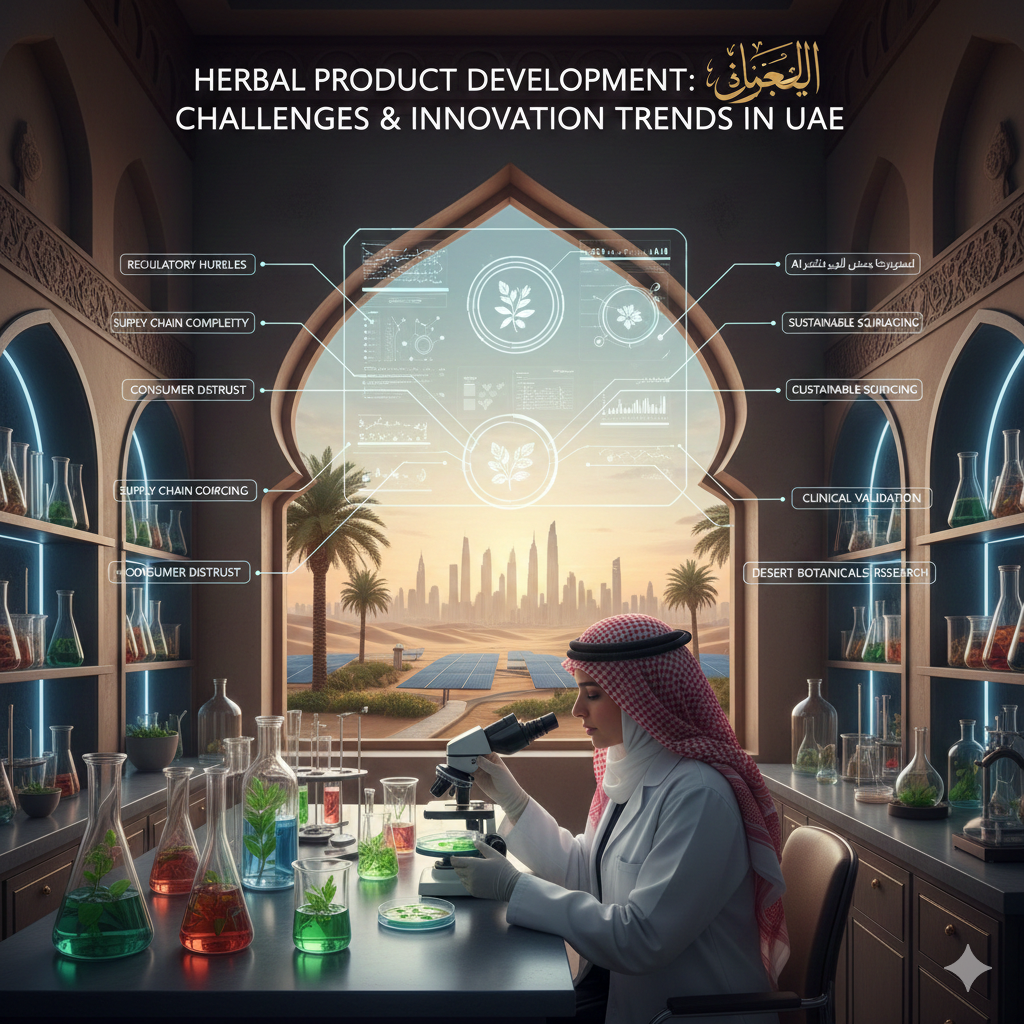
The global demand for herbal products is growing rapidly, driven by increasing consumer preference for natural, plant-based, and wellness-focused solutions. In regions like the UAE, where health-conscious consumers and regulatory rigor go hand in hand, herbal product development has evolved into a highly specialized and innovation-driven process. However, developing safe, effective, and market-ready herbal products comes with its own set of challenges. This article explores the key challenges in herbal product development, emerging innovation trends, and problem-solving approaches adopted by leading herbal product development and innovation services.
Key Challenges in Herbal Product Development
1. Raw Material Quality and Consistency
One of the biggest challenges in herbal product development is ensuring consistent quality of raw herbal ingredients. Variations in climate, soil conditions, harvesting methods, and storage can significantly impact the potency and efficacy of herbal extracts. Inconsistent raw materials often lead to formulation instability and batch-to-batch variations.
Solution:
Expert herbal formulation development begins with supplier qualification, botanical authentication, and standardized extract selection to ensure consistency and quality across production batches.
2. Scientific Validation of Herbal Claims
Consumers and regulators increasingly demand scientifically backed claims for herbal products. Traditional knowledge alone is no longer sufficient to support efficacy claims in competitive markets like the UAE.
Solution:
Herbal product development and innovation consultants integrate traditional knowledge with modern R&D, including phytochemical analysis, functional testing, and stability studies to validate product performance.
3. Regulatory Compliance in UAE and GCC Markets
Navigating regulatory frameworks for herbal products in the UAE can be complex. Products must comply with local health authority regulations, labeling standards, ingredient approvals, and safety documentation.
Solution:
Herbal product development and innovation contract R&D services offer end-to-end regulatory support, ensuring formulations align with UAE and GCC compliance requirements, reducing time-to-market risks.
4. Formulation Stability and Shelf Life
Herbal formulations are often sensitive to environmental factors such as temperature, humidity, and light. Achieving a stable formulation with an acceptable shelf life is a major technical challenge.
Solution:
Advanced herbal formulation development and scale-up solutions use optimized excipient selection, encapsulation techniques, and controlled processing conditions to enhance product stability and shelf life.
5. Scaling Up from Lab to Commercial Production
Many herbal products perform well at the laboratory stage but face challenges during scale-up due to changes in processing parameters and ingredient behavior.
Solution:
Contract R&D services bridge the gap between lab-scale innovation and commercial manufacturing through pilot trials, process optimization, and scalable formulation strategies.
Emerging Trends in Herbal Product Development
1. Evidence-Based Herbal Innovation
The herbal industry is shifting toward evidence-based formulations supported by scientific data. Brands are investing in clinically inspired formulations to build consumer trust and regulatory acceptance.
2. Clean Label and Natural Positioning
Consumers increasingly demand clean-label herbal products free from artificial additives, preservatives, and synthetic colors. This trend is especially strong in premium UAE markets.
3. Functional Herbal Products
Herbal products are no longer limited to supplements. Functional foods, ready-to-mix beverages, herbal cosmetics, and wellness formulations are gaining popularity, expanding innovation opportunities.
4. Personalized Herbal Solutions
Personalized wellness is becoming a key trend, with brands developing targeted herbal solutions for immunity, digestion, stress management, and beauty-from-within concepts.
5. Sustainability and Ethical Sourcing
Sustainable sourcing and environmentally responsible production are becoming essential for brand credibility. Ethical harvesting and traceable supply chains are now part of product innovation strategies.
Problem-Solving Approach to Herbal Product Development
A structured, problem-solving approach ensures successful herbal product development:
- Market and Consumer Insight Analysis
Understanding target consumer needs, trends, and regulatory expectations. - Ingredient Selection and Validation
Choosing high-quality, standardized herbal ingredients with proven safety and efficacy. - Formulation Design and Optimization
Developing stable, effective, and scalable herbal formulations. - Regulatory and Compliance Review
Ensuring alignment with UAE and international regulatory standards. - Pilot Trials and Scale-Up
Testing formulations under real manufacturing conditions. - Commercial Launch Support
Final validation, documentation, and market-ready positioning.
Conclusion
Herbal product development in the UAE is a dynamic and evolving field that requires a balance of traditional knowledge, scientific innovation, and regulatory expertise. By addressing challenges related to raw materials, formulation stability, compliance, and scalability, brands can successfully launch high-quality herbal products. Partnering with herbal product development and innovation services, experienced consultants, and contract R&D experts enables businesses to accelerate innovation while ensuring safety, efficacy, and market readiness.
As consumer demand for natural and functional products continues to rise, investing in advanced herbal formulation development and scale-up solutions is key to staying competitive in the rapidly growing herbal market.