

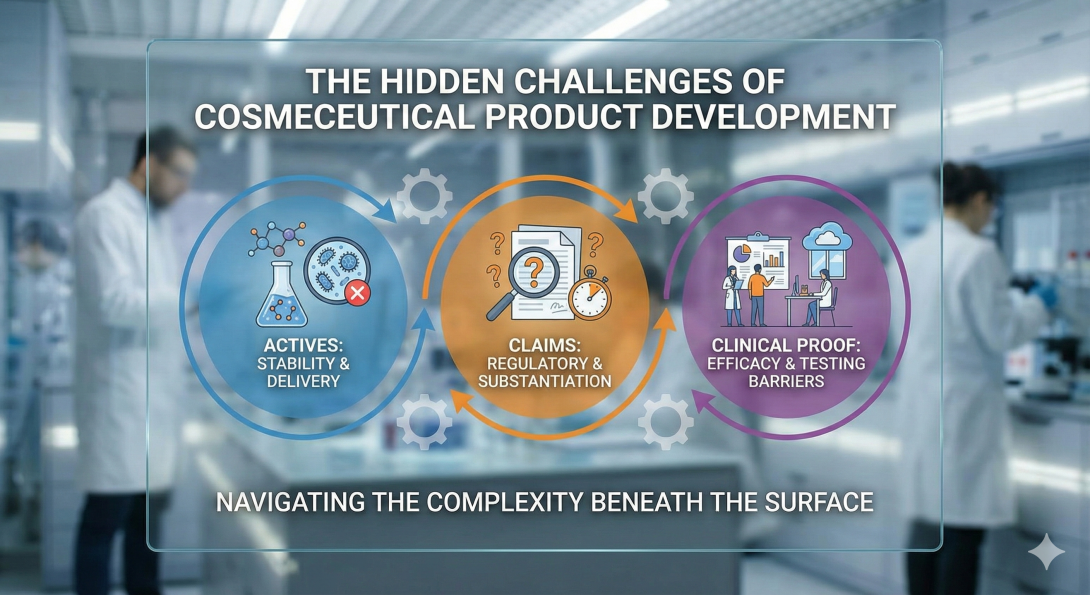
The beauty and skincare industry has shifted dramatically in recent years, with consumers demanding products that deliver visible, scientifically proven results. This demand has elevated cosmeceuticals—products that sit between cosmetics and pharmaceuticals—into one of the fastest-growing beauty segments. But behind every successful cosmeceutical lies a sophisticated scientific process that many brands underestimate.
From ingredient stability to claim substantiation, cosmeceutical product development involves navigating challenges that require deep scientific understanding. Without the right expertise, brands often face unstable formulas, regulatory delays, or products that fail to deliver promised results.
This article explores the hidden challenges behind developing high-performance cosmeceuticals and why partnering with experienced formulation scientists is essential for brand success.
1. Choosing the Right Active Ingredients Isn’t as Simple as It Seems
Actives like peptides, retinoids, ceramides, AHAs, niacinamide, botanical extracts, and antioxidants are at the heart of every effective cosmeceutical. But selecting them requires more than following trends.
Many brands overlook key scientific considerations:
- Ingredient stability under heat, light, or oxygen
- pH and compatibility with other components
- Sensitivity or irritation potential
- Required concentration for visible effects
- Interaction with emulsifiers, preservatives, or fragrances
This is why brands rely on structured cosmetic product development processes, where each active ingredient is evaluated based on efficacy, performance, and long-term stability. Without this scientific validation, products may degrade quickly, oxidize, or fail to deliver results.
2. Formulating With Potent Actives Requires Technical Expertise
Cosmeceutical formulas contain higher concentrations of active molecules than standard beauty products, which introduces a new layer of complexity. Certain actives—such as vitamin C, retinol, and peptides—are notoriously difficult to stabilize.
Common formulation challenges include:
- Oxidation of sensitive materials
- pH drift that reduces efficacy
- Incompatibility with emulsions
- Loss of potency during production
- Increased irritation if the delivery system is incorrect
This is where advanced cosmetic formulation development becomes essential. Techniques such as encapsulation, controlled-release systems, and optimized emulsions ensure that actives remain stable and effective from formulation to application.
3. Creating Claims That Are Both Believable and Legally Compliant
Cosmeceuticals often make claims like:
- “Reduces fine lines in 2 weeks”
- “Clinically proven brightness boost”
- “Strengthens the skin barrier”
However, these claims must be supported by scientific evidence. Many brands struggle because:
- Supplier data is mistaken for finished-product proof
- Clinical requirements vary by region
- Claims may be considered therapeutic, triggering stricter regulations
- Marketing teams push for wording that isn’t legally permissible
A strong understanding of claim regulations is critical in beauty product development, ensuring the messaging is both compelling and compliant.
4. Proper Testing Is Essential but Often Ignored
Testing is one of the most critical steps in creating a trustworthy cosmeceutical, yet it’s frequently overlooked due to cost or time constraints.
Depending on the product and claims, testing may include:
- Stability studies
- Microbiology testing
- Dermatological safety assessments
- Consumer perception trials
- Clinical efficacy studies
These scientific evaluations are foundational in modern skincare product development, helping brands demonstrate real results and build consumer trust.
5. Stability and Packaging Compatibility Are Make-or-Break Factors
A formula can be highly effective in the lab but fail once it goes to market. Instability can cause:
- Separation or texture changes
- Loss of active potency
- Color or odor shifts
- pH changes
- Microbial contamination
Packaging plays an equally critical role—some actives degrade quickly if exposed to light or air.
This is why brands focusing on custom skincare product development invest heavily in stability and compatibility testing to ensure long-lasting performance.
6. Scaling Up From Lab to Production Introduces New Challenges
A formulation that works perfectly in a 100-gram lab sample may behave differently when scaled to a 100-kg manufacturing batch. Scale-up challenges can include:
- Uneven distribution of actives
- Variations in viscosity
- Increased oxidation
- Changes in texture or feel
Brands that prioritize precision and consistency rely on structured processes found in custom cosmetic formulation development, ensuring the formula remains stable and effective at any production size.
Why Working With an Experienced R&D Partner Matters
In today’s competitive market, developing advanced cosmeceuticals requires more than creativity—it requires scientific rigor. Brands benefit tremendously when they collaborate with experts who understand the nuances of cosmetic product development, cosmeceutical product development, and beauty product development, ensuring each formula is grounded in proven research and functional design.
By integrating research, innovation, and regulatory awareness, Food Research Lab support transforms ideas into reliable, high-performing cosmeceutical products capable of succeeding in a crowded and demanding beauty industry.