

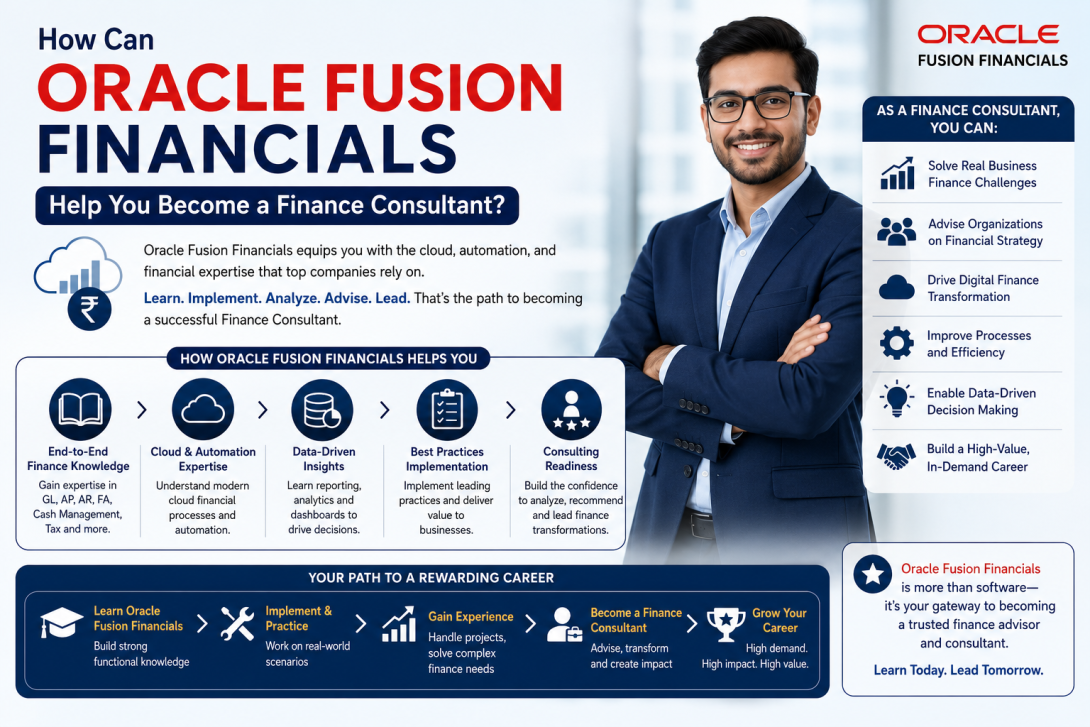
Introduction
Ask most people what a "finance consultant" actually does day to day, and you'll get a vague answer involving spreadsheets, strategy meetings, and maybe a laptop in a client's conference room. Soft Online Training hears that same fuzzy picture constantly from learners who want to move past routine accounting work but aren't sure what the actual path looks like. The clearer answer, once you strip away the vague job-title glamor, is that Oracle Fusion Financials has quietly become one of the more reliable on-ramps into real consulting work not despite being "just software," but because of it.
The confusion usually comes down to a few persistent misconceptions about what this path actually requires. Clearing those up is often more useful than another generic list of steps, and it explains exactly why solid Oracle Fusion Financials Online Training ends up mattering so much along the way.
Myth: Consulting Is About Strategy, Not Systems
Reality: a large share of modern finance consulting is systems work wearing a strategy hat. Organizations don't just want advice on budgets in the abstract they want someone who can help implement, configure, and optimize the platform their finance operations actually run on. Because Oracle Fusion Financials is used so widely across banking, manufacturing, healthcare, and retail, deep fluency in it functions as a genuinely transferable consulting skill, not a narrow technical specialty.
Myth: You Need Years of Experience Before Anyone Takes You Seriously
Reality: what you actually need is configuration-level command of the core modules General Ledger, Accounts Payable, Accounts Receivable, Cash Management, and Fixed Assets understood well enough to explain why a specific setup fits one business better than another, not just what each module technically does. That's precisely the depth a properly built Oracle Fusion Financials Course is designed to develop, and it's achievable well before you've clocked years on the job.
Myth: Knowing the Software Is the Hard Part
Reality: the harder shift is learning to think in full business processes instead of individual screens. Procure-to-Pay, Order-to-Cash, and Record-to-Report aren't isolated features they're connected cycles clients actually care about. Nobody hires a consultant to explain what a button does; they hire someone to solve a business problem that happens to run through that button. Making that mental shift, from operating software to solving business problems, is genuinely what separates a consultant from a support technician.
Myth: Client Skills Come Naturally Once You Know the System
Reality: technical fluency alone rarely produces good client-facing instincts. Gathering requirements from a client who isn't sure what they want, translating vague business needs into concrete system configurations, and explaining trade-offs to non-technical stakeholders are learned skills built through mock scenarios, real implementation practice, and honest feedback, not absorbed automatically alongside module knowledge.
Myth: Certifications Are Just Paper
Reality: for anyone without a long consulting track record yet, a relevant Oracle certification carries real weight. It tells a client or employer your knowledge has actually been tested, not just claimed a genuinely useful credibility signal early on, before your project history alone can do the talking.
Myth: You Either Start as a Consultant or You Don't Get There
Reality: almost nobody starts there directly. Most people build toward it through ERP Support, Functional Associate, or Business Analyst roles first, gradually earning more client-facing responsibility as trust and hands-on experience accumulate. Each of those roles adds a genuine, defensible layer of experience that eventually supports real consulting work.
Myth: Technical Depth Is What Gets You Promoted
Reality: communication is often the actual differentiator at senior levels. A consultant's real value usually comes down to translation turning complicated system and financial logic into something a business leader can act on with confidence. Developing that skill alongside technical depth is what actually opens doors to bigger engagements, not technical knowledge in isolation.
Where the Path Genuinely Leads
With enough accumulated experience, this route can lead toward Senior Functional Consultant, Solution Architect, Finance Transformation Consultant, or independent consulting work roles that blend deep platform knowledge with real strategic input into how an organization actually runs its finance operations.
Why Structured Training Cuts Through the Confusion
A well-designed Oracle Fusion Financials Online Training program builds far more than module familiarity. It develops business process thinking, client-communication practice, and genuine implementation exposure the actual pieces that shape a consulting career, rather than leaving learners to stumble through years of trial and error figuring out what actually matters.
Why Soft Online Training
The program combines live instructor-led classes with hands-on Oracle Cloud practice, real implementation scenarios, mock interviews, resume support, and placement guidance built specifically to help learners move deliberately from technical training toward genuinely consulting-track roles.
Conclusion
Becoming a finance consultant through Oracle Fusion Financials isn't about memorizing module names it comes down to configuration-level system knowledge, full business process understanding, real implementation exposure, and genuine client-communication skill. Enrolling in Oracle Fusion Financials Online Training builds that functional foundation, and a comprehensive Oracle Fusion Financials Course like the one offered through Soft Online Training gives you the structured, practical path to build a real consulting career, rather than staying stuck in execution-only work indefinitely.