

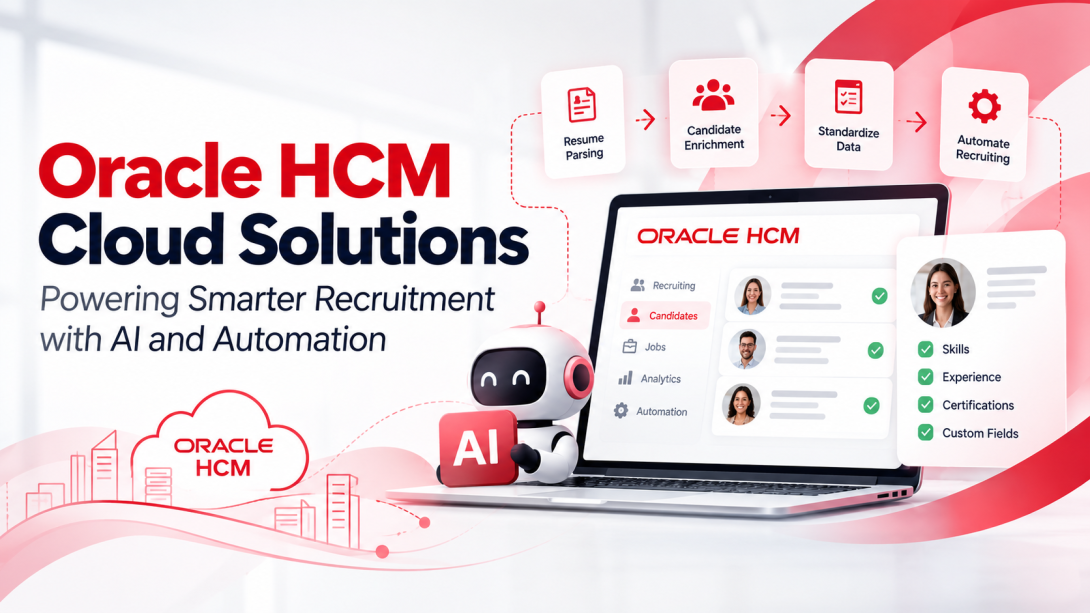
Artificial intelligence is changing the way organizations approach recruitment and talent management. What once required recruiters to manually review applications, prepare job descriptions, organize candidate information, initiate sourcing activities, and complete repetitive administrative tasks can increasingly be supported by intelligent workflows.
For organizations using Oracle Fusion Cloud HCM, this transformation is becoming particularly significant with the expansion of AI agents across recruiting and talent management.
Oracle HCM AI agents can help organizations automate specific activities, assist users with information, and trigger actions within defined HCM workflows. When combined with accurate and structured candidate data, these capabilities can create a recruiting environment where recruiters spend less time on repetitive processes and more time engaging candidates and making informed hiring decisions.
The result is not simply more automation. It is a shift toward connected recruiting workflows in which data, artificial intelligence, and human decision-making work together.
What Are Oracle HCM AI Agents?
AI agents are software-based capabilities designed to assist with or perform specific tasks using available data, business rules, workflows, and artificial intelligence.
Within Oracle Fusion Cloud HCM, Oracle has introduced AI-agent capabilities across areas including human resources, recruiting, talent management, workforce management, payroll, and other HCM functions.
In recruiting specifically, Oracle's current AI functionality includes capabilities related to candidate experience, candidate selection processes, sourcing activities, job requisition content, candidate outreach, interviews, and recruiting activity centers.
Instead of requiring recruiters to manually initiate every activity, organizations can configure certain workflow agents to respond when particular conditions or events occur.
For example, Oracle's 26C recruiting functionality allows a published HCM workflow agent to be automatically launched when configured events or states occur in the candidate selection process.
This represents an important development in recruitment automation.
Rather than simply giving recruiters another AI tool to open separately, AI capabilities can become part of the workflow they already use.
Moving from Traditional Automation to Agentic Recruitment
Recruitment automation itself is not new.
Applicant tracking systems have long automated activities such as application confirmations, interview notifications, candidate status changes, and approval workflows.
Traditional automation generally follows predefined logic:
Trigger → Rule → Action
For example, when a candidate reaches a particular stage, the system might automatically send an email.
Agentic workflows can expand this model.
An AI agent can use available context to assist with more complex tasks such as generating content, initiating sourcing activities, analyzing information, or supporting recruiter decisions.
This does not mean every recruiting decision should be automated.
Instead, Oracle Recruiting automation can help organizations determine which repetitive or information-intensive activities can be supported by technology while keeping recruiters and hiring managers involved where human judgment is required.
AI Agents Can Support Candidate Sourcing
Finding qualified candidates is one of the most time-consuming parts of recruiting.
Recruiters may need to search existing candidate databases, build talent pools, create campaigns, review previous applicants, and reach out to prospective candidates.
Oracle is introducing agentic capabilities directly into these activities.
For example, Oracle's Recruiting Sourcing Activity Center Agent can be configured to initiate sourcing efforts based on requisition activities. Depending on the configuration, the agent can create candidate pools, campaigns, or both.
This is important because sourcing can become more event-driven.
Instead of waiting for a recruiter to notice that a requisition needs additional candidates, an organization can configure workflows that initiate appropriate sourcing activities based on defined conditions.
Recruiters can then focus more of their time on evaluating and engaging the resulting talent pool.
Improving Job Requisition Content
Creating effective job descriptions is another area where AI agents can support recruitment teams.
Recruiters and hiring managers often spend considerable time drafting job descriptions, responsibilities, qualifications, and other requisition content.
Oracle's 26C recruiting capabilities include a workflow agent that powers AI Assist for job requisition posting descriptions.
The agent can generate content for fields including:
- Short Description
- Description
- Responsibilities
- Qualifications
Oracle provides configuration controls over which posting-description fields use AI-assisted generation.
The practical benefit is straightforward.
AI can create a useful starting point, while recruiters and hiring managers retain the ability to review and refine the content according to organizational requirements.
This can reduce repetitive writing work without removing human oversight.
Making Candidate Outreach More Efficient
Recruiting does not end when a candidate enters the database.
Recruiters must continuously communicate with prospects and candidates, particularly when sourcing passive talent.
Personalizing every outreach message manually can become difficult when recruiters manage multiple requisitions simultaneously.
Oracle's Candidate Outreach capabilities use AI agents to help generate personalized, context-specific communications based on information such as candidate profile and job details. Recruiters can provide guidance and further personalize the generated communication.
This provides another example of how AI agents can support recruiters rather than simply replace an existing process.
The recruiter provides the context and remains involved in the communication, while AI helps reduce the time required to prepare the initial message.
Supporting Interview Processes with AI
Interviews generate large amounts of unstructured information.
Interviewers take notes, complete feedback questionnaires, compare observations, and provide recommendations.
Some of this work can also be supported by AI.
Oracle's 26C Interview Insights Generator can analyze supported interview transcripts to generate an interview summary and pre-populate feedback questionnaires. The resulting information is then provided to interviewers for review and submission.
This human-review step is particularly important.
AI can help organize information and reduce administrative effort, while the interviewer remains responsible for reviewing and submitting feedback.
This illustrates a practical model for AI adoption in talent acquisition:
AI prepares → Human reviews → Workflow continues.
Why Candidate Data Quality Becomes More Important with AI
As recruitment systems become more intelligent, the quality of their underlying data becomes increasingly important.
Consider a candidate whose resume contains:
- Eight years of professional experience
- Multiple technical skills
- Three certifications
- Two degrees
- Several previous job titles
If only a small portion of this information reaches the structured candidate profile, AI-assisted search, screening, matching, or workflow processes may be working from an incomplete representation of that candidate.
This is why Oracle HCM candidate profile import capabilities can become an important part of the AI-ready recruiting environment.
RChilli's Enhanced Candidate Profile Import is designed to transform resumes into structured Oracle-ready candidate profiles. According to RChilli, the solution captures Flexfield data, extracts 15+ skills per candidate, normalizes degrees and job roles against predefined values, and supports customizable field mapping.
The objective is to make more candidate information available as structured data rather than leaving valuable details only inside resume documents.
Clean Data Creates a Better Foundation for AI Agents
Completeness is only one dimension of data quality.
Consistency matters as well.
Candidate databases frequently contain variations such as:
Software Engineer
Software Developer
Sr. Software Engineer
Senior SW Engineer
Similar inconsistencies can occur with skills, degrees, certifications, locations, and other fields.
If these variations are not standardized appropriately, candidate search, matching, analytics, and AI-assisted processes can become less consistent.
RChilli's Oracle HCM offering includes data-hygiene capabilities such as Full Database Reprocessing, List of Values mapping, and Customizable Taxonomy. Its taxonomy offering is designed to standardize skills and job information while allowing organizations to adapt terminology to their requirements.
This creates an important relationship:
Better candidate data → Better AI context → More useful recruiting workflows
AI agents should therefore not be viewed independently from candidate data management.
Extending Oracle Recruiting with Specialized AI Agents
Organizations can also extend their Oracle recruiting environment with specialized AI capabilities.
RChilli currently describes five AI agents that work with Oracle Recruiting Cloud workflows:
Interview Question Generator AI Agent – Creates role-specific technical, behavioral, and competency-based interview questions using requisition and candidate application information.
Job Description Optimizer AI Agent – Supports the creation and rewriting of job descriptions.
Job Application Analyzer Agent – Analyzes applications against requisition requirements and identifies skill gaps.
Pre-Screening AI Agent – Supports resume screening and AI-assisted text or audio pre-screening.
Profile Augmentation – Talent Data Refresh Agent – Identifies gaps in existing profiles and enriches information such as skills, certifications, and experience.
RChilli states that these agents read Oracle data, generate output for recruiter review, and write approved results back to Oracle records.
This model is significant because it keeps recruiter review within the workflow instead of treating AI output as an automatic final decision.
AI Agents Beyond Recruitment
The impact of Oracle Fusion HCM AI agents also extends beyond talent acquisition.
Oracle's current HCM AI roadmap includes agent capabilities across HR and talent-management processes.
For example, Oracle's 26C functionality includes an Onboard Assistant that supports new hires and provides natural-language assistance based on organizational policies.
Oracle also lists AI capabilities in talent management such as Intelligent Talent Profile Search, talent calibration and review workspaces, goal-related agents, feedback assistance, and performance-management functionality.
This creates the potential for AI assistance across a broader talent lifecycle:
Attract → Recruit → Interview → Hire → Onboard → Develop → Manage Talent
For HR organizations, this means AI agents can increasingly become part of connected HCM processes rather than isolated recruiting tools.
The Role of Humans in AI-Powered Recruitment
AI agents can automate tasks, summarize information, generate content, and help initiate workflows.
But hiring still involves decisions that require human judgment.
Recruiters and hiring managers understand factors that may not be completely represented in structured data, including team requirements, organizational context, communication, career motivations, and the nuances of individual roles.
The strongest approach is therefore not:
AI instead of recruiters.
It is:
AI + reliable data + recruiter judgment.
AI agents can handle or assist with repetitive and information-intensive work. Recruiters can concentrate on activities where relationships, context, judgment, and communication matter most.
Preparing an Oracle HCM Environment for AI Agents
Organizations considering broader adoption of AI agents should first examine their current recruitment data and workflows.
Important questions include:
- Are candidate profiles complete and consistently structured?
- Are skills and job titles standardized?
- How much candidate information still requires manual entry?
- Are recruiters spending significant time reviewing repetitive information?
- Which workflows could safely use AI assistance?
- Where should human review remain mandatory?
- Can existing candidate data support effective search and matching?
- Are custom Oracle fields populated correctly?
- Are historical candidate profiles still usable?
- How will AI-generated outputs be reviewed and governed?
Answering these questions can help organizations prioritize implementation.
In many cases, the first step toward successful AI adoption may not be deploying another agent. It may be improving the data foundation that those agents will depend on.
The Future of Talent Management Is Connected
The evolution of Oracle HCM Cloud solutions suggests that AI will increasingly operate inside HR workflows rather than as a separate technology layer.
Oracle's current recruiting capabilities already demonstrate this direction. Workflow agents can be connected with candidate selection processes, recruiting activities, candidate experiences, sourcing, job requisitions, interviews, and outreach.
For organizations, the opportunity is to build a connected environment where candidate data is captured accurately, standardized consistently, enriched when necessary, and then made available to the workflows and AI capabilities that need it.
Conclusion
AI agents are changing recruitment from a collection of manual processes into increasingly intelligent and connected workflows.
Oracle HCM AI agents can support sourcing, candidate communication, job requisition creation, candidate progression, interviews, and other recruiting activities. Across the wider HCM environment, agentic capabilities are also expanding into onboarding and talent-management processes.
However, AI effectiveness depends on more than the sophistication of the agent.
The underlying candidate information needs to be complete, structured, standardized, and accessible.
Solutions such as candidate profile import, data enrichment, taxonomy standardization, database reprocessing, and specialized recruiting agents can help strengthen that foundation.
The organizations that gain the most from recruitment AI will therefore be those that treat AI, data quality, workflow automation, and human expertise as parts of the same strategy.
When those elements work together, AI agents can reduce repetitive work, improve the flow of recruiting information, and give talent teams more time to focus on the human side of hiring.