

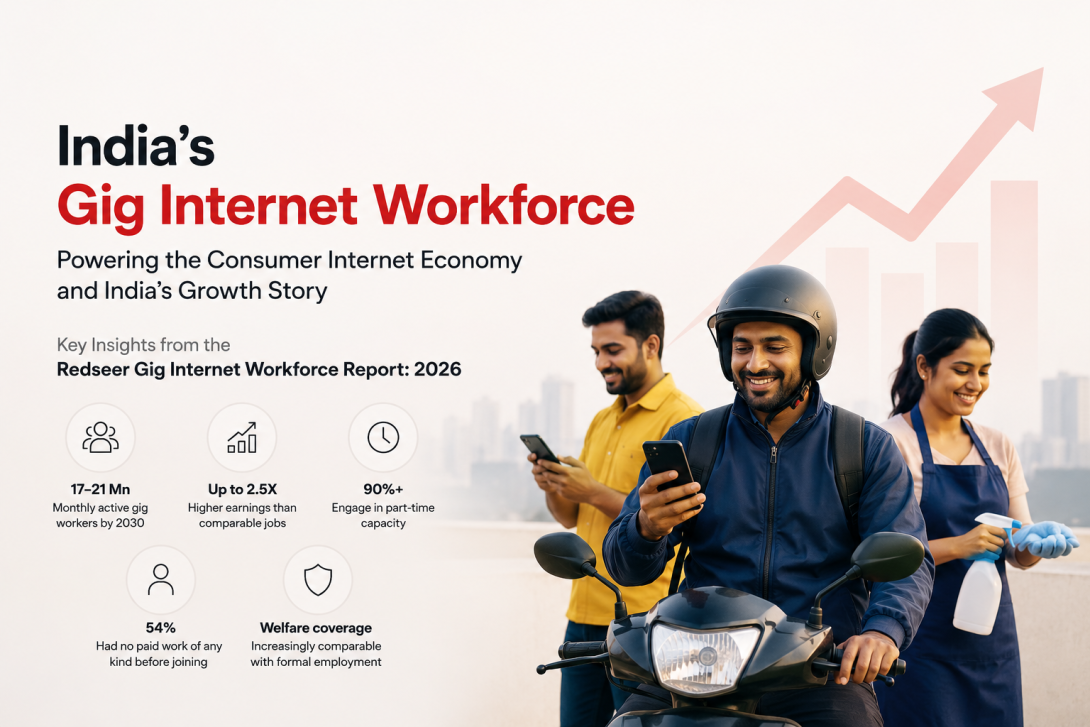
India's consumer internet economy has changed the way people order food, book a cab, get their homes repaired, and shop online. What gets talked about far less is the workforce standing behind all of that convenience. A new report from Redseer Strategy Consultants, the Redseer Gig Internet Workforce Report 2026, puts numbers to this shift, and the picture it paints is bigger and more nuanced than most people assume.
A Workforce Already Bigger Than Most Realise
According to the report, India's Gig Internet Workforce has crossed 6 million monthly active workers, and it is on track to grow to somewhere between 17 and 21 million by the end of the decade. That is close to a three fold jump in under five years, driven by the same forces that built India's consumer internet economy in the first place: rising smartphone penetration, cheap data, and platforms that keep expanding into tier 2 and tier 3 cities.
One data point from the report stands out in particular: gig internet growth could address roughly 70% of India's annual non-farm job gap. In a country where formal job creation has struggled to keep pace with the number of people entering the workforce every year, that is not a small claim. It positions gig work not as a side story to India's employment problem, but as one of the more meaningful answers to it.
Why Workers Are Choosing Gig Work
Most coverage of gig economy India tends to focus on scale alone. The report goes a level deeper and asks why people are actually choosing this kind of work, and the answer is flexibility. Over 90% of gig workers on platforms today engage part time, working fewer than 40 hours a week, and by their own account, more than 90% say flexibility is the main reason they picked gig work over a conventional job.
This is not a workforce accidentally ending up in gig roles because nothing else was available. It is, in large part, a workforce actively choosing a model that fits around other responsibilities, whether that is studying, caregiving, or holding down another source of income at the same time.
An Entry Point Into the Workforce
Perhaps the most striking figure in the report is this one: 54% of gig workers had no paid work of any kind before they joined a platform. That reframes what gig internet growth actually means for India. It is not simply pulling workers away from other jobs, it is bringing a large number of people into paid work for the first time, including many from cohorts that have historically struggled to access formal or even informal employment.
And the earnings, at least for full time gig workers, hold up well once people are in. The report finds that full time gig workers can earn up to 2.5 times what people in comparable informal and formal roles make. Combined with the low barrier to entry, this is what makes gig work function as a genuine livelihood engine rather than a stopgap that leaves workers worse off.
The Stopgap Nature of Gig Work Is a Feature, Not a Flaw
One of the more counterintuitive arguments in the report is that gig work is designed to be transient, and that this is exactly what makes it effective. The average worker stays active on a platform for only about 3 months a year. Rather than reading this as instability, the report frames it as evidence that gig internet is functioning as a flexible, supplemental income source that people dip in and out of as their circumstances change.
This has direct implications for how welfare and benefits should be designed. The report argues that policy built for full time, long tenure employment does not map cleanly onto a workforce where most participants are part time and short tenured by choice. Welfare coverage for gig workers is already becoming more comparable to formal employment, but the report's central point is that benefit design needs to be built around the part time, transient nature of the role from the outset, not retrofitted from a traditional employment model.
Where the Growth Is Coming From, and Who Is Missing
Looking ahead to India gig workforce 2030 projections, the report maps out which sectors and worker segments are expected to drive the next leg of growth as platforms deepen their presence across the country. It also flags a gap that the industry has not solved yet: women make up only about 1% of India's gig workforce overall, despite strong participation in categories like home services. Closing that gap is described in the report as one of the biggest untapped opportunities for platforms looking to scale their workforce sustainably.
Why This Matters Beyond the Numbers
Gig economy growth in India is often discussed purely in terms of headcount, how many delivery partners a platform has added, how many drivers are on the road. The Redseer report is useful precisely because it moves past headcount and asks the harder questions: who is actually taking up this work, why they are choosing it, what they earn relative to alternatives, and what kind of welfare framework would actually serve a workforce built around flexibility rather than permanence.
For platforms, policymakers, and investors trying to understand where India's labour market is headed, these are the questions worth sitting with. The full Redseer Gig Internet Workforce Report 2026 goes into each of these in detail, including the framework Redseer uses to separate workers using gig platforms as a launchpad from those relying on it as a primary income source, and a sector by sector view of where growth is likely to come from through CY30.
Related Reading From Redseer
Readers interested in the broader consumer internet economy that gig work sits inside of may also find these Redseer reports useful:
- State of India's Food Services Market, which covers a sector that leans heavily on gig delivery workers.
- Value Grocery Commerce: The Bharat Unlock, on how grocery commerce is expanding into new geographies, another key demand driver for gig roles.
- The Indian Consumer at 2030, for a wider view of how Indian consumer behaviour is expected to evolve this decade.
To read the complete findings, including detailed data on earnings, welfare coverage, and sector level growth projections, download the Redseer Gig Internet Workforce Report 2026 here.