

A Jeep JK steering upgrade can make an important difference when your Wrangler is running larger tires, navigating challenging trails, or operating with suspension modifications that place additional demands on the factory steering system. Whether you own a two-door Jeep Wrangler JK or a four-door Wrangler Unlimited JKU, the condition and compatibility of your tie rod, drag link, steering ends, and front suspension components directly affect how your Jeep handles on the road and off it.
The Jeep Wrangler JK is a popular platform for customization, but upgrading tires and suspension without evaluating the steering system can leave important components overlooked.
Larger tires may increase steering loads. Rock crawling can expose steering linkage to impacts. Suspension lifts can change the operating angles of the drag link and track bar. Together, these modifications make it important to select steering components designed for your vehicle's actual configuration.
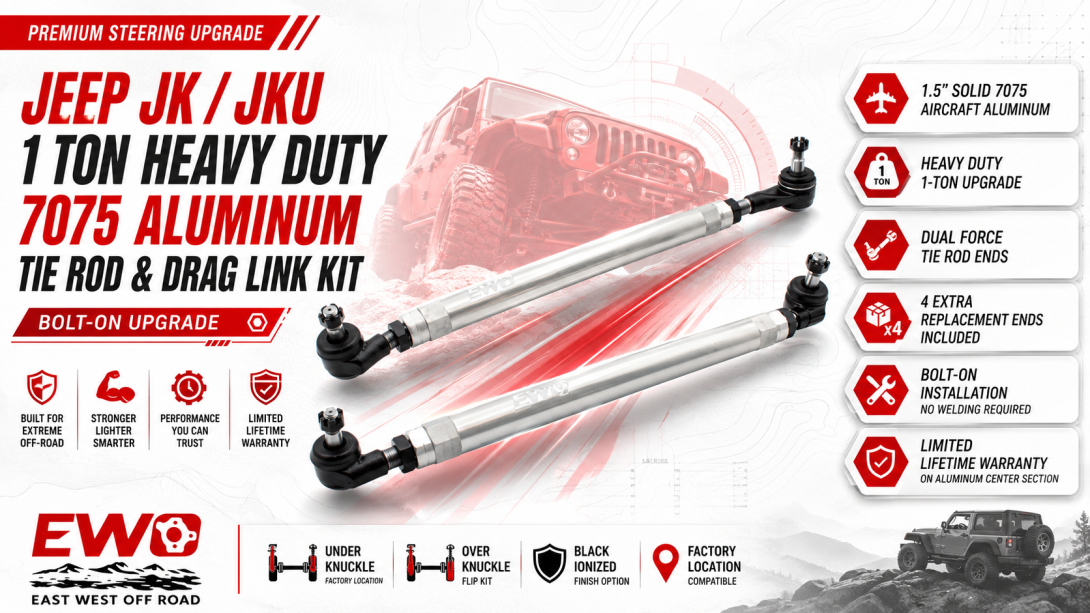
For 2007–2018 Jeep Wrangler JK and JKU owners, East West Off Road offers a 1-Ton Heavy Duty 7075 Aluminum Tie Rod and Drag Link Steering Kit featuring solid 1.5-inch aluminum steering bars, greaseable Dual Force steering ends, additional replacement parts, and multiple steering configurations.
This guide explains how to evaluate your current front end, decide which steering components to upgrade, compare factory and heavy-duty linkage, understand steering geometry, and select the right kit for your Wrangler build.
What Does a Jeep JK Steering Upgrade Actually Include?
A complete steering upgrade involves more than replacing a single metal bar underneath your Jeep.
The Wrangler JK uses a steering system in which several components work together to control the front wheels.
When one component develops excessive wear, damage, or incorrect geometry, the entire system can be affected.
Understanding these parts makes it easier to plan an effective upgrade.
Tie Rod: Connecting the Front Wheels
The tie rod connects the left and right front steering knuckles.
As steering input moves one knuckle, the tie rod helps coordinate movement between both front wheels.
The tie rod is also involved in maintaining front-wheel toe alignment.
Because of its location near the front axle, it can be exposed to trail obstacles.
For owners considering a Jeep JK tie rod upgrade, damage resistance, joint compatibility, and adjustment features are important buying considerations.
Drag Link: Transferring Steering Input
The drag link transfers steering input from the pitman arm at the steering box to the steering knuckle.
It is an important part of directional control and steering-wheel centering.
On lifted Jeeps, the drag link's location and operating angle also affect steering geometry.
A Jeep JK drag link upgrade must therefore account for the suspension and track bar configuration.
Tie Rod Ends and Drag Link Ends
Steering ends provide articulated connections between the linkage and mounting points.
These joints must accommodate steering movement while remaining securely mounted.
Worn or damaged ends can contribute to steering looseness and poor response.
Track Bar
The track bar controls the front axle's lateral position relative to the chassis.
Its relationship to the drag link is particularly important on lifted Wranglers.
A heavy-duty drag link should not be installed without considering the track bar's position and condition.
Steering Stabilizer
The steering stabilizer helps damp certain steering movements.
However, it does not replace the need for healthy steering joints, correct alignment, and properly matched steering geometry.
A larger or additional stabilizer should never be used to hide an unresolved mechanical issue.
Why Jeep JK Owners Upgrade Their Steering Systems
Many Wrangler owners begin modifying their vehicles with larger tires and suspension components.
Eventually, the steering system may also need attention.
Larger Tires Create Additional Steering Demands
Installing 35-inch or 37-inch tires can change the forces acting on the steering system.
Larger and heavier tire-and-wheel combinations may increase steering loads, particularly when maneuvering at low speeds or when a tire is pressed against a trail obstacle.
Wheel offset, tire pressure, traction, and vehicle weight also influence these demands.
A Jeep Wrangler heavy duty steering upgrade may be worth considering as part of a build intended for larger tires.
Off-Road Driving Exposes Steering Linkage to Impacts
Rock crawling places steering components near rocks, ledges, and uneven terrain.
The tie rod may experience direct impacts during difficult maneuvers.
An aftermarket heavy-duty steering system may provide a more substantial alternative to certain factory-style components.
However, no steering assembly is immune to severe impact damage.
Lift Kits Change Steering Geometry
A suspension lift changes the relationship between the frame and front axle.
As that relationship changes, the drag link and track bar can operate at different angles.
Incorrectly matched geometry may contribute to unwanted steering movement as the suspension compresses and extends.
This is why a Jeep JK steering upgrade for lifted Wranglers should account for the complete suspension setup.
Factory Steering Components Can Wear
Tie rod ends, drag link ends, and other steering joints can wear with age and use.
Damage to protective boots may allow moisture and debris to reach joint surfaces.
Replacing worn components is necessary for proper steering operation.
A complete aftermarket kit becomes worth evaluating when multiple components need attention or the vehicle is being prepared for more demanding use.
Seven Signs Your Jeep JK Steering Needs Inspection
Not every steering symptom means you need an expensive aftermarket kit.
However, several warning signs indicate that the front end should be inspected.
1. Excessive Steering-Wheel Play
If the steering wheel moves significantly before the front wheels respond, excessive looseness may be present.
Potential causes include worn steering ends, track bar connections, or steering-box components.
2. Wandering on the Highway
A Wrangler that requires constant steering corrections may have worn steering or suspension components, alignment problems, or tire-related issues.
The cause should be identified before parts are purchased.
3. Uneven Front-Tire Wear
Incorrect toe alignment can accelerate tire wear.
A bent or improperly adjusted tie rod may contribute to the problem.
4. Visible Tie Rod Damage
A tie rod that has been bent or otherwise damaged by trail obstacles should be inspected promptly.
Physical damage can affect steering linkage geometry and alignment.
5. Clunking During Steering
Clunking near the front axle may indicate excessive movement in steering or suspension connections.
A technician should inspect the relevant joints and mounting points.
6. Torn Joint Boots
Damaged boots can allow contamination into steering joints and contribute to premature wear.
7. Steering Changes After Installing a Lift
If your Wrangler develops new steering problems following suspension modifications, inspect the alignment and steering geometry.
The issue may involve drag link and track bar positioning rather than the strength of the tie rod alone.
Important: A qualified inspection should identify the cause of steering symptoms before determining which components require replacement.
What Should You Upgrade First on a Jeep Wrangler JK?
The best upgrade sequence depends on the Jeep's condition and intended use.
Some vehicles need only a replacement tie rod. Others require more extensive work.
Existing Problem or Modification
Component to Evaluate
Reason
Bent factory tie rod
Heavy-duty tie rod
Replace damaged linkage
Excessive play in drag link ends
Drag link and joints
Address worn steering connections
Both steering links worn
Complete tie rod and drag link kit
Replace both primary steering links
Loose front track bar
Track bar joints and mounts
Restore secure axle positioning
Steering problems after a lift
Drag link and track bar geometry
Identify unwanted steering movement
Larger tires and frequent trail use
Heavy-duty steering linkage
Evaluate components for increased demands
Unexplained vibration or wobble
Full front-end inspection
Diagnose the underlying problem
When Is a Tie Rod-Only Upgrade Enough?
A tie rod-only replacement may be appropriate when the drag link and other steering components remain in good condition.
The replacement must still be compatible with the vehicle's steering knuckles, wheels, and existing hardware.
When Should You Upgrade the Tie Rod and Drag Link Together?
A complete steering kit becomes worth considering when both components are worn, damaged, or being upgraded for a modified Jeep.
Using a matched system allows you to evaluate the primary steering links together.
If you're planning a Jeep JK tie rod upgrade, the East West Off Road 1-ton kit provides a combined tie rod and drag link option rather than requiring separate purchases of the main linkage.
East West Off Road 1-Ton Jeep JK / JKU Steering Kit
The East West Off Road E30112 is a heavy-duty aftermarket steering package advertised for 2007–2018 Jeep Wrangler JK and JKU applications.
It combines 7075 aluminum steering bars with greaseable Dual Force steering ends and factory-location or flip steering options.
EWO E30112 Product Specifications
Feature
Product Details
Product Name
1-Ton Heavy Duty 7075 Aluminum Tie Rod & Drag Link Steering Kit
Item Number
E30112
Brand
East West Off Road
Vehicle Application
2007–2018 Wrangler JK / JKU
Steering Link Material
7075 aluminum
Center Sections
1.5-inch solid aluminum
Primary Components
Tie rod and drag link
Steering Ends
Greaseable Dual Force 1-ton ends
Included Steering Ends
Four primary ends plus four extra replacements
Adjustment Features
Right- and left-hand threaded ends with hex-style adjustment
Finish Options
Aluminum and black anodized
Steering Options
Factory Location / Under the Knuckle and Flip Kit / Over the Knuckle
Steering-End Warranty
Advertised two-year unlimited warranty
Aluminum Center Section Warranty
Advertised limited lifetime warranty
The current product listing also offers selectable options related to pitman-arm reaming and an additional tie rod clamp.
Buyers should verify the included hardware for their selected configuration.
Warranty coverage is subject to the manufacturer's written terms, limitations, and exclusions.
Four Available Finish and Steering Combinations
The EWO 1-ton steering kit is offered in four combinations:
- Aluminum Finish — Under the Knuckle / Factory Location
- Aluminum Finish — Over the Knuckle / Flip Kit
- Black Anodized — Under the Knuckle / Factory Location
- Black Anodized — Over the Knuckle / Flip Kit
The finish affects the appearance of the steering components.
The steering configuration affects their mounting arrangement and compatibility with the vehicle's suspension.
Selecting the correct configuration is more important than choosing a finish based on appearance alone.
Why Choose a 7075 Aluminum Steering Kit?
One of the most important features of the EWO E30112 is its solid 7075 aluminum construction.
High-strength aluminum steering systems have become popular in the off-road aftermarket because their material properties can be useful in properly engineered steering components.
What Is 7075 Aluminum?
7075 is a high-strength aluminum alloy used in demanding engineering applications.
It is frequently described as aircraft-grade aluminum because of its use in aerospace-related components.
However, the aircraft-grade description alone does not establish a particular product's strength or quality.
The alloy condition, dimensions, design, and manufacturing process all matter.
What Makes a Solid 1.5-Inch Bar Different?
The EWO kit uses solid 1.5-inch aluminum center sections.
A solid bar has a different cross-sectional structure from a hollow steel tube.
Bar strength and stiffness depend on the material properties and the way material is distributed throughout the component.
A larger outside diameter can be useful, but it does not automatically make one steering system stronger than every competing design.
Can 7075 Aluminum Return to Shape After an Impact?
Some properly designed aluminum steering bars can elastically deflect under load.
Elastic deformation means a component temporarily changes shape and returns toward its original shape after the load is removed.
However, every material has a limit.
A sufficiently severe impact can permanently deform or damage the steering bar.
A 7075 aluminum tie rod should not be described as indestructible.
7075 Aluminum vs. Steel Steering Bars
Factor
7075 Aluminum
Conventional Steel
Material density
Lower
Higher
Typical construction
Solid aftermarket bars
Solid or tubular components
Strength
Depends on alloy temper and geometry
Depends on steel grade and geometry
Elastic deformation
Possible within design limits
Possible within design limits
Permanent damage
Possible under excessive loads
Possible under excessive loads
Corrosion behavior
Does not form red rust like carbon steel
May require protective finishes
Best buying consideration
Overall design and compatibility
Overall design and compatibility
For Wrangler owners shopping for a Jeep JK aluminum steering kit, the complete assembly's design and fitment matter more than material comparisons alone.
Dual Force Steering Ends: More Than Just a Stronger Bar
A steering upgrade should be evaluated as a complete system.
The steering ends connect the bars to the vehicle and allow the movement required during steering and suspension travel.
These components experience repeated loading and require regular inspection.
Heavy-Duty 4130 and 4340 Steel Components
According to EWO's product specifications, its Dual Force steering ends use:
- 4130 steel joint bodies.
- 4340 hardened-steel ball pins.
- Greaseable joint construction.
EWO compares this design with traditional steering ends using 1540 steel bodies and 4130 steel ball pins.
The company advertises approximately 40% greater stress-load capability and twice the service life compared with its referenced conventional design.
These are manufacturer-provided performance claims rather than independently verified comparative test results.
Actual service life depends on installation, driving conditions, maintenance, and the loads experienced by the joints.
Why Greaseable Tie Rod Ends Matter
Greaseable steering ends provide a means of maintaining the joints with appropriate lubrication.
Owners should follow the manufacturer's service recommendations and inspect joint boots regularly.
Four Additional Replacement Ends
The EWO kit is advertised with four extra replacement steering ends in addition to the primary ends used in the assembly.
This can be useful for owners who regularly maintain their Jeeps or travel to remote off-road areas.
Having compatible service parts available can make future maintenance planning easier.
Right- and Left-Hand Threaded Adjustment
The EWO steering kit includes right- and left-hand threaded ends with hex-style adjustment features.
This design can simplify appropriate linkage adjustments during installation and alignment.
However, every adjustment must follow the product's installation instructions.
Factory-Location vs. Flip Steering for Lifted Jeep JK Builds
A major part of planning a Jeep JK steering upgrade is determining the correct drag link location.
EWO offers factory-location and over-the-knuckle configurations.
The appropriate choice depends on the suspension lift and overall steering geometry.
Factory Location / Under the Knuckle
The factory-location option retains the lower drag link mounting position.
EWO's published product guidance recommends this setup for vehicles with less than 3 inches of suspension lift.
For stock-height or moderately lifted Wranglers, this is generally the configuration to consider first.
However, wheel clearance and axle compatibility must still be verified.
Flip Kit / Over the Knuckle
The flip option relocates the drag link connection to a higher mounting position on a compatible steering knuckle.
EWO's product guidance recommends the flip configuration for vehicles with more than 3 inches of lift.
A properly planned flip can be part of obtaining suitable steering geometry on a lifted Jeep.
However, it may require additional components or modifications.
What If Your Wrangler Has Exactly 3 Inches of Lift?
The supplied EWO recommendations distinguish between lifts below and above 3 inches.
If your vehicle sits at exactly 3 inches of lift, confirm the correct configuration directly with EWO.
Actual ride height and suspension geometry are more useful than relying solely on the lift kit's advertised height.
Steering Configuration Comparison
Suspension Setup
EWO Option to Evaluate
Additional Checks
Stock-height JK
Factory Location
Axle and wheel clearance
Less than 3-inch lift
Factory Location
Steering angles and articulation
More than 3-inch lift
Over the Knuckle / Flip Kit
Track bar geometry and hardware
Exactly 3-inch lift
Confirm with EWO
Actual ride height and configuration
Custom suspension
Manufacturer consultation
Full steering geometry
Aftermarket front axle
Manufacturer consultation
Knuckles, tapers, and mounting points
Why the Track Bar and Drag Link Must Work Together
The track bar controls lateral movement of the front axle.
The drag link transfers steering input.
Both components move as the suspension compresses and extends.
If their geometry is poorly matched, suspension movement may create unwanted steering input.
This condition is commonly known as bump steer.
A flipped drag link may require a compatible raised track bar mounting arrangement.
The correct setup depends on the vehicle, so do not assume every high-steer conversion uses identical parts.
Jeep JK Wheel Fitment: Requirements You Must Check Before Buying
Heavy-duty steering ends may occupy more space than factory steering joints.
The EWO E30112 includes specific wheel and installation requirements that should be reviewed before purchasing.
17-Inch Wheel Requirement
The EWO product specifications require 17-inch wheels.
Smaller wheels may not provide sufficient clearance for the upgraded steering ends.
Maximum 4.75-Inch Backspacing
The kit specifies wheel backspacing of 4.75 inches or less.
Backspacing affects the position of the wheel relative to steering and suspension components.
Checking this measurement before ordering can help avoid unexpected fitment problems.
Factory Rubicon and AEV Wheels
EWO's supplied fitment guidance states that factory Rubicon and AEV wheels require 1.5-inch wheel spacers for this steering setup.
Wheel spacers must be compatible with the vehicle and installed according to the applicable requirements.
Confirm the complete wheel, hub, and spacer arrangement before purchasing.
Steering Stabilizer Must Remain in the Factory Location
EWO specifies that the steering stabilizer must remain in the factory location.
Owners using a relocated stabilizer or aftermarket mounting arrangement should verify compatibility before installation.
EWO E30112 Fitment Checklist
Fitment Item
Product Requirement
Jeep Model
Wrangler JK / JKU
Model Years
2007–2018
Wheel Diameter
17 inches
Maximum Backspacing
4.75 inches
Factory Rubicon Wheels
1.5-inch wheel spacers required
AEV Wheels
1.5-inch wheel spacers required
Steering Stabilizer
Factory location
Lift Under 3 Inches
Factory-location steering
Lift Over 3 Inches
Flip steering
Exact 3-Inch Lift
Confirm configuration with EWO
The wheel-clearance requirements are especially important when comparing larger aftermarket steering ends.
Dana 30 vs. Dana 44: Will the Kit Fit Your Front Axle?
Many Wrangler JK owners have either a Dana 30 or Dana 44 front axle, depending on the vehicle's configuration.
Others install upgraded axle housings, aftermarket steering knuckles, or axle swaps.
The front axle affects where and how the steering linkage connects.
Dana 30 Front Axle
For a JK equipped with a Dana 30, confirm the steering-knuckle design and the taper required by the replacement steering ends.
The axle designation alone does not guarantee compatibility.
Dana 44 Front Axle
A Dana 44-equipped Jeep requires the same attention to mounting points, joint fitment, and available clearance.
Factory and aftermarket knuckle configurations may differ.
Aftermarket Axles and High-Steer Knuckles
Custom axles, upgraded steering knuckles, and previous steering modifications may create additional requirements.
Before ordering, confirm the exact mounting arrangement with EWO.
Avoid assuming that every aftermarket axle will accept a steering kit advertised for the Wrangler JK platform.
Is the EWO Jeep JK Steering Kit Really Bolt-On?
The EWO E30112 is marketed as a bolt-on steering upgrade for compatible Jeep JK and JKU applications.
The product is intended to upgrade the primary steering linkage without requiring welded fabrication.
However, the installation requirements may vary by configuration.
Why Bolt-On Does Not Always Mean No Modifications
Some steering setups retain factory-style mounting locations.
Others involve a drag link flip or mounting arrangements that require additional preparation.
The EWO listing includes an optional pitman-arm reamer selection, while its product information also notes that some installations may require drilling or reaming.
Therefore, buyers should verify their exact installation requirements instead of assuming every configuration is a no-drill replacement.
Does the Drag Link Flip Require Extra Parts?
Depending on the vehicle's suspension and steering geometry, additional brackets or other components may be necessary.
The drag link and track bar relationship must be evaluated together.
Can You Install the Kit Yourself?
An experienced mechanic with the appropriate tools may be familiar with steering-linkage replacement.
However, installing or modifying steering components affects vehicle control.
Professional installation is recommended when the configuration involves unfamiliar joint mounts, drilling, reaming, or geometry changes.
How to Plan a Jeep JK Steering Upgrade Step by Step
A successful steering upgrade starts with a clear understanding of your Wrangler's existing components.
Step 1: Identify Your Wrangler Generation
Confirm whether your vehicle is a Jeep Wrangler JK or four-door JKU.
The 2018 model year includes both JK-generation and newer JL-generation Wranglers.
Do not assume a JK steering kit fits a JL.
Step 2: Identify the Front Axle
Determine whether your Jeep uses its original axle or an aftermarket replacement.
Record any modified steering-knuckle details.
Step 3: Measure the Actual Suspension Lift
Check the Jeep's current ride height and suspension configuration.
Choose the steering option based on the manufacturer's recommendations and the actual geometry.
Step 4: Inspect the Existing Steering and Suspension
Look for worn steering ends, damaged bars, loose track bar connections, and other front-end problems.
Repair unrelated defects before expecting a new steering kit to improve handling.
Step 5: Check Wheels and Tires
Confirm wheel diameter, backspacing, tire dimensions, and spacer requirements.
Step 6: Select the Correct Steering Configuration
Choose factory-location or over-the-knuckle steering based on the Jeep's setup.
For the EWO kit, confirm any uncertainty around the exact 3-inch lift threshold.
Step 7: Verify Included Hardware and Installation Requirements
Review steering ends, mounting hardware, reaming requirements, and stabilizer compatibility.
Step 8: Install and Check Component Clearance
Installation should follow EWO's instructions.
The steering linkage must clear nearby components throughout the intended range of steering and suspension movement.
Step 9: Perform a Professional Alignment
Replacing the tie rod and drag link affects important steering adjustments.
The tie rod influences front-wheel toe.
The drag link affects steering-wheel centering.
A professional alignment and front-end inspection should be performed before normal driving.
Step 10: Reinspect After Driving
Follow the manufacturer's recommendations for post-installation checks.
Inspect steering ends, mounting hardware, and joint boots following demanding trail use.
Jeep JK Steering Upgrade for Daily Driving, Overlanding, and Rock Crawling
Different Wrangler builds place different priorities on the steering system.
Daily-Driven Wrangler JK
For a daily driver, predictable steering, correct alignment, and reliable joints are essential.
A heavy-duty kit may be appropriate when factory components are worn or the vehicle has substantial modifications.
However, larger steering bars alone do not guarantee better highway handling.
Jeep JKU Overlanding Builds
A four-door JKU used for overlanding may carry additional equipment and travel long distances between destinations.
For these vehicles, serviceability and proper fitment are important.
The EWO kit's additional replacement steering ends may be useful for future maintenance.
If your four-door Wrangler needs a complete steering-linkage replacement, a Jeep JKU drag link kit that includes both primary steering links may be worth considering.
Rock-Crawling Jeep JK
Rock crawling can expose steering components to direct impacts and high resistance at the tires.
For this type of use, a substantial aftermarket steering system can be part of preparing the vehicle for demanding terrain.
The axle, ball joints, track bar, steering box, and suspension components must also be appropriate for the build.
Can a Jeep JK Steering Upgrade Fix Death Wobble?
Death wobble is a severe front-end oscillation that may occur when certain steering, suspension, alignment, or tire-related conditions are present.
Replacing worn steering linkage can help when those components contribute to the problem.
However, a heavy-duty steering kit is not a guaranteed cure.
Common Components to Inspect
A complete diagnosis may involve:
- Front track bar joints and mounting points.
- Tie rod ends.
- Drag link ends.
- Ball joints.
- Wheel bearings.
- Steering box and mounting hardware.
- Suspension bushings.
- Wheel and tire condition.
- Front-end alignment and steering geometry.
If your Wrangler experiences violent shaking, have the entire front end professionally inspected before returning to normal driving.
Does a Bigger Steering Stabilizer Solve the Problem?
A steering stabilizer may damp certain steering movements.
It does not correct loose joints, damaged mounting hardware, or incorrect geometry.
Address the underlying mechanical cause before considering additional damping components.
How Much Does a Jeep JK Steering Upgrade Cost?
A complete steering upgrade can cost more than a basic factory-style replacement because it may include both primary steering links, heavy-duty ends, upgraded materials, and additional hardware.
The total cost depends on the selected kit and the work required.
What Influences the Total Cost?
Important factors include:
- Tie rod and drag link construction.
- Steering-end design and specifications.
- Material and finish choices.
- Included replacement parts.
- Factory-location or flip configuration.
- Any required drilling or reaming.
- Additional mounting brackets.
- Wheel spacers.
- Professional installation.
- Wheel alignment.
Compare the Entire Package
A cheaper steering kit may include fewer components or require additional purchases.
A more comprehensive package may include service parts that are useful for long-term ownership.
However, the initial price alone does not establish which system is the better choice.
Check the current EWO product page for the latest price and available configuration options.
Is a Heavy-Duty Steering Kit Worth the Investment?
It may be worthwhile when the existing linkage is damaged or the Jeep is being prepared for more demanding use.
For a stock vehicle with a single worn joint, a compatible individual repair may be sufficient.
The best decision is based on the Jeep's mechanical condition, modification level, and intended driving environment.
Common Jeep JK Steering Upgrade Mistakes to Avoid
A well-designed steering kit can still perform poorly if the installation or fitment is incorrect.
Buying by Tonnage Alone
The term "1-ton" is a common aftermarket steering designation.
It is not a standardized strength rating for the complete assembly.
Compare the actual components and their application.
Ignoring Wheel Backspacing
Larger steering ends may require additional wheel clearance.
Check wheel diameter and backspacing before ordering.
Choosing a Flip Kit Just Because the Jeep Is Lifted
A drag link flip changes steering geometry.
It should be selected because it is appropriate for the suspension configuration, not simply because the vehicle has aftermarket tires or looks more aggressive.
Overlooking Track Bar Geometry
Drag link and track bar movement must be considered together.
An incorrectly planned steering relocation can create handling problems.
Assuming Bolt-On Means Every Installation Is Identical
Some configurations may need additional hardware or mounting modifications.
Read the product instructions for the exact setup.
Skipping the Alignment
Correct toe adjustment and steering-wheel centering are important after replacing major steering components.
Ignoring Other Worn Components
A new tie rod and drag link cannot compensate for damaged ball joints, loose track bar mounts, or other unresolved front-end problems.
Why Consider East West Off Road for Your Jeep JK Steering Upgrade?
The EWO E30112 offers a complete tie rod and drag link package for the advertised 2007–2018 Wrangler JK/JKU application.
Its product features include solid 1.5-inch 7075 aluminum center sections, greaseable Dual Force steering ends, additional replacement ends, and multiple steering configurations.
These details make it worth considering for owners looking beyond a basic factory-style steering replacement.
Key Advantages to Evaluate
- Complete tie rod and drag link package.
- Solid 7075 aluminum steering bars.
- Heavy-duty greaseable steering ends.
- Four additional replacement steering ends.
- Right- and left-hand threaded adjustment features.
- Factory-location and flip configurations.
- Aluminum and black anodized finishes.
- Manufacturer-advertised warranty coverage.
Before ordering, verify that the kit's wheel, axle, lift, and stabilizer requirements match your Jeep.
Where to Buy a Jeep JK Steering Upgrade Kit
If you're planning to replace the factory steering linkage on your 2007–2018 Wrangler, East West Off Road offers the E30112 as a 1-ton 7075 aluminum steering upgrade option.
The product is designed to address both the tie rod and drag link, with selectable configurations for different lift setups.
Before purchasing, identify your front axle, measure the suspension lift, review your wheel specifications, and confirm the correct mounting arrangement.
You can review the available finish, steering-position, and accessory choices for the 1 ton steering kit JK directly through East West Off Road.
For a dependable result, combine the correct components with appropriate installation, professional alignment, and regular front-end inspections.
Frequently Asked Questions (FAQs)
1. What is the best Jeep JK steering upgrade?
The best upgrade depends on your Wrangler's mechanical condition, suspension lift, tires, front axle, and intended use. A properly matched heavy-duty tie rod and drag link kit may be useful for modified Jeeps, while a stock-style repair may be sufficient for less extensively modified vehicles.
2. Why should I upgrade my Jeep JK steering system?
An upgrade may be appropriate when factory steering components are damaged, worn, or no longer suitable for the vehicle's modifications and intended driving conditions.
3. Does the EWO steering kit fit a 2007–2018 Jeep Wrangler JK?
East West Off Road advertises E30112 for 2007–2018 Jeep Wrangler JK and JKU applications. Exact compatibility depends on the axle, steering knuckles, wheels, and suspension.
4. Does the kit fit the four-door Jeep Wrangler Unlimited JKU?
Yes, the product is marketed for the JK and JKU platforms. Four-door owners should verify the same steering and wheel-clearance requirements.
5. What does a 1-ton Jeep steering kit include?
The EWO E30112 includes the main tie rod and drag link assemblies with four primary Dual Force steering ends and four additional replacement ends, according to the manufacturer's product information.
6. Is the EWO kit made from solid 7075 aluminum?
Yes. The supplied product specifications identify 1.5-inch solid 7075 aluminum center sections.
7. Is 7075 aluminum stronger than steel?
The answer depends on which alloys, tempers, dimensions, and component designs are being compared. A properly engineered 7075 aluminum steering bar may be suitable for heavy-duty use, but material alone does not establish overall strength.
8. Can an aluminum steering bar bend and return to shape?
Aluminum can undergo limited elastic deformation within its design limits. Excessive loading can still cause permanent deformation or failure.
9. Does the EWO kit include greaseable tie rod ends?
Yes. The product is advertised with greaseable Dual Force 1-ton steering ends.
10. What are Dual Force steering ends?
Dual Force is EWO's advertised heavy-duty steering-end design, using 4130 steel bodies and 4340 hardened-steel ball pins according to the supplied specifications.
11. How many spare steering ends come with the kit?
EWO advertises four additional replacement ends beyond the four primary steering ends used in the assembly.
12. Does the kit come in a black finish?
Yes. The product offers aluminum and black anodized finish options.
13. What is the difference between factory-location and flip steering?
Factory-location steering keeps the lower drag link mounting arrangement. A flip configuration relocates the drag link connection to a higher position on a compatible steering knuckle.
14. Which configuration should I choose for a 2-inch lift?
EWO's supplied guidance recommends the factory-location configuration for lifts under 3 inches. Confirm compatibility with the rest of the steering and suspension system.
15. Which configuration should I choose for a 4-inch lift?
EWO recommends the flip configuration for lifts over 3 inches. Verify track bar geometry and any additional installation requirements.
16. What if my Jeep has exactly 3 inches of lift?
The manufacturer's supplied guidance distinguishes between under and over 3 inches. Confirm the correct option directly with EWO for an exact 3-inch lift.
17. Does the EWO steering kit require 17-inch wheels?
Yes. The supplied product specifications require 17-inch wheels with 4.75 inches of backspacing or less.
18. Do factory Rubicon wheels need wheel spacers?
According to EWO's supplied fitment notes, factory Rubicon and AEV wheels require 1.5-inch wheel spacers for this steering setup.
19. Can I use an aftermarket steering stabilizer location?
EWO specifies that the stabilizer must remain in the factory location. Confirm compatibility before ordering if your Jeep uses a relocation setup.
20. Is the EWO steering kit completely bolt-on?
It is marketed as a bolt-on upgrade without welding, but certain configurations may require drilling, reaming, or additional modifications. Verify the requirements for the exact setup.
21. Will this steering kit fit a Dana 30 or Dana 44 front axle?
Compatibility depends on the axle's steering knuckles and mounting points. Confirm exact fitment rather than assuming that every Dana 30 or Dana 44 arrangement is identical.
22. Is a heavy-duty steering upgrade necessary for 35-inch tires?
Not automatically. Larger tires may increase steering demands, but the decision depends on the vehicle's condition, wheel offset, axle, suspension, and intended use.
23. What about 37-inch tires and rock crawling?
A substantial steering system may be worth evaluating for a heavily modified Jeep, but the rest of the front end must also be appropriate for the increased demands.
24. Will a Jeep JK steering upgrade fix death wobble?
Not necessarily. Severe front-end oscillation may involve the track bar, ball joints, steering joints, tires, alignment, or other components. A complete diagnosis is necessary.
25. Do I need an alignment after installing the kit?
Yes. Toe, steering-wheel centering, and the overall front-end setup should be inspected after replacing major steering components. Professional alignment is recommended.
26. What warranty does the EWO steering kit include?
EWO advertises a two-year unlimited warranty on the tie rod ends and limited lifetime coverage on the aluminum center sections. Review the current written warranty terms and exclusions before purchasing.
27. Is this steering upgrade suitable for daily driving?
A properly matched and installed heavy-duty steering system may be suitable for a daily-driven JK or JKU. Correct alignment, secure hardware, steering geometry, and clearance are essential.
28. How much does a Jeep JK steering upgrade cost?
The total cost depends on the selected kit, finish, configuration, additional hardware, wheel requirements, professional labor, and alignment. Check EWO's current product listing for the latest price.
29. Should I replace both the tie rod and drag link?
A complete replacement may make sense when both components are worn or the vehicle is undergoing a major steering upgrade. If only one component needs repair, a compatible individual replacement may be sufficient.
30. Where can I buy a heavy-duty Jeep JK steering upgrade kit?
East West Off Road offers the E30112 1-ton 7075 aluminum tie rod and drag link steering kit for advertised 2007–2018 Jeep JK/JKU applications. Confirm the appropriate configuration before ordering.
Final Thoughts: Plan Your Jeep JK Steering Upgrade the Right Way
A Jeep JK steering upgrade should be based on more than the appearance or advertised size of the replacement components.
For a successful result, inspect the complete front end, identify worn or damaged parts, verify axle and wheel compatibility, and choose a steering configuration suited to the vehicle's suspension.
The East West Off Road E30112 1-Ton Heavy Duty 7075 Aluminum Tie Rod and Drag Link Steering Kit offers a complete steering-linkage option with solid aluminum bars, greaseable Dual Force ends, extra replacement components, and factory-location or flip configurations.
For modified Wrangler JK and JKU builds, these features make it worth evaluating as part of a well-planned steering upgrade.
The right components, correct steering geometry, professional alignment, and regular inspections are essential to preparing your Jeep for dependable on-road driving and demanding off-road adventures.