

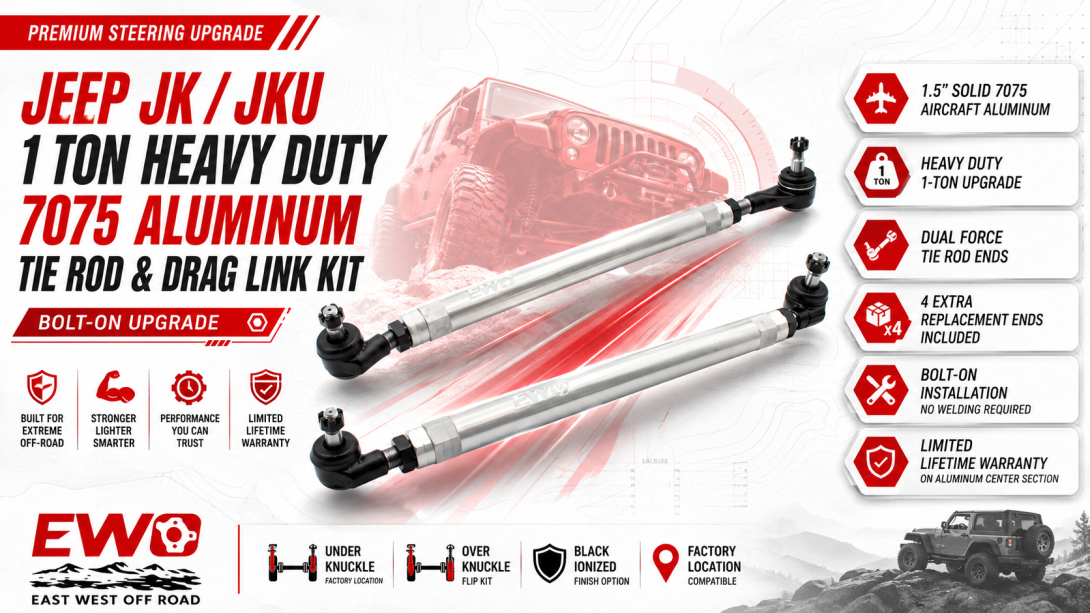
A Jeep JKU drag link kit is an important upgrade for Wrangler owners who use their Jeeps with larger tires, suspension lifts, and demanding off-road equipment. The drag link transfers steering input from the steering box to the front axle steering linkage, making it one of the key components responsible for steering response. When a JKU is modified for serious trail use, replacing the factory linkage with a properly engineered heavy-duty system can provide a stronger and more capable steering foundation.
The right Jeep JKU steering kit should not be selected by size alone. Tire diameter, lift height, wheel backspacing, axle configuration, steering geometry, steering stabilizer location, and intended driving conditions all influence which setup makes sense.
What Does a Jeep JKU Drag Link Do?
The drag link connects the steering system to the front steering linkage. When the driver turns the steering wheel, the steering box operates the pitman arm, which transfers movement through the drag link and ultimately changes the direction of the front wheels.
Because the drag link is directly involved in steering movement, its condition is important for both street driving and off-road use.
A factory drag link may be perfectly adequate for a stock Jeep. However, modifications such as larger tires, increased suspension travel, aftermarket wheels, and aggressive trail driving can change the loads and operating conditions experienced by the steering system.
That is why a Jeep JKU drag link upgrade can be a logical modification for a heavily built Wrangler.
Why Upgrade the Factory JKU Drag Link?
The reason to upgrade depends heavily on how the Jeep is being used.
A modified Wrangler can experience additional steering-system stress from:
- Larger and heavier tires
- Increased suspension lift
- Rock crawling
- Trail obstacles
- Hard steering impacts
- Increased tire leverage
- Aftermarket axle modifications
- Aggressive off-road driving
A heavy-duty drag link is intended to provide a more robust steering component for demanding applications.
However, installing a stronger component does not eliminate the need to inspect the rest of the steering system. Tie rod ends, ball joints, steering-box mounting, track bar, pitman arm, wheel bearings, and other front-end components should also be in good condition.
Jeep JKU Drag Link Kit vs. Single Drag Link Replacement
There is a difference between replacing a damaged drag link and upgrading the complete steering system.
If the Jeep is mostly stock and the factory components are simply worn, replacing the affected component may be sufficient.
For a heavily modified JKU, however, a complete Jeep Wrangler heavy duty steering setup may offer a more consistent approach.
The drag link and tie rod work together within the steering system. If one component has been upgraded while another remains significantly weaker or worn, the overall system is still limited by the condition and design of the remaining components.
This is one reason complete tie rod and drag link kits have become popular among modified Jeep owners.
What Is a 1 Ton Steering Kit JK?
A 1 ton steering kit JK generally refers to aftermarket heavy-duty steering components designed around larger steering ends and robust linkage construction.
The “1 ton” terminology describes the aftermarket steering component class. It does not mean that the Jeep has been converted to a one-ton vehicle or that its GVWR has changed.
For owners building a Jeep for larger tires and serious off-road use, a 1 ton steering kit JK can be an attractive option because it upgrades the steering links and associated heavy-duty hardware as a system.
7075 Aluminum Drag Link: What Makes It Different?
Material selection is another important consideration when comparing aftermarket steering systems.
7075 aluminum is a high-strength aluminum alloy known for its strength-to-weight characteristics. When used in an appropriately engineered steering component, it can provide a useful combination of strength and reduced material weight compared with a similarly sized steel component.
For a Jeep, reducing unnecessary component weight can be beneficial, but the material should never be considered independently of the complete design.
The bar diameter, construction, threaded ends, rod ends, mounting hardware, and geometry all contribute to the performance of the finished steering system.
The EWO 7075 aluminum tie rod and drag link steering kit is designed around a heavy-duty aluminum steering configuration for JK and JKU applications.
Jeep JK Drag Link Upgrade for Lifted Wranglers
Lifted Jeeps require additional attention because changing suspension height can affect steering geometry.
When suspension components move through their travel, the drag link and track bar follow different arcs. If their geometry becomes significantly mismatched, the Jeep can experience unwanted steering movement as the suspension cycles.
This is commonly discussed as bump steer.
A Jeep JK drag link upgrade should therefore be evaluated alongside the track bar and overall suspension configuration.
A stronger drag link alone does not automatically correct geometry problems.
For a lifted Jeep, inspect:
- Drag-link angle
- Track-bar angle
- Relative mounting points
- Suspension lift height
- Axle position
- Steering travel
- Tire clearance
- Steering-stop clearance
- Steering stabilizer location
The objective is to create a steering configuration that works correctly through the suspension's usable range.
Does a JKU Need a Drag Link Flip?
A drag link flip is one possible geometry modification for certain lifted Jeep configurations.
A Jeep JK flip kit can reposition the drag link higher on the steering knuckle. This may help improve the drag-link angle on some lifted Jeeps, but it is not automatically required for every JKU.
Before choosing a flip configuration, consider the Jeep's:
- Lift height
- Front axle
- Steering knuckle
- Track-bar configuration
- Wheel backspacing
- Tire size
- Steering stabilizer
- Suspension travel
A drag-link flip should be treated as part of the entire steering-geometry package rather than as an automatic upgrade.
Jeep Wrangler JKU Steering Kit: What Should You Look For?
When shopping for a Jeep Wrangler JKU steering kit, focus on the complete system rather than marketing terminology.
Heavy-Duty Linkage
The steering links should be appropriate for the intended tire size and off-road application.
Quality Tie Rod Ends
The rod ends connect the steering links to the vehicle. Their size, design, mounting configuration, and compatibility matter.
Appropriate Material
7075 aluminum can offer an appealing strength-to-weight combination when properly engineered.
Correct Fitment
The kit should be designed for the specific JK/JKU configuration and compatible with other modifications.
Adequate Clearance
The steering system must clear wheels, tires, axle components, differential covers, track bars, sway bars, and other hardware.
Serviceable Hardware
Jam nuts and other adjustment hardware should remain accessible for future maintenance and steering-system adjustments.
Heavy Duty Drag Link Jeep Applications
A heavy duty drag link Jeep setup is particularly relevant for owners who frequently leave the pavement.
Rock crawling can place unusual loads on steering components because the tires may be wedged against obstacles while the driver is attempting to change direction.
Larger tires can also increase leverage at the steering system.
For these applications, a heavy-duty steering system can provide additional strength compared with stock-style components.
Still, no steering upgrade should be considered a replacement for proper driving technique, suspension setup, maintenance, or inspection.
Jeep JKU Steering Stabilizer Kit Considerations
The steering stabilizer is often discussed alongside a drag link upgrade.
A stabilizer can damp certain steering movements and impacts, but it should not be used to compensate for loose or worn steering components.
If a Jeep has steering shake, excessive play, wandering, or unusual tire movement, diagnose the underlying issue before relying on a stabilizer.
After installing new Jeep Wrangler steering parts, verify that the stabilizer does not interfere with the new drag link or other components.
Depending on the steering configuration, the factory stabilizer mounting arrangement may need to be evaluated.
Bolt-On Steering Kit JK: Is It Easy to Install?
A bolt-on steering kit JK can reduce the amount of fabrication required compared with a completely custom steering conversion.
However, bolt-on does not mean that installation should be treated as a simple parts swap.
Before installation, compare the new and original components and inspect the condition of the existing mounting points.
During installation, pay particular attention to:
- Correct component placement
- Thread engagement
- Jam-nut installation
- Tie rod and drag link movement
- Steering-stop position
- Tire and wheel clearance
- Track-bar clearance
- Steering stabilizer clearance
- Suspension articulation
- Fastener torque according to the manufacturer's instructions
Once installed, turn the steering from lock to lock and cycle the suspension through its usable range. Look for contact between the linkage and tires, wheels, axle housing, differential, track bar, sway bar, or other components.
How Tire Size Changes Steering Requirements
Tire size is one of the most important variables when selecting an off road steering upgrade.
A 37-inch tire does not behave like a factory-size tire. Larger tires can increase weight and leverage, especially when the Jeep is crawling over obstacles at low speed.
Wheel offset and backspacing also influence the leverage and clearance around the steering system.
This is why the same Jeep JKU drag link kit may be suitable for one build but require additional geometry or clearance considerations on another.
Instead of asking only, “Will this drag link fit my Jeep?” consider the entire configuration.
Choosing Offroad Jeep Steering Components
A reliable steering system starts with compatibility.
Before ordering, identify:
- Jeep model and wheelbase
- Model year
- Tire size
- Wheel size
- Wheel backspacing
- Suspension lift
- Front axle configuration
- Track-bar setup
- Steering stabilizer configuration
- Existing steering modifications
This information helps determine whether a standard replacement, heavy-duty drag link, complete steering kit, or modified geometry setup is appropriate.
For JK and JKU owners wanting a comprehensive upgrade, an off road steering upgrade can address the tie rod and drag link together rather than upgrading only one steering link.
Maintenance After Installing a JKU Drag Link Kit
Heavy-duty steering components still require regular inspection.
After installation and after initial driving, inspect the steering system for:
- Loose hardware
- Changes in steering feel
- Damaged rod ends
- Excessive play
- Contact marks
- Bent components
- Damaged threads
- Abnormal tire wear
- Steering stabilizer interference
Off-road vehicles should be inspected more frequently because trail impacts can damage or loosen components even when the original installation was correct.
If the Jeep develops sudden steering play, unusual wandering, abnormal noises, or visible damage, stop driving and diagnose the problem before returning to normal road or trail use.
Why Upgrade the Tie Rod and Drag Link Together?
The tie rod and drag link perform different functions, but both are fundamental parts of the steering linkage.
Replacing both with a matched heavy-duty system can simplify component selection and provide a more consistent overall upgrade.
For JK and JKU owners running large tires and modified suspensions, this approach can be especially attractive because the steering system is being upgraded as a complete assembly rather than treating individual components independently.
Final Thoughts
Choosing a Jeep JKU drag link kit should involve more than finding the largest available steering component.
The right solution depends on the Jeep's tire size, lift, wheel configuration, axle setup, steering geometry, and intended use. A heavy-duty drag link can be an important upgrade for modified Wranglers, particularly when paired with an appropriately designed tie rod.
A 7075 aluminum steering system can also provide an appealing strength-to-weight balance for builders who want a robust off-road steering upgrade.
The EWO Jeep JK/JKU 1 Ton Heavy Duty 7075 Aluminum Tie Rod & Drag Link Steering Kit provides a bolt-on-oriented approach for JK and JKU owners looking to upgrade the primary steering links.
As with any steering modification, verify fitment and clearance carefully, follow the manufacturer's installation instructions, inspect the complete front end, and confirm that the steering and suspension operate correctly through their full range of movement.
Frequently Asked Questions (FAQs)
What is a Jeep JKU drag link kit?
A Jeep JKU drag link kit provides the components needed to replace or upgrade the factory drag-link assembly. Heavy-duty kits are commonly used on modified JK and JKU Wranglers with larger tires and demanding off-road applications.
Is a heavy-duty drag link worth it on a lifted JKU?
It can be worthwhile when the Jeep has larger tires, increased suspension lift, or frequent off-road use. However, the drag link should be selected as part of the complete steering and suspension configuration.
Does a drag link upgrade fix bump steer?
Not necessarily. Bump steer is influenced by steering and suspension geometry. A stronger drag link may improve component durability, but correcting geometry requires evaluating the relationship between the drag link, track bar, and other suspension components.
Does a Jeep JKU need a drag link flip?
Not every JKU needs one. A drag link flip may be beneficial for certain lifted configurations, but lift height, axle, track-bar geometry, wheels, tires, and clearance should all be considered.
What is a 1 ton steering kit JK?
It is an aftermarket heavy-duty steering setup generally using larger steering components and tie rod ends. “1 ton” describes the aftermarket component class and does not change the Jeep's GVWR.
Is 7075 aluminum strong enough for a Jeep steering system?
7075 aluminum is a high-strength aluminum alloy, but the suitability of a steering component depends on the complete engineering of the part and system, not simply the alloy designation.
Should I upgrade the tie rod and drag link at the same time?
For heavily modified Jeeps, upgrading both can provide a more consistent steering system and avoid combining a new heavy-duty component with an older or worn factory linkage.
What should I check after installing a Jeep JKU drag link kit?
Check fastener installation, thread engagement, steering movement, wheel and tire clearance, steering-stop clearance, track-bar clearance, stabilizer clearance, and suspension articulation.
Can larger tires damage factory JK steering components?
Larger tires can increase the loads and leverage experienced by steering components, particularly during low-speed off-road use. The effect depends on tire construction, wheel configuration, driving conditions, and the overall vehicle setup.
Is a bolt-on steering kit JK completely maintenance-free?
No. Steering components should be inspected regularly, especially on Jeeps that see frequent off-road use. Trail impacts can cause wear, damage, or loosening that requires attention.
What are 1 ton tie rod ends?
1 ton tie rod ends are heavy-duty steering ends commonly used in aftermarket steering systems. Their compatibility with a particular Jeep depends on the steering linkage and mounting configuration.