

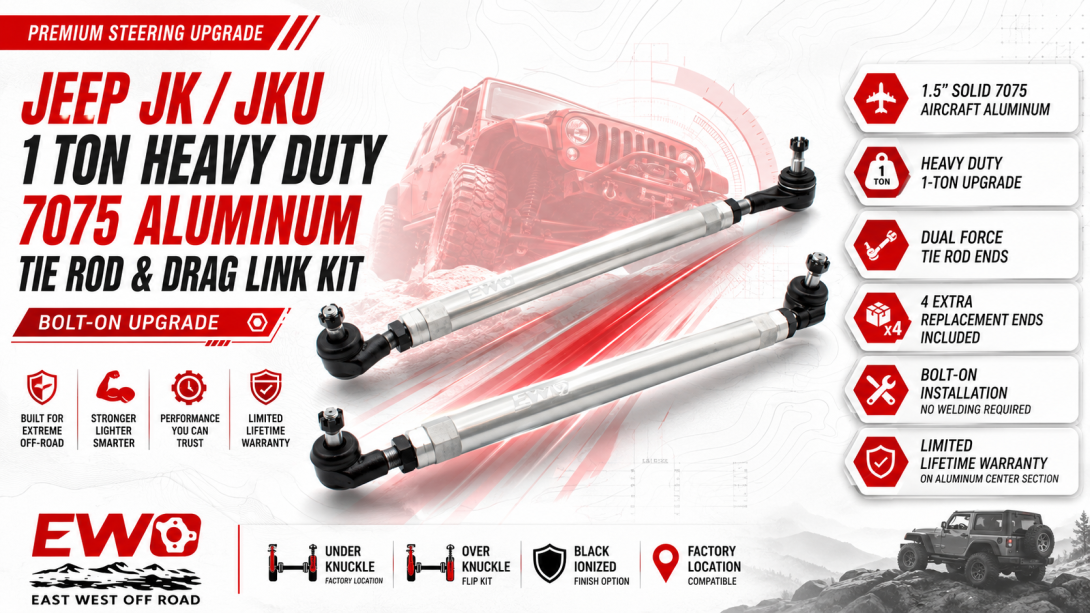
Buy Now: Jeep JK/JKU 1-Ton Heavy-Duty 7075 Aluminum Tie Rod & Drag Link Steering Kit
A JK crossover steering kit is an upgrade option for Jeep Wrangler JK and JKU owners who want stronger steering linkage for lifted suspensions, larger tires, and demanding off-road use. Crossover steering changes the way steering input is transferred across the front axle, while a heavy-duty steering kit can replace factory-sized linkage with components designed for more demanding applications.
For 2007–2018 Jeep Wrangler builds, choosing the correct setup requires careful attention to steering geometry, track-bar position, wheel clearance, and axle configuration. It is also important to understand that a crossover steering conversion and a heavy-duty tie rod and drag link replacement are not necessarily the same modification. The appropriate system depends on the Jeep's existing steering architecture and the specific product's fitment.
What Is a JK Crossover Steering Kit?
A crossover steering system routes the drag link from the steering box's pitman arm across the front axle to the steering knuckle on the opposite side. This differs from steering arrangements that use a different factory linkage layout.
Crossover steering is commonly associated with solid-axle conversions and certain modified 4x4 platforms. On a Jeep JK, the correct steering configuration depends on the axle, knuckles, steering components, and intended modification.
How Crossover Steering Works
The steering box turns the pitman arm when the driver turns the steering wheel. The drag link transfers this movement to the steering knuckle, while the tie rod connects the two steering knuckles so the front wheels turn together.
A crossover arrangement changes the routing and attachment points of the steering linkage. When properly engineered for a particular vehicle, it can provide a suitable steering layout for that build.
Crossover Steering vs. Heavy-Duty Steering
These terms describe different things.
- Crossover steering describes the steering-linkage arrangement.
- High-steer describes positioning steering linkage higher using suitable arms and mounting points.
- Heavy-duty steering describes components designed to provide greater strength or durability than the original parts.
A heavy-duty tie rod and drag link kit does not automatically convert a Jeep JK to a different crossover steering architecture. Confirm that the kit matches the modification you intend to perform.
Why Upgrade Jeep JK Steering for Off-Road Use?
Jeep Wrangler JK models are popular platforms for trail driving, rock crawling, and overland builds. Larger tires and suspension lifts can change the loads and geometry experienced by the front steering system.
Stronger Steering Linkage
The tie rod and drag link can encounter bending loads and impacts when a Jeep travels over rocks and uneven terrain.
A properly engineered heavy-duty steering system can provide stronger linkage for a modified vehicle. The complete design matters, including the center sections, steering ends, threaded connections, and mounting points.
Support for Larger Tires
Larger tires increase the leverage applied to steering components. If your Jeep runs oversized tires, it is important to select linkage designed for the vehicle's configuration and intended use.
A steering upgrade should also be considered alongside the condition of the steering box, ball joints, track bar, and other front-end components.
Better Linkage Clearance
Crossover or high-steer arrangements may provide a more suitable linkage position for certain solid-axle builds. However, clearance depends on the exact design and the relationship between the steering components, axle, wheels, tires, and suspension.
Moving the steering linkage higher does not guarantee that it will clear every obstacle or eliminate steering problems.
Jeep JK and JKU Heavy-Duty Steering Options
The two-door Wrangler JK and four-door Wrangler Unlimited JKU share the same general front steering architecture, and many aftermarket steering products are offered for both.
For compatible 2007–2018 vehicles, one option is the EWO Jeep JK/JKU 1-ton heavy-duty steering kit.
This kit is designed around a heavy-duty tie rod and drag link configuration using 7075 aluminum. It is an option for owners evaluating steering-linkage durability, but it should not be assumed to be a universal crossover conversion.
Before ordering, confirm the current product specifications and your Jeep's steering arrangement.
What to Check Before Buying
Verify the following:
- Model year and JK or JKU configuration
- Front axle and steering-knuckle setup
- Factory or modified steering linkage
- Suspension lift height
- Tire size
- Wheel diameter and backspacing
- Steering stabilizer mounting location
- Required mounting hardware or additional components
Previous modifications can affect fitment even when the product is listed for the correct model year.
7075 Aluminum for Heavy-Duty Jeep Steering
7075 aluminum is a high-strength alloy valued for its strength-to-weight ratio. Properly engineered aluminum steering components can provide a combination of strength and reduced weight compared with many steel alternatives.
Benefits of 7075 Aluminum
Depending on the design, a 7075 aluminum steering system can offer:
- High strength relative to its weight
- Reduced component mass compared with many steel designs
- A purpose-built option for modified Jeep applications
- A suitable finish when maintained according to manufacturer recommendations
Material alone does not determine the strength of a steering system. Thread engagement, attachment design, steering ends, and manufacturing quality all affect the finished assembly.
Why Consider a Complete Tie Rod and Drag Link Kit?
The tie rod and drag link perform different functions, but both are essential to steering control. Upgrading them together can make it easier to select compatible components and establish a consistent steering-linkage setup.
For a Jeep JK build, evaluate the complete EWO 1-ton 7075 aluminum steering kit against your vehicle's actual requirements rather than choosing solely by advertised component size.
Steering Geometry and Track-Bar Compatibility
Steering geometry is a major consideration when modifying a lifted Jeep. Even high-strength steering components can perform poorly if the drag link and suspension geometry are not properly matched.
Understanding Bump Steer
Bump steer occurs when suspension movement causes unintended changes in wheel direction.
The drag link and front track bar need to operate through compatible arcs. Their angles, lengths, and mounting locations influence how the steering responds as the suspension compresses and extends.
A crossover or high-steer modification changes the linkage arrangement, so the geometry should be evaluated after the change.
Track-Bar Position
The track bar locates the solid front axle laterally beneath the chassis. Its mounting position and angle affect how the axle moves relative to the vehicle frame.
When changing steering-linkage height or routing, inspect the track bar and its brackets at the same time. Supporting geometry corrections may be required, depending on the setup.
A heavy-duty steering kit alone should not be treated as a guaranteed fix for bump steer or death wobble.
High-Steer and Drag-Link Flip Considerations
Some Jeep JK builds use a drag-link flip to move the drag link above its original mounting position. This is related to high-steer modifications, but it is not identical to every crossover steering conversion.
When Might a Flip Configuration Be Appropriate?
A flip configuration may be considered for a lifted Jeep when the kit is specifically designed for that mounting arrangement and the resulting geometry is suitable.
The correct choice depends on:
- Lift height
- Steering-knuckle design
- Track-bar geometry
- Wheel and tire clearance
- Steering-arm mounting
- Manufacturer fitment requirements
Do not choose a flip kit solely because the Jeep has a suspension lift. The complete steering and suspension arrangement must be checked.
Wheel and Tire Clearance
Aftermarket wheels can interfere with steering arms or linkage, depending on their diameter and backspacing.
Check the manufacturer's wheel requirements before purchase. If spacers are specified, verify their compatibility and installation requirements rather than assuming they are suitable for every wheel combination.
Installation Checklist for a JK Steering Upgrade
Steering components are safety-critical. Installation should follow the manufacturer's instructions and applicable vehicle service procedures.
1. Confirm Component Compatibility
Check that the steering ends, tapers, threads, mounting hardware, and steering arms match the vehicle and the selected kit.
2. Inspect Clearance
Turn the steering from lock to lock and check for interference between the linkage and:
- Wheels and tires
- Front axle and differential housing
- Track bar and brackets
- Springs and shocks
- Sway bar and suspension components
- Frame and steering box
- Steering stabilizer
- Brake hoses and nearby hardware
Repeat the checks with the suspension compressed and extended.
3. Verify Fasteners and Alignment
Use the specified hardware and torque values. After installation, verify toe and steering-wheel position, and arrange a professional inspection if there is uncertainty about the setup.
Do not drive the Jeep if the steering binds, has excessive play, or shows signs of loose mounting hardware.
Common Mistakes When Choosing a JK Crossover Steering Kit
Assuming every heavy-duty kit is a crossover conversion: A tie rod and drag link replacement may retain the original steering architecture.
Ignoring suspension geometry: A different linkage position can affect the relationship between the drag link and track bar.
Choosing components by size alone: Link diameter does not establish complete system compatibility.
Overlooking wheel clearance: Wheel design and backspacing can determine whether the steering linkage fits properly.
Skipping full-travel inspection: Components that clear at ride height may contact the suspension or tires during articulation.
Expecting the kit to fix every steering issue: Worn joints, alignment problems, tires, and track-bar issues require separate diagnosis.
Frequently Asked Questions (FAQs)
What is a JK crossover steering kit?
A JK crossover steering kit changes the steering-linkage routing so the drag link crosses the axle to a steering knuckle on the opposite side. The exact components depend on the vehicle and conversion design.
Is crossover steering the same as high-steer?
No. Crossover steering describes the linkage arrangement, while high-steer refers to positioning the linkage higher with compatible steering arms and mounting points.
Does a heavy-duty tie rod and drag link kit convert a Jeep JK to crossover steering?
Not necessarily. Many heavy-duty kits replace the existing tie rod and drag link while retaining the original steering architecture. Confirm the product's specific design before ordering.
Is a 7075 aluminum steering kit suitable for off-road use?
A properly engineered 7075 aluminum steering system can be suitable for its intended application. The complete design, steering ends, connections, fitment, and installation all matter.
Does crossover steering eliminate bump steer?
No. Bump steer depends on steering and suspension geometry. The drag link and track bar must operate through compatible arcs.
Will a crossover steering kit fix death wobble?
Not automatically. Death wobble can involve worn joints, loose hardware, track-bar problems, tires, alignment, or suspension geometry. Diagnose the cause before replacing components.
What should I check before buying a JK steering kit?
Confirm the Jeep's year, axle configuration, steering architecture, lift height, tire size, wheel specifications, steering-end compatibility, and clearance requirements.
Can I install a steering kit at home?
An experienced mechanic may be able to install a vehicle-specific kit by following the instructions. Because steering is safety-critical, professional installation or inspection is recommended when fitment or geometry is uncertain.
Final Thoughts
A JK crossover steering kit can be a useful option for a Jeep Wrangler build that requires a different steering-linkage arrangement. For owners primarily seeking greater linkage durability, a heavy-duty tie rod and drag link kit may be the more appropriate upgrade without necessarily converting the steering architecture.
The key is to identify the modification your Jeep actually needs. Check axle compatibility, steering geometry, track-bar position, wheel clearance, and the manufacturer's installation requirements before selecting components.
For compatible 2007–2018 Jeep Wrangler JK and JKU models, the EWO 1-ton 7075 aluminum steering kit is one heavy-duty linkage option to evaluate. Choose a configuration designed for your vehicle and have the complete steering system inspected before returning to road or trail use.