

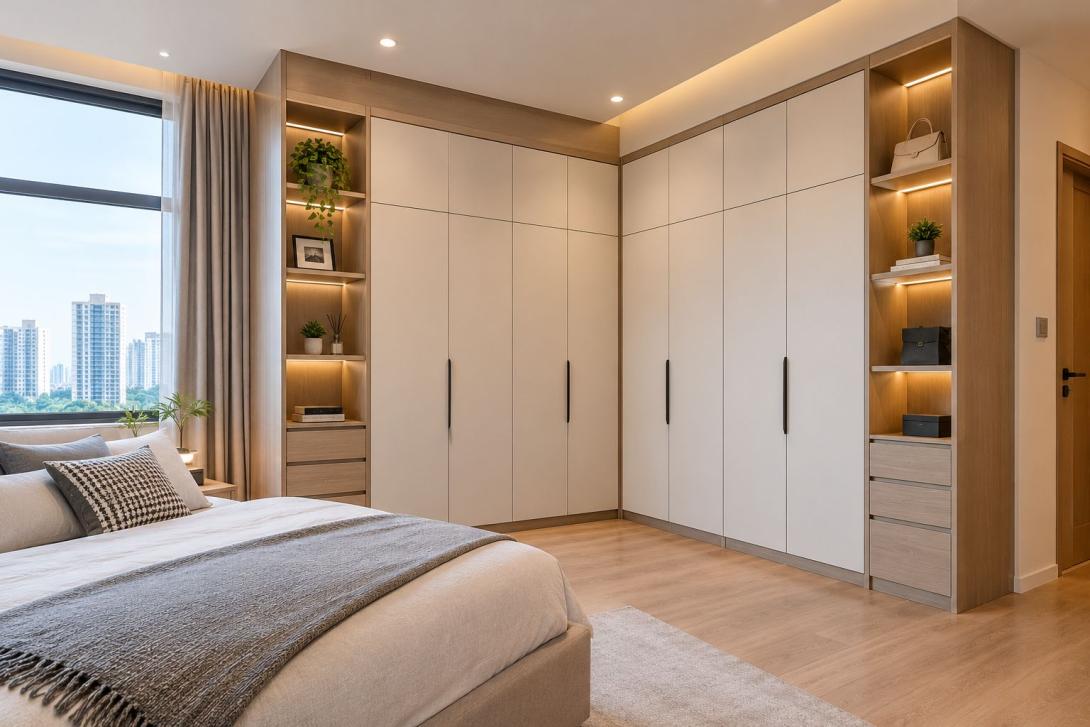
An L-shaped wardrobe uses two adjoining walls to create corner storage, while a straight wardrobe runs along a single wall. L-shaped designs offer greater storage capacity and make better use of awkward corner spaces, but straight wardrobes suit narrower rooms and simpler layouts. The right choice depends on your room dimensions, storage needs, and how you move through the space.
Choosing between an L shaped wardrobe vs straight wardrobe is one of those decisions that looks simple on paper but matters a great deal once you're living with it. In Singapore's HDB flats and condominiums, where bedroom sizes are compact and every square foot counts, getting the wardrobe layout right can genuinely transform how a room feels and functions.
What Is an L-Shaped Wardrobe?
A corner wardrobe, or L-shaped wardrobe, wraps around two walls meeting at a 90-degree angle. It fills the corner a spot that often goes completely to waste with freestanding furniture and extends along both walls to create a continuous storage run.
In a typical HDB master bedroom, this layout can add 30–40% more hanging and shelving space compared to a single-wall configuration, simply by activating that underused corner zone.
What Is a Straight Wardrobe?
A straight wardrobe is exactly what it sounds like a single linear unit fitted along one wall. It's the most common wardrobe layout in Singapore homes, particularly in common bedrooms and older HDB flat types where room proportions are narrower.
Straight wardrobes are straightforward to plan, easier to access end-to-end, and work well when you have a clear uninterrupted wall to work with.
L-Shaped Wardrobe vs Straight Wardrobe: A Direct Comparison
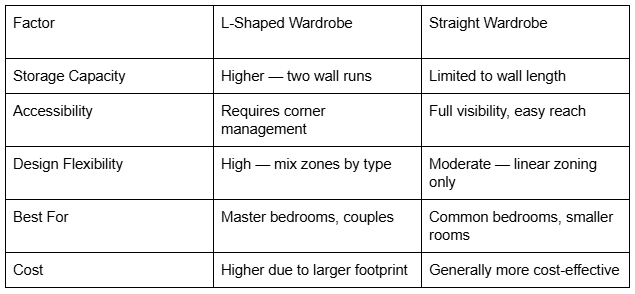
Space Utilisation: Who Wins in a Singapore Bedroom?
In Singapore, HDB bedroom sizes typically range from around 8 sqm for common bedrooms to 12–15 sqm for master bedrooms in newer Build-To-Order (BTO) flats. Corner spaces in these rooms rarely serve any functional purpose they collect dust or end up with a lamp squeezed in.
An L-shaped wardrobe reclaims that corner completely. By running storage along two walls, you gain usable depth on both sides without pushing the wardrobe further into the walking area of the room. The result is a room that feels more open, not more cramped.
A straight wardrobe, on the other hand, works best when your room has one dominant long wall common in older HDB 3-room and 4-room flat configurations. If the wall is clear and long enough, a straight wardrobe can be surprisingly generous on storage without complicating the room layout.
Storage Capacity: More Than Just Linear Metres
L-Shaped Wardrobes Give You More Zones
Because an L-shaped design spans two walls, you can naturally divide storage by category — one side for hanging clothes, the other for folded items, accessories, and shelving. This zoning approach reduces the need to dig through everything to find what you need.
- Dedicate one arm to full-length hanging for dresses and suits
- Use the second arm for double-hang sections, drawers, and shoe compartments
- Corner units can house pull-out organisers or a built-in vanity nook
Straight Wardrobes Keep Things Simple
A straight wardrobe's strength is clarity. Every section is visible at a glance, which makes daily use feel effortless. For a single occupant or a child's bedroom, this simplicity is often exactly what's needed no complex corner mechanisms, no wasted transition zones.
The trade-off is that when your storage needs grow a new season's wardrobe, sports equipment, extra bedding a straight wardrobe runs out of wall before it runs out of items to store.
Accessibility: Can You Reach Everything Easily?
This is where the straight wardrobe has a genuine advantage. Every door panel is directly in front of you. Sliding or hinged doors open in a predictable way, and there are no awkward zones.
L-shaped wardrobes require more thoughtful planning around the corner section. A poorly designed corner can result in dead space — areas you technically have but can never comfortably reach. The solution is in the detailing:
- Use a dedicated corner unit with a carousel or pull-out tray
- Design the corner as open shelving rather than deep enclosed storage
- Avoid placing everyday items in the corner pivot zone
When the corner is handled well, accessibility is no longer a problem — it becomes a feature.
Design Flexibility: Which Wardrobe Adapts Better?
L-shaped wardrobes offer more creative freedom in interior design terms. The two-wall configuration creates a natural focal point in the room, and the layout can be designed to incorporate mirrors, integrated lighting, open display shelves, and even a built-in dressing area all within the same continuous unit.
For HDB and condo homeowners doing a full renovation, this makes the L-shape a more versatile canvas. You're not just storing clothes; you're shaping how the whole room looks and feels.
Straight wardrobes are easier to adapt after installation. You can extend them, adjust internal fittings, or even relocate them more feasibly than a corner unit. If flexibility over time is a priority for example, if you're renting out the room later a straight wardrobe is the more practical choice.
Which Wardrobe Layout Is Right for You?
Here's a practical decision guide based on common Singapore home scenarios:
- Master bedroom with corner space: L-shaped wardrobe maximise storage and create a defined dressing zone
- Common bedroom or guest room: Straight wardrobe clean, accessible, proportionate to the space
- Couple sharing a wardrobe: L-shaped wardrobe zone each arm by person to reduce daily friction
- Single occupant, smaller room: Straight wardrobe simpler, cost-effective, easier to manage
- Room with awkward corner or odd angles: Custom L-shape built to fit the actual room geometry
If you're renovating an HDB or condo bedroom and want a wardrobe that genuinely fits your space rather than forcing your space to fit a standard product, Ecozy Furniture offers custom-made L-shaped wardrobes designed specifically for Singapore homes. Visit the Ecozy Furniture website to explore their full range of wardrobe solutions.
Frequently Asked Questions
Is an L-shaped wardrobe suitable for a small HDB bedroom?
Yes, provided the room has a usable corner. An L-shaped wardrobe in a small room can actually free up more floor space than a large straight wardrobe by distributing storage across two walls rather than one, reducing visual bulk along any single wall.
What is the minimum room size for an L-shaped wardrobe?
A bedroom of at least 10–12 sqm is generally recommended for a functional L-shaped wardrobe. This allows enough room for comfortable door clearance and movement. In tighter spaces, a compact custom design with sliding doors can work within smaller footprints.
Are L-shaped wardrobes more expensive than straight wardrobes?
Generally, yes. The larger footprint, additional materials, and corner unit detailing increase the overall cost. However, the cost-per-storage-unit ratio is often better, as you get significantly more usable space relative to the floor area occupied.
How do I manage the corner section of an L-shaped wardrobe?
Design the corner zone with a purpose — either as open shelving, a pull-out carousel unit, or a fixed display area. Avoid placing items you use daily in hard-to-reach corner depths. A well-planned corner becomes a functional feature rather than wasted space.
Can I customise an L-shaped wardrobe to fit my exact room dimensions?
Yes. Custom-made L-shaped wardrobes are built to your exact room measurements, accounting for ceiling height, wall irregularities, and door swing requirements. This is the most practical approach for Singapore HDB and condo bedrooms where standard dimensions rarely apply consistently.
Which wardrobe layout is better for couples sharing a bedroom?
An L-shaped wardrobe works particularly well for couples. Each arm of the wardrobe can be designated to one person, creating clear storage zones that reduce the daily overlap of shared wardrobe use and making the space feel more organised for two occupants.