

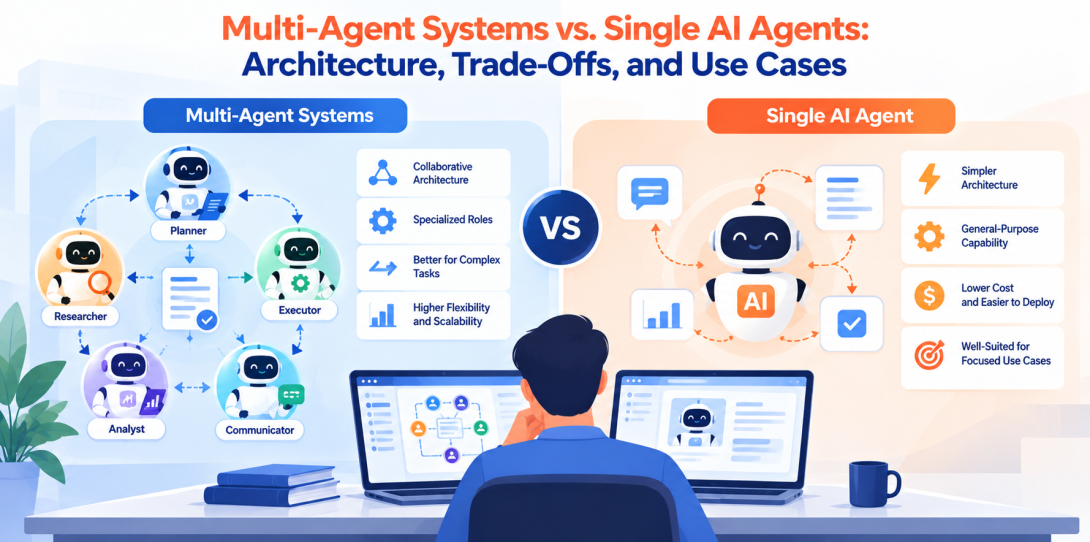
Multi-agent systems and single AI agents represent two distinct ways to build autonomous software, and the choice shapes cost, speed, and reliability.
One agent handles focused tasks with little overhead, while several coordinated agents tackle complex, multi-step work.
This guide compares architecture, trade-offs, and real-world use cases so you can select the right design with confidence. Each section builds toward a practical decision framework.
What Are Single AI Agents?
A single AI agent is one autonomous program, usually powered by a large language model (LLM), that reasons about a goal, decides what to do next, and executes tasks on its own.
Through tool calling, it can query data sources, trigger actions, and remember earlier steps. Every decision flows through one reasoning loop, which keeps behavior predictable and traceable.
Single agents work best when the job is well defined and the context stays manageable. Teams often start here because setup is quick and results are easy to evaluate.
Many types of AI agents, from simple reflex agents to goal-based agents, can run alone without any coordination layer, which makes them a practical entry point into agentic AI.
What Are Multi-Agent Systems?
Multi-agent systems are architectures in which several AI agents work toward a shared objective, each with its own role, tools, and instructions. A planner might break down a request, a researcher might gather evidence, and a reviewer might check the result. Together they form an agentic AI workflow that mirrors how specialized human teams operate.
Agents in these systems exchange messages, share state, and hand off work through defined protocols. A supervisor agent or orchestration layer usually controls the flow, though some designs let agents negotiate peer to peer. Each component can be improved or scaled independently, which is why teams seeking AI agent development services often choose this model for complex, high-value processes.
Single AI Agent vs. Multi-Agent System: Architecture
Single-Agent Architecture
In a single-agent architecture, one agent manages reasoning, decision-making, and task execution. The loop is simple: receive input, plan, act, observe the result, and repeat until the goal is met.
One context window holds everything, which removes handoff errors but limits how much information the agent can process. Strong LLM development services help tune the model behind this loop.
Multi-Agent Architecture
A multi-agent architecture splits work across specialized agents that coordinate their outputs.
Common patterns include a supervisor that delegates subtasks, a pipeline where each agent passes results onward, and a parallel setup where agents work at the same time and merge findings.
Each agent keeps a narrow context window, which sharpens focus but demands careful message design and shared memory.
Task Distribution, Communication, Orchestration, and Complexity
Task distribution is centralized in a single agent and divided by role in a multi-agent system. Communication is internal in the first case and message-based in the second.
Orchestration is trivial for one agent but critical for many, and system complexity rises with every agent added. Understanding these differences clarifies where each design fits best.
Key Differences Between Single and Multi-Agent Systems
Architecture and Workflow
Single agents follow a linear workflow in which one reasoning loop handles every step. Multi-agent systems follow a distributed workflow where roles, handoffs, and shared state define progress.
The first approach is easier to design and visualize, while the second supports branching, parallel paths, and review stages that a single loop struggles to manage cleanly.
Task Complexity and Specialization
Single agents suit narrow, well-scoped tasks where one prompt and one toolset are enough. As work grows into many subtasks that need different skills, one agent becomes a generalist stretched thin.
Multi-agent systems assign task decomposition to a planner and give each specialist its own instructions, tools, and knowledge, which raises quality on demanding work.
Performance and Scalability
A single agent processes steps sequentially, so latency grows with task length and context size. Multi-agent systems enable parallel execution, letting agents handle independent subtasks simultaneously.
Scaling is also more flexible because you can add or upgrade individual agents. Teams tracking adoption can review current AI agents statistics to benchmark their own plans.
Resource Consumption and Operational Costs
Single agents use fewer model calls, tokens, and infrastructure resources, so costs stay low and predictable.
Multi-agent systems multiply those costs because every agent consumes tokens and every message adds overhead.
Budgets must also cover orchestration, monitoring, and retries. The extra spend pays off only when the value of the task or the quality gain justifies it.
Reliability, Error Handling, and Maintenance
A single agent has one failure point, which simplifies debugging and logging. Multi-agent systems offer fault tolerance because another agent can retry or take over, yet errors can also cascade across handoffs.
Maintenance means versioning prompts, tools, and roles for every agent, backed by strong observability so teams can trace exactly where a workflow failed.
Coordination and Communication Overhead
Single agents carry no coordination cost because all reasoning lives in one place. Multi-agent systems must manage inter-agent communication, shared memory, and conflict resolution.
Poorly defined protocols cause duplicated work, contradictory outputs, or endless loops. Clear message formats, role boundaries, and termination rules keep this overhead manageable and stop coordination from erasing the benefits of specialization.
Advantages and Limitations of Each Approach
Single AI Agents
Advantages:
- Simpler architecture: One reasoning loop means fewer components to design, deploy, and secure.
- Lower overhead: Fewer model calls and no message passing keep token spend and latency low.
- Easier debugging: A single trace shows every decision, so failures are quick to diagnose.
- Faster implementation: Teams can prototype and ship a working agent in days instead of weeks.
- Predictable behavior: One agent with one context produces consistent outputs that are simple to test.
Limitations:
- Restricted specialization: One prompt and toolset cannot match the depth of dedicated expert agents.
- Context overload: Long tasks fill the context window and reduce accuracy and recall.
- Sequential execution: Steps run one after another, so complex jobs take longer to finish.
- Difficulty with complex workflows: Branching logic and review stages are hard to manage in one loop.
- Single point of failure: One faulty reasoning step or tool error can derail the entire task.
Multi-Agent Systems
Advantages:
- Task specialization: Each agent focuses on one role, which improves accuracy on demanding subtasks.
- Parallel execution: Independent subtasks run simultaneously, cutting total completion time.
- Modularity: Agents can be updated, swapped, or scaled without rebuilding the whole system.
- Support for complex workflows: Planning, execution, and review stages map naturally onto separate agents.
- Built-in quality checks: Reviewer or critic agents can validate outputs before they reach the user.
Limitations:
- Coordination challenges: Agents need clear roles and protocols to avoid conflicts and duplicated work.
- Higher costs: More model calls, tokens, and infrastructure drive up operating expenses.
- Communication failures: Lost, ambiguous, or malformed messages can break a workflow midstream.
- Difficult debugging: Tracing a fault across many agents and handoffs requires advanced observability.
- Larger security surface: Every agent with tool access adds permissions that must be governed and audited.
Real-World Use Cases
Single AI Agent Use Cases
Single agents excel where tasks are repetitive, bounded, and low risk. A focused scope lets one agent deliver reliable results without the cost of coordination.
Businesses often deploy them first because they are quick to launch, simple to monitor, and easy to measure against clear service goals. These are the most common applications today.
- Customer support and FAQ automation: Answers common questions, checks order status, and escalates edge cases to humans.
- Personal AI assistants: Manages calendars, drafts emails, and handles reminders for a single user.
- Document summarization and content generation: Condenses long reports and drafts outlines, summaries, and first-pass copy.
- Simple research and data extraction: Pulls structured fields from invoices, forms, and web pages.
Multi-Agent System Use Cases
Multi-agent systems fit work that spans several skills, data sources, or approval stages.
Our guide to AI agents in business shows how organizations apply these designs across departments, and the examples below highlight where specialization and parallel execution pay off most.
Teams usually see the biggest gains when tasks are long, branching, or high value.
- Complex research and report generation: Researcher, analyst, and editor agents gather sources, test claims, and compile a cited report.
- Software development and code review: Planner, coder, tester, and reviewer agents build and check code together.
- Enterprise workflow automation: Agents coordinate approvals, data entry, and system updates across teams, much like modern workflow automation solutions.
- Supply chain planning and optimization: Forecasting, procurement, and logistics agents rebalance inventory and routes as conditions change.
- Financial analysis and risk assessment: Data, modeling, and compliance agents evaluate exposure and flag anomalies for analyst review.
How to Choose the Right Architecture
The right choice depends on your task, budget, and risk tolerance rather than on trends. Work through the criteria below before committing, and expect to revisit them as requirements change.
Organizations that want an outside view can begin with AI consulting services to assess readiness and map the architecture to business goals.
- Evaluate task complexity: Count the distinct subtasks and skills involved, since many steps across different domains favor multiple agents.
- Consider budget, latency, and compute: Single agents cost less and respond faster, so reserve multi-agent designs for work that justifies the spend.
- Assess parallelism and expertise needs: Independent subtasks and deep specialization benefit from separate agents running together.
- Determine reliability, security, and oversight needs: Regulated or high-stakes work may require reviewer agents, strict permissions, and human-in-the-loop approval.
- Plan for growth: Begin with one agent, then expand into a multi-agent system when context overload, slow runs, or quality gaps appear.
Best Practices for Implementing AI Agent Architectures
Strong architecture choices still fail without disciplined execution. These practices help teams keep agent systems reliable, secure, and affordable as they grow from a first prototype into production.
Apply them early, because retrofitting governance, monitoring, and cost controls into a live multi-agent workflow is far harder than building them in from day one.
- Start simple: Use the simplest architecture that meets requirements, and add agents only when evidence demands it.
- Define clear responsibilities: Give each agent one role, explicit boundaries, and a documented success criterion.
- Set permissions and protocols: Apply least-privilege tool access and standardize message formats and handoff rules.
- Monitor and recover: Add logging, evaluation suites, retries, and fallbacks so failures are caught and contained.
- Measure what matters: Track performance, accuracy, latency, and total cost per task to guide every design change.
Conclusion
Multi-agent systems offer specialization, parallel execution, and modularity, while single AI agents deliver simplicity, speed, and lower cost. Neither design wins in every case, and your goals and constraints should always drive the decision.
Match the architecture to task complexity, budget, and risk, start with the simplest option that works, and add agents only when real limits appear. Consistent measurement will show you exactly when that moment arrives.