

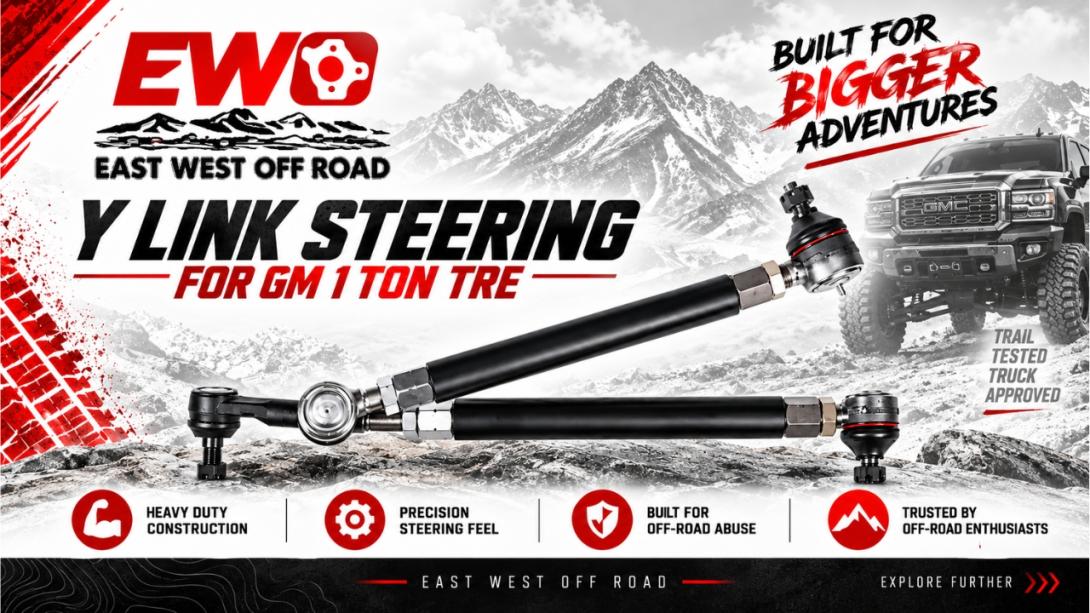
Buy Now: https://www.eastwestoffroad.com/product/y-link-steering-for-gm-1-ton-tre
An off road steering kit is an important consideration for 4x4 enthusiasts who want steering components suited to demanding trails, modified suspensions, and custom solid-axle builds. Whether you're navigating rocky terrain, exploring backcountry trails, or upgrading a Dana 44 or Dana 60 axle, your steering system needs to operate reliably under changing loads and suspension movement.
Unlike highway driving, off-road conditions expose steering components to obstacles, uneven surfaces, sudden changes in wheel position, and potential impacts.
Factory steering systems are engineered for specific vehicle configurations. Once you introduce larger tires, suspension lifts, custom axles, or significant changes to steering geometry, the original components may no longer be appropriate for your build.
That's why many off-road builders explore heavy-duty steering systems featuring GM 1-ton tie rod ends, DOM steel tubing, and custom Y-link steering configurations.
However, choosing the right steering kit requires more than selecting thicker tubing or larger joints. Steering geometry, component articulation, axle compatibility, and mounting clearance all matter.
This guide explains how off-road steering systems work, which components are worth comparing, and what to verify before investing in a steering upgrade for your 4x4.
What Is an Off Road Steering Kit?
An off road steering kit is an aftermarket package containing steering components intended for a particular vehicle or custom steering application.
Depending on the manufacturer, a kit may replace or provide components for the tie rod, drag link, steering ends, and related linkage connections.
Common components include:
- Heavy-duty tie rods: Connect steering knuckles and transmit movement between the front wheels.
- Drag links: Transfer steering input from the steering gear through the pitman arm.
- Tie rod ends: Provide articulated connections between steering components and mounting points.
- DOM steel tubing: Used to fabricate steering links in some aftermarket kits.
- Threaded tube adapters: Connect compatible steering ends to linkage tubing.
- Jam nuts: Secure the adjustment of threaded steering connections.
- Y-link steering ends: Provide the junction between steering components in certain Y-link systems.
Some kits are designed specifically for particular Jeep or truck models, while others supply components for custom fabrication.
This distinction is important because a fabricated steering-component package should not automatically be treated as a direct-fit replacement.
What Makes a Steering Kit Suitable for Off-Road Use?
The suitability of a steering system depends on how its components work together.
A good off-road steering arrangement should account for:
- Component construction and specifications
- Available steering-end articulation
- Tire and wheel clearance
- Differential and axle housing clearance
- Suspension movement
- Steering linkage geometry
- Serviceability and replacement parts
- Correct installation and inspection
These factors matter more than general marketing claims about strength or trail performance.
Why Steering Performance Matters on Difficult Trails
Off-road driving places different demands on steering components compared with ordinary highway use.
When a vehicle climbs uneven terrain or encounters obstacles, its wheels and suspension can move through a much wider range of positions.
The steering linkage must accommodate that movement without binding or interfering with surrounding components.
Rocky Trails and Obstacle Clearance
Rocky terrain can expose steering components to accidental impacts.
Tie rods and drag links are often positioned near the front axle, where their location may leave them vulnerable to obstacles.
A steering upgrade may involve evaluating the position of the linkage and whether an alternative mounting arrangement offers suitable clearance.
However, moving a tie rod higher does not automatically eliminate the risk of impact or guarantee better steering performance.
Uneven Terrain and Suspension Articulation
As one wheel moves upward and the other downward, steering joints must accommodate changing angles.
If a steering end reaches its articulation limit, the linkage can bind or transmit unwanted forces.
For this reason, joint articulation and suspension movement should be evaluated together.
A heavy-duty joint is not necessarily suitable if its operating angle is incorrect.
Mud, Water, and Trail Debris
Mud, water, and abrasive contaminants can affect exposed steering components, particularly when protective boots or seals are damaged.
Regular inspection becomes especially important for vehicles frequently used in these conditions.
An upgraded steering kit does not eliminate the need for cleaning, inspection, and maintenance.
Larger Tires and Modified Suspension
Larger tires and altered suspension geometry may change the demands placed on steering components.
However, tire diameter alone cannot determine the correct steering kit.
The actual axle, steering knuckles, suspension arrangement, and linkage geometry must guide the selection.
GM 1-Ton Steering Components for Off-Road Applications
GM 1-ton-style steering ends are commonly used in aftermarket solid-axle steering projects.
These components are available in various configurations and can be combined with appropriate linkage materials for compatible custom builds.
A GM 1 ton steering kit may be worth evaluating when your project requires this steering-end family and the mounting interfaces are suitable.
Why Builders Consider GM 1-Ton Tie Rod Ends
GM-style steering ends are frequently used because they offer recognizable component part numbers and multiple aftermarket configurations.
Potential considerations include:
- Availability of specific replacement components
- Compatibility with certain custom steering arrangements
- Different joint configurations
- Use with appropriately matched threaded linkage components
However, the designation "1 ton" is not a certified load rating for the steering system.
It also does not mean that every GM-style steering end fits every axle or steering knuckle.
Understanding Steering-End Compatibility
A steering end must match more than the nominal thread size of its connecting tube.
Important specifications include:
- Thread diameter and pitch
- Left-hand or right-hand thread direction
- Mounting-stud taper
- Joint movement and articulation
- Intended steering connection
- Clearance around adjacent components
For example, two steering ends may use similar threaded connections but require different mounting interfaces.
Verifying those differences before purchasing can prevent expensive fitment problems.
Y-Link Steering vs. Crossover Steering for Off-Road Vehicles
Steering-linkage architecture is another important consideration when choosing an off-road steering upgrade.
Two commonly discussed aftermarket configurations are Y-link and crossover steering.
How Y-Link Steering Works
In the GM-style aftermarket Y-link arrangement discussed here, the drag link connects to the tie-rod assembly through a dedicated Y-link connection.
The drag link transfers steering input, while the tie rod connects the steering knuckles.
The Y-link junction allows these components to operate as part of an interconnected steering system.
This configuration may be relevant to custom axle builds where steering-arm locations or suspension components limit the available options.
How Crossover Steering Works
In a conventional crossover arrangement, the drag link generally connects independently from the pitman arm to a steering arm or knuckle on the opposite side.
Crossover steering is common in various modified solid-axle applications.
However, it may require different mounting points or additional steering-arm components depending on the axle.
Y-Link vs. Crossover Steering Comparison
Feature
Y-Link Steering
Crossover Steering
Drag link connection
Interfaces with tie-rod assembly
Generally connects independently toward opposite knuckle
Layout
Interconnected linkage
Separate drag-link path
Mounting requirements
Configuration-specific
Configuration-specific
Suspension clearance
Must be evaluated
Must be evaluated
Steering geometry
Vehicle-dependent
Vehicle-dependent
Best application
Depends on available interfaces
Depends on available interfaces
Neither design is universally superior.
The best steering layout is the one compatible with your axle, steering knuckles, suspension, and intended use.
East West Offroad Y-Link Steering for GM 1-Ton TRE
East West Offroad offers its Y Link Steering for GM 1 Ton TRE, item E90065, for builders evaluating compatible heavy-duty Y-link steering applications.
The documented product package includes GM-style steering ends, threaded adapters, jam nuts, and DOM steel tubing.
What's Included in the E90065 Package?
Component
Quantity / Specification
ES2026R drag link end
1
ES2027L drag link end
1
ES2233L Y-link tie rod end
1
ES2234R tie rod end
1
Left-hand tube adapters
2 × 7/8"-18
Right-hand tube adapters
2 × 7/8"-18
Left-hand jam nuts
2 × 7/8"-18
Right-hand jam nuts
2 × 7/8"-18
DOM steel tubing
One 54-inch length
DOM steel tubing
One 43-inch length
DOM tubing dimensions
1.50" OD × 1.00" ID × .250" wall
These specifications come from the supplied E90065 product documentation and should be confirmed against the current ordering options.
What Makes This Package Relevant to Custom 4x4 Builds?
The package provides several of the component categories needed when planning a Y-link steering assembly.
It includes identified steering ends, threaded hardware, and tube stock rather than only a pair of replacement tie rod ends.
The product documentation also identifies an over-the-knuckle or under-the-knuckle reaming selection for the Y-link steering end.
However, E90065 is not documented as a universal bolt-on kit.
Steering knuckles, high-steer arms, a pitman arm, a steering box, and a reamer tool are not listed among its included components.
Buyers should confirm the exact mounting requirements and any additional fabrication before placing an order.
DOM Steel Tubing: Why It Matters for Off-Road Steering
DOM stands for Drawn Over Mandrel, a manufacturing process used to produce steel tubing with controlled dimensions.
DOM tubing is widely used in custom steering and fabrication projects.
Its suitability depends on the chosen material, dimensions, assembly design, and intended application.
Understanding DOM Tubing Specifications
East West Offroad's E90065 documentation lists tubing with:
- 1.50-inch outside diameter
- 1.00-inch inside diameter
- .250-inch wall thickness
The package includes one 54-inch tube and one 43-inch tube.
These dimensions help buyers evaluate the supplied material and discuss fabrication requirements with a qualified installer.
However, tube dimensions alone cannot establish the performance or load capacity of the finished steering system.
Why Linkage Construction Matters
A steering assembly is only as suitable as its complete design and construction.
Important considerations include the correct tube adapters, weld quality where applicable, joint compatibility, and secure threaded connections.
Poor fabrication can compromise an otherwise suitable component package.
Custom steering fabrication should be performed and inspected by a qualified professional.
Over the Knuckle vs. Under the Knuckle Steering for Trail Clearance
Steering-linkage position can influence clearance around the axle and suspension.
Two common mounting arrangements are over-the-knuckle (OTK) and under-the-knuckle (UTK).
Over the Knuckle Steering Kit
An over the knuckle steering kit positions the relevant steering connection above the knuckle's steering arm.
Depending on the vehicle, this may provide additional clearance beneath part of the steering linkage.
However, the higher position can introduce interference with other components.
Areas that may need evaluation include wheel clearance, suspension brackets, springs, and steering-end articulation.
Under the Knuckle Steering Kit
An under the knuckle steering kit positions the relevant steering connection below the steering arm.
This may be appropriate for certain factory-style mounting positions or custom suspension configurations.
However, lower mounting can place parts of the linkage closer to obstacles or other axle components.
Which Configuration Works Better Off-Road?
Consideration
OTK
UTK
Connection position
Above steering arm
Below steering arm
Clearance beneath linkage
May improve
Application-dependent
Upper suspension interference
Must be checked
Must be checked
Lower axle clearance
Must be checked
Must be checked
Knuckle compatibility
Required
Required
Additional preparation
May be necessary
May be necessary
The correct choice depends on the vehicle's actual mounting interfaces and suspension geometry.
OTK does not automatically mean high steer, and neither arrangement guarantees improved handling.
Dana 44 Off-Road Steering Kit: Compatibility Considerations
The Dana 44 is used in various off-road trucks, Jeeps, and custom 4x4 applications.
Its popularity makes it a common platform for aftermarket steering upgrades.
However, choosing a Dana 44 Y link steering kit requires identifying the exact axle and knuckle configuration.
Verify the Existing Steering Knuckles
Different Dana 44 applications may use different knuckle designs and steering-arm arrangements.
An axle swap or previous modification can also change the steering setup.
Before purchasing, identify the mounting interfaces and confirm that the selected steering ends are compatible.
Check Tire and Suspension Clearance
Larger tires, modified suspension components, and aftermarket differential covers can affect steering clearance.
The entire proposed linkage must be evaluated across steering movement and the expected suspension travel.
Review Existing Steering Geometry
A steering upgrade may change the relationship between the drag link and suspension components.
On vehicles using a track bar, the relationship between the drag link and track bar is particularly important.
A heavier steering kit does not automatically correct poor steering geometry.
Dana 60 Off-Road Steering Kit: What to Know
The Dana 60 is used in numerous heavy-duty axle applications, but the axle family includes different steering-knuckle configurations.
Some Dana 60 axles use kingpin designs, while others use ball joints.
These differences can affect steering-arm selection and aftermarket steering compatibility.
Identify Your Dana 60 Configuration
Before choosing a kit, verify:
- Exact Dana 60 axle variant
- Knuckle and steering-arm configuration
- Existing steering-end mounting positions
- Required connection taper
- Suspension geometry and component clearance
A product advertised for Dana 60 applications is not automatically compatible with every Dana 60 axle.
Consider High-Steer Requirements
Some Dana 60 projects incorporate aftermarket high-steer arms.
These are separate components from the Y-link steering arrangement itself.
If your build requires additional steering arms, verify them separately rather than assuming they are included in a Y-link component package.
How to Choose an Off Road Steering Kit Based on Your Driving Conditions
Your intended off-road use can help identify which engineering and fitment questions deserve the most attention.
Driving Conditions
Steering Considerations
Rocky trails
Linkage exposure, clearance, and potential impact damage
Muddy trails
Joint protection, contamination, and maintenance
Uneven terrain
Joint articulation and suspension movement
Forest trails
Clearance around obstacles and suspension components
Desert trails
Steering inspection, vibration, and component security
Mixed road/trail use
Geometry, alignment, and road-use suitability
These are planning considerations, not automatic recommendations for a specific steering layout.
Rock Crawling and Technical Obstacles
For technical terrain, inspect how exposed the tie rod and drag link may be to obstacles.
The proposed system should also allow the steering joints to operate without binding as the suspension articulates.
Overlanding and Long-Distance Trail Use
Vehicles used for long-distance trips benefit from well-documented service components and regular inspections.
Knowing the exact steering-end part numbers can simplify replacement planning.
Steering reliability depends on correct component selection, maintenance, and installation—not simply larger components.
Weekend Off-Road and Daily-Driving Builds
For vehicles used both on pavement and off-road, steering geometry and road-use suitability are especially important.
A custom steering arrangement should be evaluated for stable road behavior, appropriate alignment, and compliance with applicable requirements.
Pre-Trail Steering Inspection Checklist
Before heading off-road, a steering inspection can help identify visible problems.
Important checks include:
- Inspect steering-linkage tubing for bending or damage.
- Check steering-end boots for tears or deterioration.
- Look for loose or damaged adjustment hardware.
- Watch for abnormal movement at steering connections.
- Check for visible interference around steering and suspension components.
- Investigate new steering noises, wandering, or vibration.
- Confirm that previously identified steering issues have been professionally resolved.
After a significant trail impact, the steering system should be inspected again.
If damage, looseness, or unpredictable steering is suspected, do not continue operating the vehicle until it has been evaluated by a qualified technician.
Common Mistakes When Choosing an Off-Road Steering Upgrade
Choosing Based Only on Tube Diameter
Thicker tubing may be relevant, but it does not independently establish the suitability of a steering kit.
Joint specifications, linkage geometry, material properties, and fabrication quality also matter.
Assuming Larger Tires Require a Particular Kit
Tire size alone does not determine which steering configuration is appropriate.
A complete assessment of the axle, suspension, wheels, and steering system is necessary.
Ignoring Steering-End Articulation
An incompatible joint operating angle can cause binding during steering or suspension movement.
Proper articulation should be verified for the actual installation.
Believing a Steering Stabilizer Fixes Worn Components
A steering stabilizer cannot repair worn tie rod ends, loose suspension parts, or incorrect steering geometry.
The underlying problem must be diagnosed and corrected.
Confusing Y-Link and High-Steer Systems
Y-link refers to a steering-linkage connection arrangement.
High steer refers to a steering mounting approach involving raised steering-arm connections.
These terms should not be treated as interchangeable.
Assuming Every Kit Is Ready to Install
Some steering kits contain finished links, while others supply unassembled components.
A package containing tubing and threaded adapters may require professional fabrication and fitting.
Is a GM 1-Ton Y-Link Steering Kit Right for Your Build?
A GM-style Y-link configuration may be worth considering if you're planning a compatible custom solid-axle steering system.
The right choice depends on your knuckle interfaces, drag link and tie rod arrangement, suspension geometry, and fabrication requirements.
East West Offroad's Y link steering kit provides identified GM-style steering ends, threaded hardware, and DOM tubing for builders evaluating this type of arrangement.
Before ordering, discuss the following questions with your steering specialist:
- Does the Y-link architecture suit the vehicle's axle and suspension?
- Are the steering ends compatible with the mounting interfaces?
- Is OTK or UTK mounting appropriate?
- Will the proposed linkage clear nearby components?
- What fabrication or machining is necessary?
- What additional parts are required?
- Is the finished system suitable for the vehicle's intended use?
These questions can help avoid buying an impressive-looking kit that does not meet the actual needs of your build.
Final Thoughts: Build Your Off-Road Steering System Around the Trail
Choosing an off road steering kit involves more than searching for the strongest advertised components.
A suitable steering system must accommodate the axle, suspension, tire and wheel configuration, steering geometry, and the driving conditions the vehicle is expected to encounter.
GM 1-ton-style steering ends, DOM tubing, and Y-link configurations are common options in custom off-road steering projects, but their suitability depends on accurate fitment and professional assembly.
Whether you're working with a Dana 44, Dana 60, or another solid-axle build, prioritize compatibility, clearance, joint movement, serviceability, and proper installation.
For builders comparing GM-style heavy-duty steering components, East West Offroad's E90065 Y-link package provides a product option worth reviewing.
Explore the available specifications and configuration choices, verify the requirements for your exact vehicle, and build your steering system around real mechanical compatibility.
Frequently Asked Questions (FAQs)
1. What is an off road steering kit?
An off road steering kit is an aftermarket package containing steering components for a particular vehicle or custom steering application. Depending on the kit, it may include tie rods, drag links, steering ends, tubing, and related hardware.
2. Do I need a heavy-duty steering kit for off-roading?
Not every off-road vehicle requires upgraded steering components. The need depends on the existing system's condition, vehicle modifications, intended use, and whether the original steering components remain appropriate.
3. What is a GM 1 ton steering kit?
A GM 1 ton steering kit uses GM-style heavy-duty steering ends and related linkage components. The term describes a component family rather than a certified steering load rating.
4. Is a Y-link steering kit suitable for off-road vehicles?
A Y-link arrangement can be suitable for certain solid-axle off-road builds. Compatibility depends on the actual steering-knuckle interfaces, suspension geometry, clearance, and installed linkage arrangement.
5. What is the difference between Y-link and crossover steering?
In the aftermarket Y-link configuration discussed here, the drag link connects into the tie-rod assembly. Conventional crossover steering generally uses an independent drag link connecting toward the opposite steering knuckle.
6. Why is DOM tubing used in steering kits?
DOM tubing is often used because it offers controlled dimensions suitable for appropriately engineered fabricated steering links. The material grade, tubing dimensions, assembly design, and installation quality all matter.
7. Can an off road steering kit fit a Dana 44?
Some Dana 44 configurations can use aftermarket steering kits featuring GM-style components. However, the actual knuckles, steering-arm interfaces, and geometry must be verified.
8. Will a GM 1-ton steering kit work on a Dana 60?
Certain Dana 60 applications may accommodate GM-style steering components. Compatibility depends on the axle version, knuckle design, steering-arm arrangement, and other vehicle-specific requirements.
9. Is over-the-knuckle steering better for rock crawling?
OTK steering may offer additional clearance beneath part of the linkage in certain applications. However, it is not automatically the best configuration for every rock-crawling vehicle.
10. What is the difference between OTK and UTK steering?
OTK positions the relevant steering connection above the knuckle's steering arm, while UTK positions it below. The correct choice depends on mounting compatibility, clearance, and steering geometry.
11. Does a steering kit eliminate bump steer?
Not automatically. Bump steer depends on steering and suspension geometry. Larger steering components do not independently guarantee its elimination.
12. Can a steering stabilizer fix loose steering?
No. A steering stabilizer does not repair worn joints, damaged linkage, loose mounting hardware, or incorrect geometry. These problems require diagnosis and appropriate repair.
13. Does East West Offroad's E90065 kit include DOM tubing?
The supplied product documentation lists one 54-inch and one 43-inch DOM tube, both with a 1.50-inch outside diameter and .250-inch wall thickness. Verify current contents before ordering.
14. Does the E90065 package include a reamer?
A reamer tool is not included in the documented E90065 package. Its selectable Y-link reaming configuration should not be confused with a reamer-included product.
15. Can a 1-ton steering kit increase my vehicle's towing capacity?
No. Installing GM 1-ton-style steering components does not increase the vehicle's rated towing capacity, payload, axle rating, or gross vehicle weight rating.
16. Should I inspect steering components after off-roading?
Yes. Inspections are especially important after severe trail use or significant impacts. Damaged joints, bent linkage, loose hardware, and unusual steering behavior require professional attention.
17. Are off-road steering kits legal for highway driving?
Road-use requirements depend on the vehicle, the modifications, and applicable laws. A qualified professional should verify the suitability and legal requirements of the complete modified steering system.
18. Where can I buy an off road steering kit with GM 1-ton components?
East West Offroad offers its Y Link Steering for GM 1 Ton TRE, item E90065, through its official website. Review the current specifications, available options, and compatibility requirements before purchasing.