

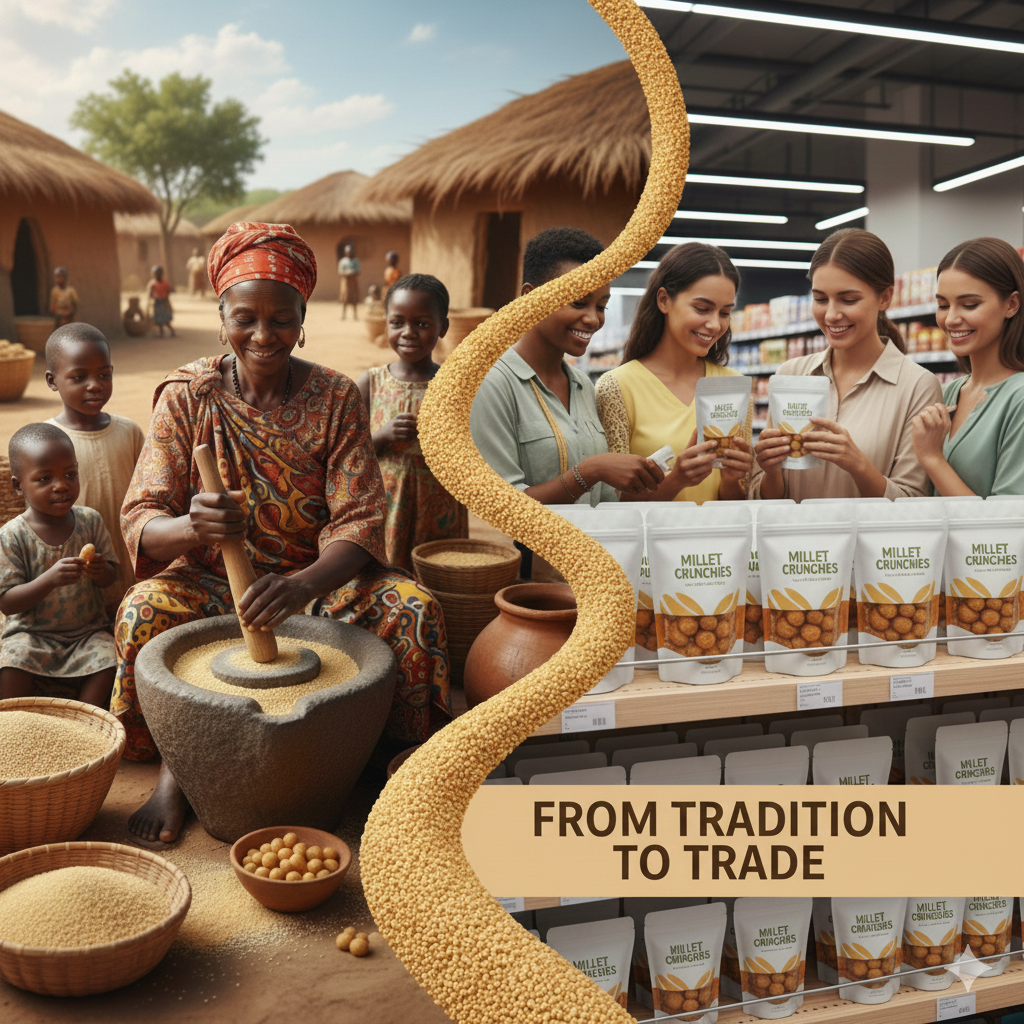
The idea of creating a food product often begins in the most familiar place — the home kitchen. For many entrepreneurs, traditional recipes carry both emotional value and untapped commercial potential. My journey of transforming a millet-based snack from a family favourite into a shelf-ready product revealed that success in the modern food market depends not only on passion, but on structured food product development backed by science and strategy.
Identifying a Market Opportunity Through Tradition
Millets have long been valued for their nutritional benefits, sustainability, and versatility. Despite their popularity in home cooking, millet-based snacks remain underrepresented in organized retail. Recognizing this gap was the first step toward new food product development. The challenge was clear: preserve the authenticity of a traditional snack while adapting it to meet modern consumer expectations for taste, safety, and convenience.
At the start, it seemed that refining flavor alone would be enough. However, as the idea moved closer to commercialization, it became evident that product development in the food industry is a multi-layered process that goes far beyond recipe perfection.
The Role of Food Formulation in Scaling Up
One of the most complex stages was food formulation. A recipe that works perfectly in small batches often behaves very differently when produced at scale. Early trials revealed issues with texture consistency, moisture control, and shelf stability. These challenges highlighted the importance of understanding ingredient functionality rather than relying solely on intuition.
Through systematic formulation trials, ingredient ratios were optimized to maintain crunch and mouthfeel. Natural stabilizers and binders were explored to improve product integrity without compromising clean-label expectations. Processing parameters such as roasting temperature and cooling time were also fine-tuned to retain flavor while enhancing shelf life.
This stage reinforced an important lesson: successful food product development is about strengthening a product’s foundation, not changing its identity.
Viewing the Product Through an Industry Lens
A major turning point came from working with a professional food consultant. Shifting from a personal perspective to an industry viewpoint changed how decisions were made. Questions around target demographics, pricing strategy, ingredient sourcing, and regulatory compliance became central to the process.
Understanding labeling laws, nutritional declarations, and permissible health claims helped position the product correctly in the market. Cost modeling ensured that quality improvements remained commercially viable. This structured guidance reduced risk and brought clarity to what can otherwise be an overwhelming process.
With expert input, new food product development became less about experimentation and more about informed decision-making.
Iteration: The Backbone of Product Development
No food product reaches the market without facing setbacks. Several formulations failed sensory evaluations, while others showed instability during storage testing. Rather than seeing these as failures, they became essential learning milestones.
Iteration is fundamental to product development in the food industry. Each round of testing provided data that guided improvements in flavor balance, texture uniformity, and shelf performance. Consumer feedback played a critical role in aligning the product with real-world expectations.
Over time, the snack evolved into a version that was not only technically sound but also consistently enjoyable — a key requirement for building a repeat customer base.
Building Consumer Trust Through Science
In today’s food market, trust is built through transparency and reliability. Scientific validation, safety assessments, and documented quality control processes are non-negotiable. By investing in proper testing and standardization, the product gained credibility with retailers, distributors, and consumers alike.
This stage emphasized that food product development carries responsibility. Every product placed on a shelf represents a promise of safety, nutrition, and consistency. Meeting that promise requires discipline and adherence to industry standards.
Motivation Through a Structured Development Process
Seeing the product progress through clear development stages — formulation approval, shelf-life validation, packaging compatibility — provided motivation and direction. Structured new food product development not only reduced uncertainty but also allowed creative energy to shift toward branding and storytelling.
With a strong technical base in place, it became easier to communicate the product’s value proposition and connect with health-conscious consumers seeking authentic, nutritious snacks.
The Importance of the Right Development Partner
This transformation would not have been possible without expert support. Food Research Lab played a pivotal role throughout the journey, offering end-to-end assistance — from formulation optimization and sensory testing to regulatory guidance and commercialization planning.
As a trusted food consultant, Food Research Lab ensured that the product met industry standards while staying true to its traditional roots. Their scientific approach and practical insights bridged the gap between a homemade idea and a market-ready brand.
Conclusion
The journey from a traditional millet snack to a scalable food product demonstrates what thoughtful product development in the food industry can achieve. With the right blend of passion, science, and expert guidance, culturally rooted ideas can evolve into credible, competitive food brands.
This experience stands as proof that structured food product development, supported by partners like Food Research Lab, can turn meaningful ideas into trusted products that resonate with modern consumers — without losing their original soul.