

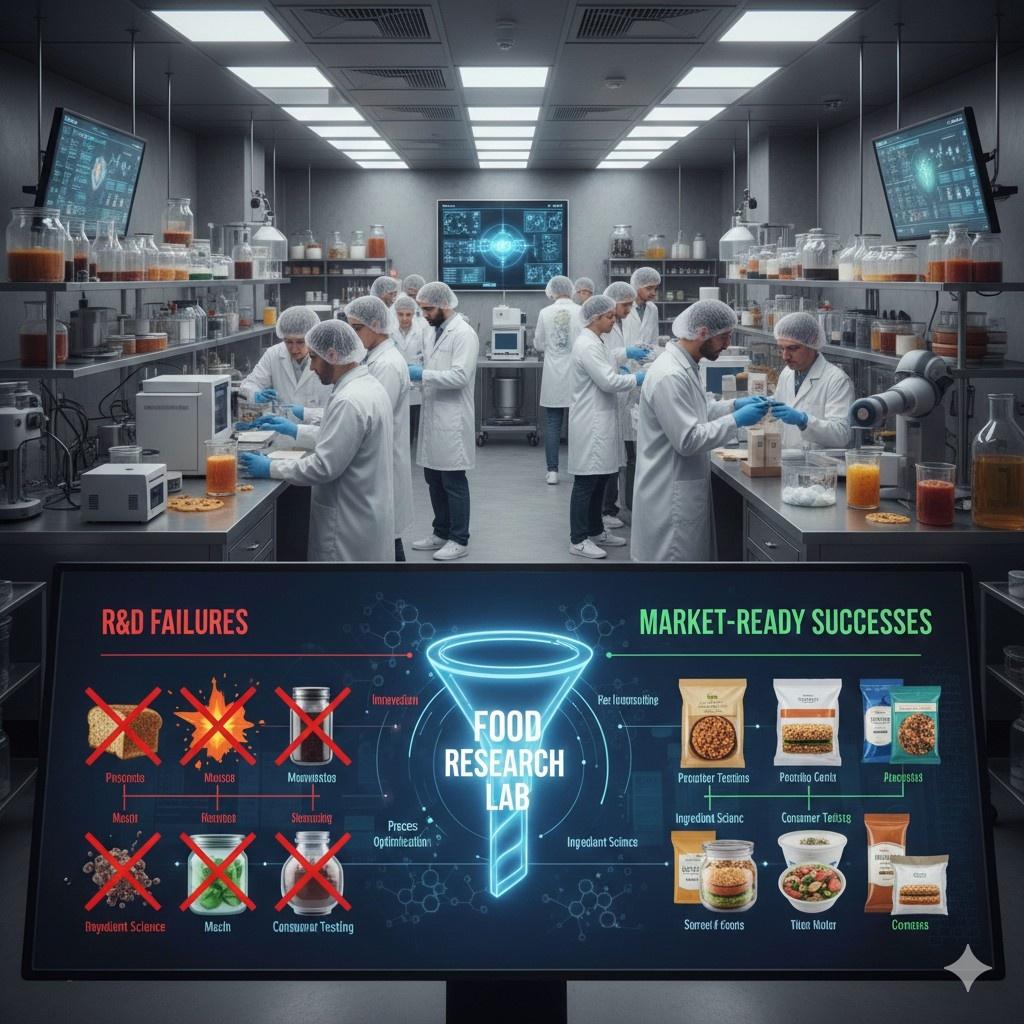
Innovation is the engine of the modern food industry—but it is also where many companies struggle the most. Despite investing time, money, and internal R&D resources, countless ideas never make it past the prototype stage. Some fail during formulation, others collapse during scale-up, and many more fall short on regulatory or sensory expectations. The truth is that new food product development is not just about creativity; it is about executing science, process, and strategy with precision.
This is where Food Research Lab (FRL) steps in. As a team of experienced technologists, food scientists, regulatory experts, and process engineers, FRL specializes in turning incomplete concepts and struggling prototypes into commercially viable, consumer-ready products. Through structured processes, technical expertise, and problem-solving methodologies, FRL helps manufacturers navigate the hurdles that commonly derail food innovations.
Why R&D Fails in the Food Industry
In product development in the food industry, failures happen for predictable reasons—and most are avoidable with the right technical support.
1. Unstable Formulations
The biggest challenge is formulation instability. Beverages separate, bars harden, sauces curdle, proteins precipitate, and fats oxidize. Without expert food formulation knowledge, companies often rely on trial and error, resulting in:
- Incorrect ingredient ratios
- Poor functional ingredient choices
- Incompatibility during thermal processing
- Sensory deterioration over time
These failures halt progress long before a product reaches consumers.
2. Sensory Mismatch with Consumer Expectations
Taste, aroma, and texture are everything. Even nutritionally strong products fail if they don’t deliver an enjoyable eating experience. Many R&D teams struggle to balance flavor systems, mask bitterness, or achieve desirable mouthfeel.
3. Scale-Up Problems Between Lab and Factory
A small-batch prototype may be perfect, but when production moves to industrial equipment:
- Heating profiles change
- Shear levels differ
- Ingredient hydration varies
- Viscosity behaves unpredictably
This leads to inconsistent quality, batch failures, or poor yield.
4. Lack of Regulatory Alignment
A product may taste great—but still fail regulatory checks for labeling, claims, permitted additives, or nutritional requirements. This is one of the most common reasons for costly reformulations.
5. Insufficient Technical Documentation
Manufacturers often lack the technical specification sheets, process flow charts, and SOPs needed for seamless production.
How Food Research Lab Converts Challenges into Solutions
Food Research Lab provides new product development services that follow a structured, proven workflow to identify problems early and build solutions that support commercial success.
1. Diagnose the Root Cause with Technical Precision
Instead of guessing, FRL uses:
- Ingredient functionality mapping
- Stability testing
- Sensory evaluation panels
- Shelf-life modeling
- Microbial and physico-chemical analysis
This identifies exactly why a prototype fails—giving companies clarity they often miss internally.
2. Redesign Formulations for Stability, Taste, and Nutrition
FRL’s food technologists reformulate products scientifically, ensuring:
- Stable emulsions
- Improved viscosity control
- Balanced sweetness and bitterness
- Optimized protein interactions
- Controlled moisture and water activity
- Clean-label ingredient replacements
This expert approach to food formulation ensures the final product is robust and commercially feasible.
3. Solve Scale-Up Problems with Pilot Trials
Most R&D teams do not have access to pilot-plant facilities. FRL bridges this gap by:
- Replicating industrial processing conditions
- Adjusting formulations for different equipment
- Optimizing thermal processing
- Mapping heat/shear profiles
- Validating yields and batch consistency
This ensures the product that leaves the factory is identical to the laboratory prototype—something many brands struggle with.
4. Ensure Regulatory Compliance for Local and Global Markets
FRL’s regulatory specialists check:
- Ingredient approval status
- Additive limits
- Nutrition claims
- Labeling requirements
- Allergen declaration rules
- International compliance for export markets
This prevents expensive reformulations and failed market launches.
5. Prepare Complete Technical Documentation for Manufacturers
FRL provides:
- Standard Operating Procedures (SOPs)
- Processing flow charts
- Ingredient specification sheets
- Quality control guidelines
- Shelf-life documentation
This reduces production errors and enhances communication between R&D and manufacturing teams.
How Food Research Lab Supports the Entire Innovation Journey
Food Research Lab does not just fix problems—it acts as an innovation partner. By integrating formulation science, process engineering, regulatory expertise, and sensory optimization, FRL ensures that every stage of food product development moves smoothly.
Whether the product is a beverage, snack, bakery item, plant-based food, confectionery, or functional supplement, FRL’s food consultants guide companies from idea generation to market-ready success.
Conclusion: From Failure to Commercial Success
R&D failures do not signal the end of an idea—they signal the need for expert intervention. With Food Research Lab’s structured approach and scientific expertise, companies transform unstable prototypes, incomplete concepts, and problematic formulations into stable, scalable, and regulatory-compliant food products prepared for market launch.
In an industry where innovation defines growth, partnering with Food Research Lab ensures that your ideas reach the shelves—not the scrap pile.