
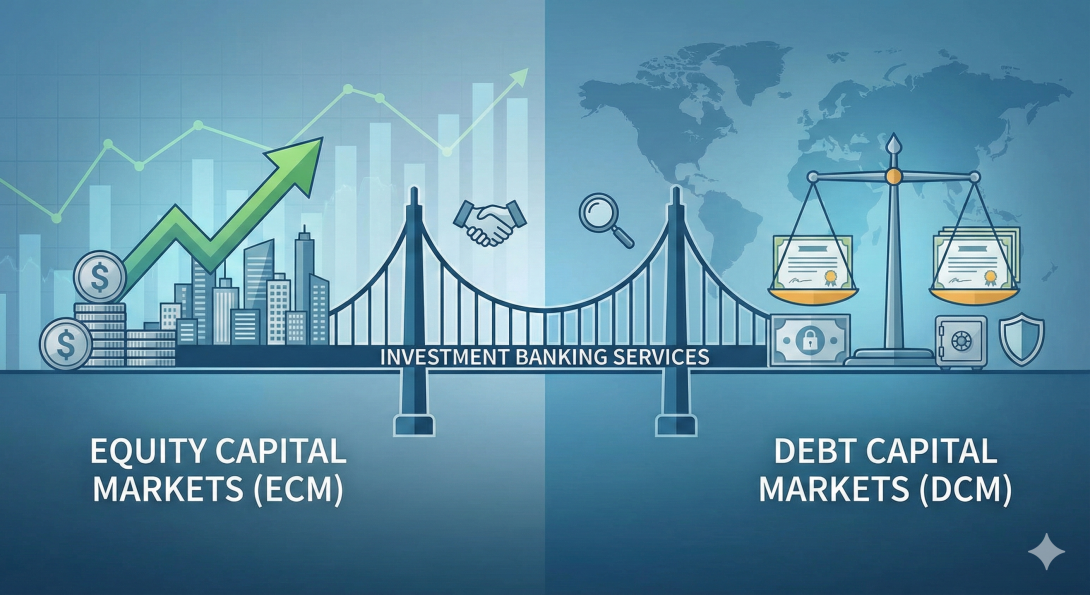
In the capital markets, equity capital markets and debt capital markets services play a significant role in helping companies raise funds, optimize their capital structure, and fulfill their long-term strategic objectives. For investment bankers, ECM and DCM transactions are not about the mere execution but value creation, mitigation of risk, and a long-term relationship with the client base.
Understanding what investment bankers are looking for from ECM and DCM services provides real insight into how deals are evaluated, structured, and brought to market successfully.
Understanding ECM and DCM in Investment Banking
Before exploring these concepts in more detail, it is necessary to understand the difference between these two terms:
- The ECM services would provide equity instruments like IPO, FPOs, rights issues, and private placements for raising capital.
- The DCM services include raising funds through debt instruments, such as bonds, debentures, syndicated loans, and structured debt products.
While each aims to raise money, both the valuation criteria and execution priorities differ quite significantly.
What Investment Bankers Look for in ECM Services
1. Strong Equity Story and Growth Potential
In ECM transactions, the investment bankers consider the growth narrative or the long-term scalability. ECM services for investment banks concentrate on whether or not the issuer has a convincing equity story that can help gain the interest of public and institutional investors. Key factors include visibility of revenue growth, competitive positioning, industry trends, and the potential for expansion. A well-defined equity story backed by credible data is important for investor confidence and favourable valuations in equity offerings.
2. Financial Performance and Transparency
Investment banks thoroughly analyze historical and pro forma financial data. Sound financials, stable earnings, and transparency are vital for ECM transactions.
They search for:
- Consistent patterns of revenue and profitability
- Healthy margins
- Strong cash flow generation
- High-quality governance and compliance
Any red flags could affect the level of investor confidence and success.
3. Valuation Readiness and Market Timing
Accurate valuation is critical to ECM success. Bankers assess comparisons from peers, market sentiment, and market demand to make a judgment on the company’s readiness for the market.
It also evaluates market timing factors that include:
- Equity market conditions
- Sector performance
- Volatility levels
- Liquidity environment
Even the best firms can delay ECM transactions when market conditions are not optimal.
4. Management Quality and Credibility
In the equity market, investors invest in the business and its leadership. Investment bankers assess the strength and vision of the management team and their communication capabilities with investors.
Better leadership increases confidence in the areas of execution, governance, as well as strategy.
5. Regulatory and Compliance Readiness
In ECM transactions, the process undergoes intense regulatory review. The bankers search for the companies that are best equipped to handle the requirements for disclosing information, listing, and ongoing compliance.
It streamlines the regulatory process and hence lessens execution risk and enhances the speed of closing deals.
What Investment Bankers Look for in DCM Services
1. Creditworthiness and Risk Profile
In DCM deals, growth becomes less important than credit risk. DCM support services for investment banking strongly emphasize in-depth credit analysis of the issuer to consider leverage ratios, debt coverage, cash flow generation, and current indebtedness. Investment bankers rely upon these evaluations to create debt securities that are well-balanced in terms of risk-adjusted rewards. This supports competitive pricing and efficient execution.
2. Stable and Predictable Cash Flows
Unlike equity investors, debt investors focus more on capital protection and income generation. They value issuers who have stable operating cash flow and the ability to service their debt comfortably.
As a result, sectors with steady and recurring revenues and fixed demand are preferred in the DCM market.
3. Optimal Capital Structure
Investment bankers assess whether the proposed debt issuance aligns with the company’s overall capital structure strategy. The aim is to balance leverage with financial flexibility.
They examine:
- Existing debt obligations
- Maturity profiles
- Risk of refinancing
- Effect of credit ratios
Well-structured debt can enhance long-term sustainability.
4. Pricing Efficiency and Investor Demand
In a DCM transaction, pricing efficiency matters considerably. Bankers examine market interest rates, investor demand, and similar transactions to determine optimal coupon rates and tenors.
They also assess:
- Institutional investor appetite
- Market liquidity
- Macroeconomic environment
Efficient pricing is key to successful placement and avoids future refinancing risks.
5. Documentation, Covenants, and Risk Mitigation
DCM transactions require complex legal documentation and obligations. Investment bankers seek clarity and balance of the terms, ensuring investor protection without being too limiting for issuer flexibility.
Having strong covenant structures motivates higher confidence in investors.
Conclusion
Investment bankers assess the ECM and DCM services offered through different perspectives, but the fundamental objective remains the same. They aim for successful capital raising with the least risk and maximum value creation.
In ECM, the most valuable attributes for a bank are growth potential, valuation, market timing, and marketability. In DCM, the key attributes include credit quality, cash flow management, pricing effectiveness, and risk management.
Those companies that have such understandings and prepare for them are best equipped for the effective completion of capital market transactions. Ultimately, it is alignment that plays a critical part in the successful accomplishment of equity and debt capital market transactions.