
Introduction
AI is reshaping industries everywhere, and enterprise finance hasn't been spared. As Oracle keeps weaving AI deeper into Oracle Cloud ERP, a lot of aspiring professionals are asking the obvious question: is this going to create more jobs, or quietly wipe some out? The honest answer is a bit more nuanced than either extreme, AI is automating the repetitive stuff, sure, but it's also opening up entirely new career paths that blend functional expertise, business knowledge, and tech awareness.
Tech Leads IT built its Oracle Fusion Financials Training to prepare learners for exactly this landscape, real Oracle Cloud ERP skills combined with genuine understanding of how AI actually fits into financial processes now.
If you're weighing whether to enroll in an Oracle Fusion Financials Course, it's worth understanding how AI is actually shaping the job market, and why the right skills are only becoming more valuable, not less.
What AI in Oracle Fusion Financials Actually Looks Like
We're talking about machine learning, predictive analytics, intelligent automation, and data-driven recommendations, all working together to improve financial operations. AI helps by automating repetitive tasks, sharpening reporting accuracy, predicting trends, catching anomalies, and generally making decision-making faster. It's there to help finance professionals do their jobs better, not do the job for them.
Why Businesses Keep Adopting It
Companies are dealing with more financial data and more complex operations than ever, and manual processes just can't keep up anymore. AI helps by processing transactions faster, cutting down errors, tightening compliance, speeding up financial closing, supporting strategic planning, and delivering real-time insights. That combination is exactly why it's become such a core part of modern Oracle Cloud ERP rollouts.
So, Is AI Actually Reducing These Jobs?
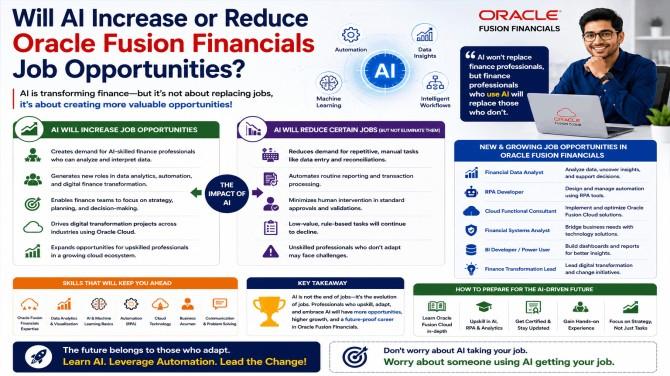
Not really. It's changing what the work looks like, not erasing it. Routine tasks like invoice matching, data entry, expense validation, payment processing, journal recommendations, and basic reconciliations are getting automated, no argument there. But organizations still need people who understand accounting principles, can configure Oracle Financial modules, analyze financial data, support ERP implementations, gather requirements, and solve genuinely complicated business problems. Automation takes the repetitive load, professionals handle everything that actually requires judgment.
How AI Is Actually Creating More Opportunities
Oracle Cloud consultants are in higher demand. As more businesses roll out Oracle Cloud ERP, they need people who understand both financial processes and AI-enabled tools. Roles like Oracle Fusion Financial Functional Consultant, Oracle Cloud ERP Consultant, and Finance Transformation Consultant keep growing in demand.
Finance roles are getting more strategic. With administrative work automated, professionals get to focus on financial planning, business analysis, performance monitoring, risk assessment, and decision support, work that's honestly a lot more interesting than data entry ever was.
Business analysts are needed more than ever. Someone has to actually interpret AI-generated insights and turn them into real decisions. That's a distinctly human skill, and it's not going anywhere.
Digital transformation projects keep expanding. Organizations migrating from legacy ERP systems need people to configure applications, test workflows, train users, manage change, and support the whole implementation, ongoing work that keeps creating jobs.
The Skills That'll Matter Most Going Forward
Real strength in the core modules, General Ledger, Accounts Payable, Accounts Receivable, Cash Management, Fixed Assets, and Financial Reporting, still forms the foundation, and solid Oracle Fusion Financials Training is what builds it. Accounting fundamentals like journal entries, trial balance, and financial statements remain essential for interpreting data correctly. Analytical thinking matters more than ever, since AI hands you insights, but you're still the one deciding what to actually do with them. Communication skills stay critical too, since consultants are constantly working with finance teams and clients. And honestly, staying a continuous learner is non-negotiable given how fast Oracle keeps rolling out new AI features.
Industries Where This Demand Keeps Growing
Banking, manufacturing, healthcare, retail, telecom, logistics, education, government, insurance, and IT are all hiring for this skill set, and as cloud adoption keeps expanding, that demand isn't slowing down anytime soon.
Career Paths Worth Targeting
After completing an Oracle Fusion Financials Course, roles worth aiming for include Oracle Fusion Financial Functional Consultant, Oracle Cloud ERP Consultant, ERP Functional Analyst, Financial Systems Analyst, Finance Transformation Consultant, and Business Process Consultant, careers that combine real finance knowledge with modern cloud technology.
How Freshers Can Stay Ahead of This
Build genuinely strong functional knowledge in the Oracle modules, practice real scenarios instead of just theory, understand how AI actually supports finance rather than fearing it, sharpen your soft skills like communication and adaptability, and don't skip mock interviews, they matter more than people expect.
Why Real Training Still Makes the Difference
A structured Oracle Fusion Financials Training program gives you expert-led instruction, genuine hands-on Oracle Cloud practice, real business scenarios, interview prep, resume guidance, and placement support, everything you need to actually thrive in this AI-enabled environment, not just survive it.
Where This Is All Headed
The outlook here genuinely looks strong. AI will keep automating the repetitive work, but it'll also keep increasing demand for people who can manage complex processes, configure Oracle systems, analyze financial data, and support digital transformation. Organizations aren't slowing down their Oracle Cloud ERP investment, which means functional consultants, analysts, and implementation specialists will keep finding solid opportunities.
Conclusion
AI isn't shrinking the Oracle Fusion Financials job market, it's transforming it. Automation is taking over the repetitive grind, but professionals remain essential for analysis, consulting, implementation, and genuine strategic decision-making. Demand for skilled Oracle Fusion Financials professionals keeps growing as more organizations modernize their finance operations. Enrolling in Oracle Fusion Financials Training prepares you for exactly this evolving landscape, and a comprehensive Oracle Fusion Financials Course gives you the functional expertise, practical experience, and AI awareness needed to build a genuinely future-ready career in Oracle Cloud ERP.