

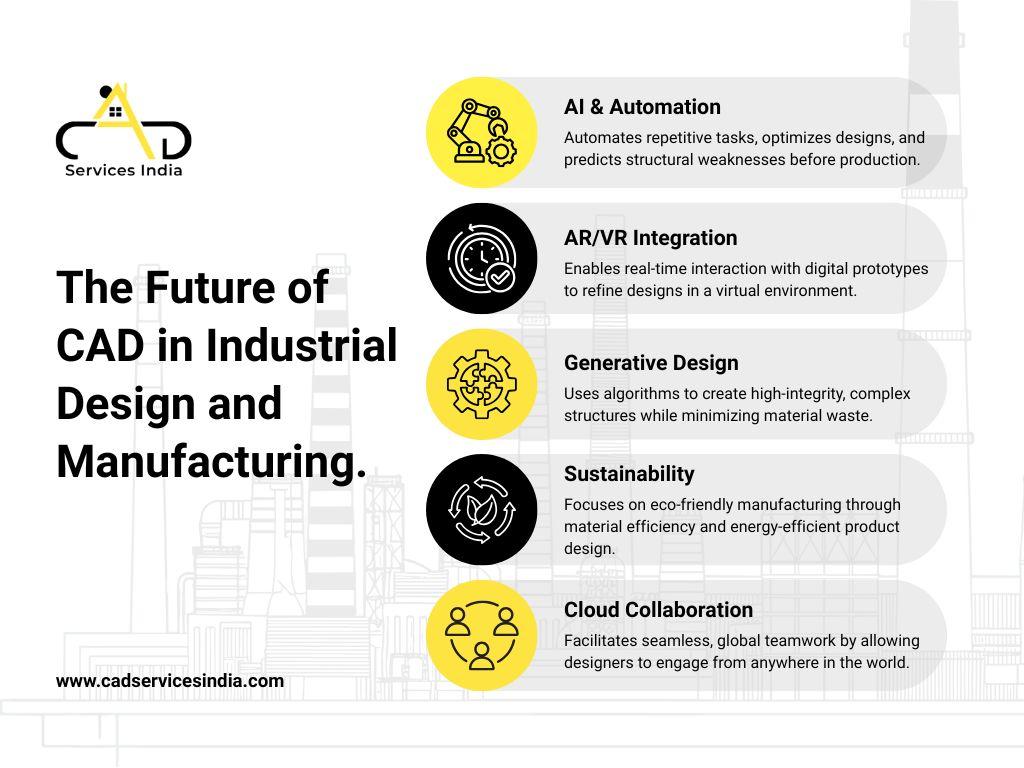
Did you know that according to recent McKinsey research, digital transformation in manufacturing can trigger a 20% to 30% increase in overall productivity? We aren't just talking about faster drawing tools; we are witnessing a fundamental shift in how the physical world is conceived. For decades, Computer-Aided Design (CAD) was essentially a digital version of the drafting board. Today, it has evolved into the "central nervous system" of the entire manufacturing lifecycle.
The AEC and manufacturing sectors are converging at a breakneck pace. Whether you are an architect designing modular components or a mechanical engineer optimizing a turbine blade, the tools we use are no longer passive. They are becoming intelligent partners. This shift highlights why understanding the importance of CAD in industrial design and manufacturing has become a prerequisite for staying competitive in a global market.
1. Generative Design: From Drafting to Co-Creation
Traditionally, an engineer would create a design and then test it. Generative design flips the script. By utilizing AI algorithms and cloud computing, designers now input constraints—such as material type, weight limits, and budget—and the software outputs thousands of optimized solutions.
- The Business Impact: It’s not just about "cool shapes." Research from Autodesk suggests that generative design can reduce material waste by up to 40%.
- The Human Touch: This doesn't replace the engineer; it liberates them from the "grunt work" of manual iteration, allowing them to focus on high-level creativity and problem-solving.
2. The Digital Twin: Bridging the Virtual-Physical Divide
We’ve moved past static 3D models. The future lies in the Digital Twin a dynamic, virtual representation of a physical asset that updates in real-time via IoT (Internet of Things) sensors.
- Global Insight: In the EU and North America, Tier 1 manufacturers are already using digital twins to predict equipment failure before it happens.
- Actionable Angle: For facility managers, this means moving from "reactive repair" to "predictive maintenance," potentially saving millions in unplanned downtime.
3. Cloud-Native Collaboration and Data Sovereignty
The "silo" is dying. Modern CAD platforms are moving to the cloud, allowing an engineer in Singapore, a consultant in London, and a fabricator in Chicago to work on the same model simultaneously.
- The Challenge: With this connectivity comes the hurdle of data security and Intellectual Property (IP) protection.
- The Shift: We are seeing a move toward Common Data Environments (CDEs) where version control is automated, ensuring that the "single source of truth" is never compromised.
4. Additive Manufacturing (3D Printing) Integration
For years, 3D printing was for prototyping. Now, it’s for production. Modern CAD tools are being rebuilt with Design for Additive Manufacturing (DfAM) at their core.
- Technical Reality: We are now designing parts with internal lattice structures that were literally impossible to manufacture via traditional milling or casting.
- Sustainability: By only using the material necessary for the part, manufacturers are significantly hitting their ESG (Environmental, Social, and Governance) targets.
5. AR/VR: The End of the 2D Screen
Why look at a 24-inch monitor when you can walk through your machine? Augmented Reality (AR) and Virtual Reality (VR) are becoming standard for design reviews and assembly training.
- Practical Application: On-site contractors can now overlay CAD models onto physical spaces using AR glasses, identifying "clashes" between pipes and beams before a single bolt is turned.
Actionable Takeaways for AEC Professionals
- Audit Your Tech Stack: Is your current CAD software cloud-compatible, or are you still emailing files back and forth? The latter is a hidden tax on your productivity.
- Invest in Upskilling: The role of the "drafter" is evolving into the "computational designer." Encourage your team to explore algorithmic modeling.
- Data Over Intuition: Start integrating IoT sensors into your prototypes. Use the data to inform your next design iteration rather than relying solely on "gut feeling."
The Road Ahead
The boundary between "designing" and "making" is blurring. As AI continues to mature, we will see CAD systems that don't just ask "What do you want to draw?" but "What problem are you trying to solve?" The future of industrial manufacturing isn't just digital—it's autonomous, collaborative, and incredibly efficient.