

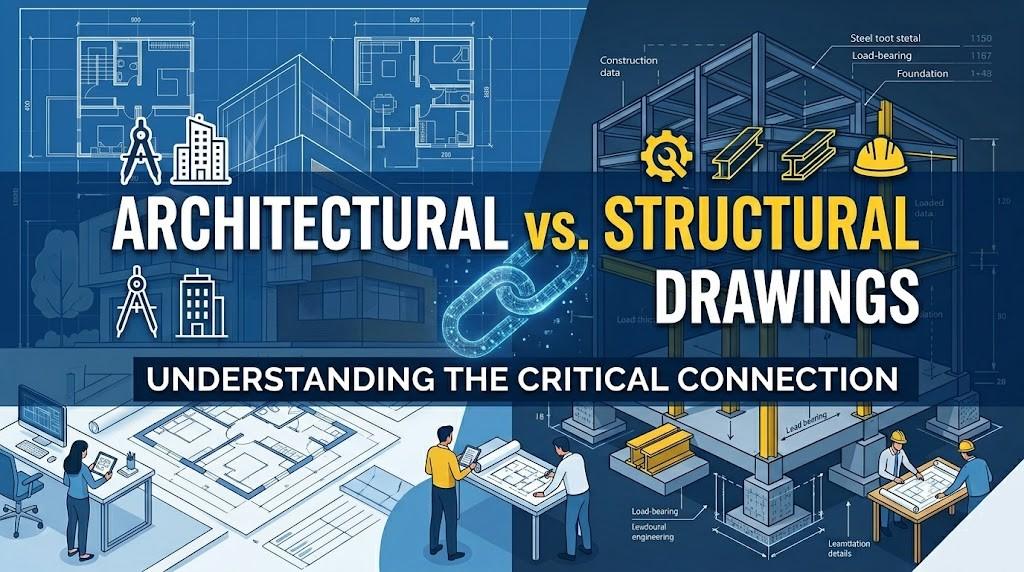
Did you know that according to a 2023 report by the Autodesk and FMI Corporation, nearly 35% of all construction project costs are lost to rework caused by poor project data and communication gaps? At the heart of this challenge lies the fundamental relationship between architectural and structural drawings. When these two distinct "languages" of design aren't perfectly synchronized, the result isn't just a headache—it’s a drain on the budget and a risk to the schedule.
In the high-stakes world of the Architecture, Engineering, and Construction (AEC) industry, the transition from a visionary design to a standing reality depends on how well we bridge the gap between form and firmness. As we lean deeper into digital transformation and Building Information Modeling (BIM), understanding the nuances between these two drawing sets has evolved from a basic requirement to a strategic advantage for project managers and developers alike.
The Visionary Blueprint: Defining Architectural Drawings
Architectural drawings are the "soul" of the building. They define the aesthetics, functionality, and spatial experience. For an architect, the goal is to translate a client's requirements into a habitable space that meets building codes and environmental standards.
These drawings encompass everything from the site plan and floor layouts to the specific finishes on a wall. They are the primary tool for communicating with the client and obtaining initial planning permissions. However, while they define where a wall goes, they don't necessarily explain how that wall stays upright under a seismic load. This is a crucial distinction in the different types of drawings used in construction, where each set serves a unique purpose in the project lifecycle.
Key Components of Architectural Sets:
- Floor Plans and Elevations: Mapping out the horizontal and vertical flow.
- Section Drawings: Cutting through the building to show interior heights and material layers.
- Schedule Tables: Detailed lists for doors, windows, and finishes.
The Skeleton of the Build: The Role of Structural Drawings
If architectural drawings are the soul, structural drawings are the "skeleton." Created by structural engineers, these documents focus on the load-bearing capacity and the integrity of the building. According to a study by the Institution of Structural Engineers, structural errors account for roughly 10-15% of construction delays globally when not identified during the pre-construction phase.
Structural drawings don't care about the color of the carpet; they care about the PSI (Pounds per Square Inch) of the concrete and the grade of the steel reinforcement. They translate the architect's vision into a buildable, safe structure that can withstand dead loads (the building's weight), live loads (people and furniture), and environmental loads (wind and snow).
Essential Elements in Structural Sets:
- Foundation Plans: Details on footings, piers, and slabs-on-grade.
- Framing Plans: The layout of beams, joists, and rafters.
- Connection Details: Specific instructions on how steel members are bolted or welded.
The Critical Connection: Where Design Meets Physics
The magic—and the friction—happens at the intersection of these two disciplines. In a traditional 2D workflow, "clash detection" was a manual, grueling process. Today, the AEC industry utilizes Construction Documentation Services to ensure that an architect’s sleek, floor-to-ceiling glass window doesn't conflict with a structural engineer's necessary cross-bracing.
One of the most significant shifts we've seen is the move toward BIM Level 2 and Level 3. By integrating architectural and structural data into a single "Federated Model," teams can identify discrepancies in the digital twin before a single shovel hits the dirt. This level of construction documentation services allows for real-time collaboration, reducing the RFI (Request for Information) cycles by up to 20-30% on complex commercial projects.
Common Conflict Points:
- Vertical Alignment: Architectural floor heights vs. structural beam depths.
- Penetrations: Mechanical ducts needing to pass through structural members.
- Load Distribution: Adding heavy architectural features (like a rooftop garden) that the original structural skeleton wasn't designed to support.
Global Trends and Regional Nuances
The way we handle these drawings varies significantly across the globe. In the United States, the AIA (American Institute of Architects) standards heavily influence how these sets are organized. Meanwhile, in the European Union, the Eurocodes provide a unified approach to structural design, emphasizing sustainability and carbon footprint—meaning architectural and structural drawings must now also align on "embodied carbon" metrics.
In the Asia-Pacific region, particularly in high-density hubs like Singapore and Hong Kong, the use of DfMA (Design for Manufacture and Assembly) is forcing architectural and structural drawings to merge even earlier in the design phase. If you are pre-fabricating a bathroom pod, the structural tolerances must be millimetre-perfect within the architectural shell.
Actionable Takeaways for AEC Professionals
Navigating the gap between these two drawing types requires more than just technical skill; it requires a process-driven approach. Here is how you can ensure your project remains "clash-free":
- Establish a Common Data Environment (CDE): Use platforms like BIM 360 or Revizto to host both drawing sets. This ensures everyone is working off the latest version.
- Mandate Regular Coordination Meetings: Schedule "Clash Resolution" sessions every fortnight. Don't wait for the contractor to find the problem on-site.
- Focus on Detail Consistency: Ensure that the "Grid Lines" on the architectural set match the structural set perfectly. A 50mm offset on paper can lead to a multi-thousand dollar mistake in the field.
- Leverage Specialized Services: If your in-house team is overstretched, utilizing professional construction documentation services can provide an objective third-party review of your drawing sets.
Conclusion: Moving Toward a Unified Future
As we look toward 2030, the line between architectural and structural drawings will continue to blur. The rise of Generative Design and AI-driven structural optimization means that architects can now receive real-time structural feedback as they move a wall in their digital workspace.
The goal isn't just to have two sets of drawings that don't disagree; the goal is to have a single, unified source of truth that empowers builders to work faster, safer, and more sustainably. By respecting the distinct roles of the architect and the engineer while forcing their drawings into a constant, digital dialogue, we can finally eliminate the "rework tax" that has plagued our industry for decades.