
The regulatory landscape for corporate sustainability in the United Arab Emirates has undergone a fundamental transformation. What was once a voluntary commitment to environmental stewardship has become a binding legal obligation with significant financial consequences for non-compliance. Federal Decree-Law No. 11 of 2024 on the Reduction of Climate Change Effects has turned climate reporting from a reputational nicety into a legal duty. For business continuity managers, compliance officers, and organizational leaders, understanding the complex web of requirements is essential. This is where professional ESG consultancy becomes not just advantageous but indispensable for ensuring regulatory adherence and maintaining stakeholder confidence.
The 2026 Regulatory Reality for UAE ESG Reporting
Mandatory Emissions Reporting Under Federal Decree-Law No. 11
Federal Decree-Law No. 11 of 2024 entered into force on 30 May 2025, establishing a binding legal obligation for companies to measure, report, and reduce greenhouse gas emissions. The law applies broadly to all emissions sources in the UAE, including companies in free zones, with no minimum size or sector threshold. Full compliance was expected by 30 May 2026, marking a critical turning point in national enforcement.
Under this framework, UAE ESG reporting is no longer a matter of corporate discretion. Organizations must measure and report Scope 1 and Scope 2 emissions through the Ministry of Climate Change and Environment's national MRV Transparency System. Entities must retain emissions records and supporting evidence for at least five years and cooperate with regulators by providing access to data and records on request. Non-compliance carries significant penalties, with fines ranging from AED 50,000 to AED 2 million, and repeat violations attracting sanctions of up to AED 4 million.
The Four-Layer Compliance Landscape
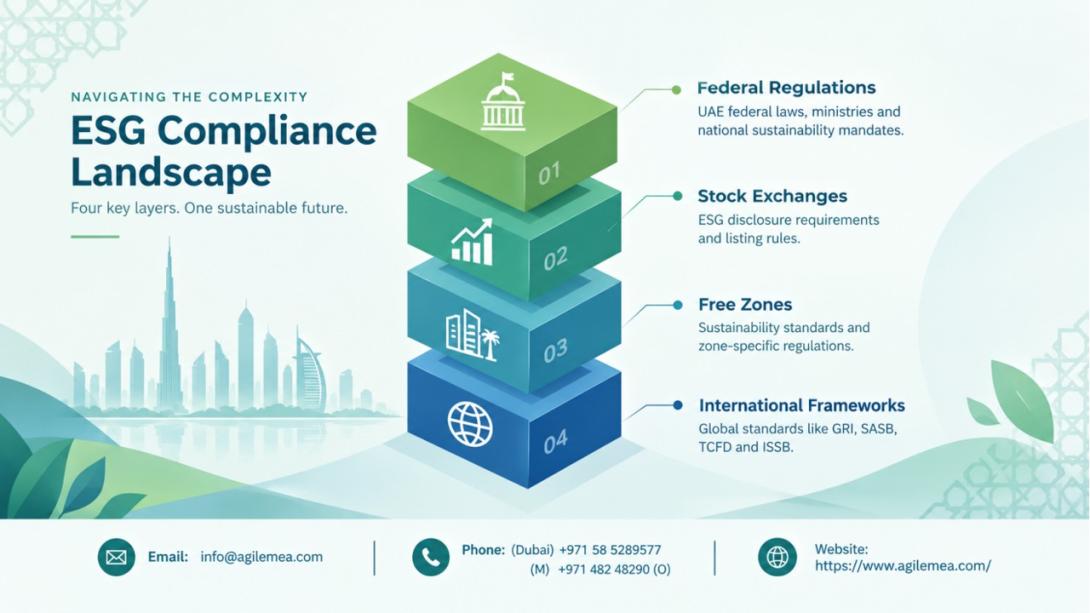
As of 2026, organizations should think of UAE ESG compliance as four interconnected layers.
- Layer 1 represents federal climate reporting requirements under Federal Decree-Law No. 11, which applies broadly across entities operating in the country.
- Layer 2 encompasses ESG disclosure requirements for listed companies on the Dubai Financial Market and Abu Dhabi Securities Exchange, which mandate annual sustainability reports aligned with GRI and ISSB standards.
- Layer 3 addresses free zone ESG requirements, including the Abu Dhabi Global Market's comply-or-explain framework for qualifying entities.
- Layer 4 covers international reporting frameworks that determine how companies report their ESG performance.
Understanding ESG Reporting Frameworks
The Key Frameworks Shaping UAE ESG and Sustainability Reporting
While UAE regulations determine whether companies must report, ESG reporting frameworks determine how they report. The UAE reporting ecosystem increasingly converges around globally recognized standards. The Global Reporting Initiative remains the most widely adopted ESG and sustainability reporting standard across UAE organizations and exchanges. The International Sustainability Standards Board, through IFRS S1 and IFRS S2, is rapidly becoming the global baseline for investor-focused sustainability disclosures. The Task Force on Climate-related Financial Disclosures continues to be widely used across financial institutions.
Preferred frameworks for UAE ESG reporting include GRI, TCFD, and IFRS Sustainability Disclosure Standards. Companies are expected to align their disclosures with these internationally recognized frameworks, ensuring consistency with global reporting practices and credibility for international investors. This flexible approach allows organizations to maintain comparability while addressing local regulatory and stakeholder expectations.
The Shift to ISSB-Aligned Reporting
The UAE has been a regional leader in adopting ISSB-aligned requirements since 2020. Regulators are increasingly aligning with IFRS S1 and IFRS S2 standards while also working to embed interoperability with GRI and European ESG and Sustainability Reporting Standards. For listed companies, sustainability reporting must incorporate ISSB standards alongside GRI Standards and GCC-specific sustainability priorities.
The Critical Role of ESG Consultancy
Why Engage ESG Consultancy Services
Navigating the complex and rapidly evolving ESG regulatory environment requires specialized expertise. Professional ESG consultancy brings deep knowledge of local requirements, including the specific provisions of Federal Decree-Law No. 11, the national MRV platform, and the emerging carbon market framework. Expert consultants guide organizations through every stage of the compliance journey, from initial gap analysis to full reporting and verification.
Engaging ESG consultancy services delivers several strategic advantages.
- Enhanced compliance assurance through expert navigation of multi-layered regulatory requirements
- Improved data quality and reporting accuracy through established methodologies and systems
- Strategic alignment with international best practices and investor expectations
- Operational efficiency through systematic emissions tracking and reduction planning
Conclusion
The era of voluntary ESG reporting in the UAE has definitively ended. Federal Decree-Law No. 11 has transformed ESG and sustainability reporting from a choice into a legal duty with significant consequences for non-compliance. For business continuity managers, compliance officers, and organizational leaders, the path forward requires expert guidance. Engaging professional ESG consultancy ensures that your organization meets its regulatory obligations while capturing the strategic benefits that come with sustainability leadership. Whether you are a multinational corporation or a local enterprise, the support of experienced consultants can make the difference between compliance success and costly regulatory failure.