

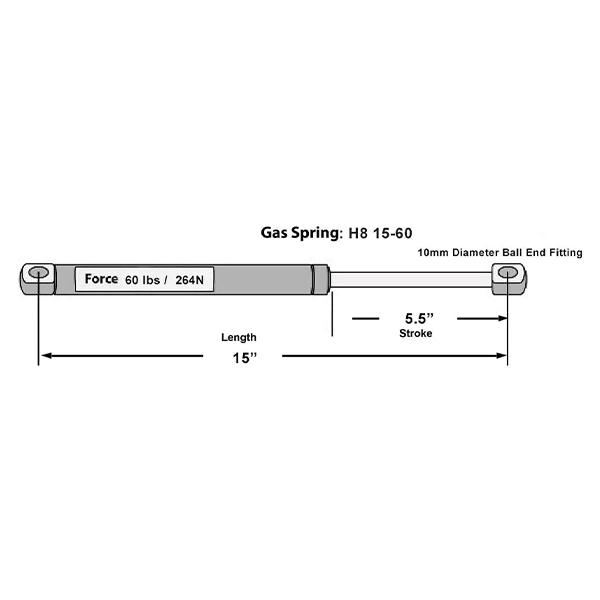
When your RV hatch, bed platform, or storage compartment no longer opens smoothly, it’s time to replace the gas spring. However, finding the correct replacement gas spring requires more than just guessing the size or strength. Choosing the right dimensions and pressure ensures proper function, safety, and longevity for your RV components. In this guide, we’ll walk you through how to measure for the correct replacement gas spring accurately.
1. Measure the Extended Length
The extended length is the distance between the centers of the two mounting points when the gas spring is fully extended.
- Step: Remove the old gas spring and extend it completely.
- Measure: From the center of one mounting point (ball socket or eyelet) to the center of the other.
This measurement is critical because an incorrect length can cause difficulty in opening or closing the hatch and may strain the hinges.
2. Determine the Stroke Length
The stroke length is the distance the piston rod travels between the fully open and fully closed positions.
- Step: Measure the length of the rod when it’s fully extended.
- Tip: The stroke should allow the hatch to open fully without overextending or binding.
A proper stroke ensures smooth motion and prevents damage to both the spring and mounting hardware.
3. Check the Force Rating
Every replacement gas spring has a specific force rating, typically listed in pounds (lbs) or newtons (N).
- Find this on: The side of your old gas spring (e.g., “40 lbs” or “176 N”).
- If unreadable: Estimate based on the hatch’s weight and size or consult a professional for guidance.
Choosing the right force rating ensures the hatch stays open securely without being too stiff or too weak.
4. Identify the Mounting Type
Gas springs come with different end fittings, such as ball sockets, brackets, or eyelets.
- Step: Note the fitting type and size used on your existing spring.
- Why it matters: Matching the correct fitting ensures the new gas spring attaches properly without modification.
If the end fittings are worn or damaged, replacing them along with the spring is recommended for safety.
5. Consider the Application Environment
Finally, consider where and how the replacement gas spring will be used. For RVs, it’s best to choose corrosion-resistant materials such as black nitrided rods or powder-coated tubes. These protect against rust and extend service life, especially in outdoor or humid conditions.
Selecting the correct replacement gas spring is key to restoring your RV’s functionality and ensuring long-lasting performance. By carefully measuring the extended length, stroke, force rating, and mounting type, you’ll get a perfect fit that offers smooth, controlled operation.
For premium-quality replacement gas springs designed for RVs and other applications, Hatchlift Products provides durable, high-performance lift solutions trusted by RV owners nationwide.