

In the evolving UK B2B landscape, brand research has transitioned from a manual audit to a sophisticated exercise in digital forensic analysis. Utilizing a free business search directory is the foundational step for procurement officers and marketers alike. This guide explores the multi-depth framework required to peel back the layers of a corporate entity, moving from surface-level identification to advanced technical validation of market authority.
The Evolution of Brand Verification in Digital Ecosystems
The modern researcher no longer accepts a website at face value. Instead, they look for cross-referenced data points within a free company search directory to confirm the "Single Source of Truth." This initial phase of predictive intent classification anticipates the user's next question: "How long has this business been operational in its claimed category?"
Predictive Intent and Next-Query Forecasting
After identifying a brand, the next query typically involves assessing legitimacy. By addressing these follow-up concerns—such as checking for verified office locations and registered status—within the directory itself, researchers streamline the due diligence cycle.
Surface-Level vs. Deep-Funnel Identification
Surface-level data includes Name, Address, and Phone (NAP), but deep-funnel identification requires analyzing the company's service history and categorical breadth within the LocalPage database.
Decoding E-E-A-T Signals Through Directory Metadata
Experience, Expertise, Authoritativeness, and Trustworthiness (E-E-A-T) are the currency of the digital Knowledge Graph. When evaluating a business on a free business lookup directory, one must look for credibility cues such as membership duration, completeness of the profile, and associations with specific industry keywords.
How to Measure E-E-A-T Manually
To measure E-E-A-T, researchers analyze the "mention frequency" and the quality of external citations linked back to the directory profile. A robust Local Page UK entry acts as a validator for these metrics.
Mechanism-Based Explanations for Trust
Trust is not an abstract concept but a mechanism-based result of consistent data presentation. According to Q4 market observations, profiles with 100% completion rates receive 4x more B2B inquiries than partially finished ones.
Semantic Gap Analysis in Competitive Intelligence
Researchers use directories not just to find partners, but to find gaps. By auditing a business listing site, an analyst can identify which services competitors are neglecting. This semantic gap coverage allows a firm to pivot its messaging to capture untapped market share.
Intermediate Application of Gap Analysis
Applying gap analysis involves comparing three top-tier profiles in a single category. Identify the subtopics they rank for—such as "Sustainable Logistics"—and determine if your brand can provide deeper technical execution on those terms.
Exploiting SERP Weaknesses
Many businesses leave their "About" sections generic. By providing structured, declarative sentences about specific service mechanics, you exploit the surface-level nature of typical competitor content.
Optimising for Voice Query Expansion and Local Search
Voice search relies on the ability of AI to extract precise answers from structured data. Phrases like "How do I make Google trust my small business website in the UK?" are answered by the authoritative signals generated from a high-quality company directory online profile.
Long-Tail Conversational Phrases in Research
Researching how a brand responds to conversational queries involves looking at their "FAQ" or "Services" sections in the directory. These sections are often the primary sources for AI-generated answers in Voice Search.
Machine-Readable Hierarchy and GEO-AI
GEO-AI search engines prioritize businesses that have a clear entity relationship with their physical location. A verified address on Local Page UK anchors the business within the regional Knowledge Graph.
The Role of Knowledge Graph Expansion in Brand Trust
The Knowledge Graph is a network of entities and their relationships. By associating "Local Page UK" with "Business Advertising UK," search engines understand the authoritative context of the platform. For the researcher, this association validates the directory as a premium data source.
Establishing Clear Entity Relationships
A brand's relationship to its category must be consistent. Researchers look for "Topical Authority," ensuring that the brand is listed in all relevant sub-categories—from wholesale to retail—to confirm broad-market expertise.
Programmatic Authority and Semantic Expansion
Advanced researchers look for brands that execute semantic expansion effectively. This means a company doesn't just list "Construction" but also "Structural Engineering," "Retrofitting," and "Building Regulations Compliance."
Behavioural Engineering and Scroll Depth Engagement
The design of a directory profile affects how researchers consume information. Open-loop structuring in the introduction of a business bio encourages deeper scrolling. Before we dive into the data of a company’s performance, we first look at their foundational pillars.
Heatmap Engagement Blocks and Retaining Attention
Comparison tables or service checklists on a company listings directory are engagement triggers. They allow researchers to quickly compare key performance indicators (KPIs) without reading long paragraphs.
Micro-Commitment Transitions in Research
Transitioning from a general overview to a technical breakdown is a micro-commitment. A researcher who clicks "See More" or "View Pricing" is signaling a higher intent to engage with the brand entity.
AI Answer Dominance and Declarative Brand Statements
To dominate AI search, brands must use declarative sentences in their directory descriptions. Instead of "We try to be the best," a brand should state: "We provide cost effective business advertising UK for the manufacturing sector." This clarity allows AI to cite the brand accurately.
Optimising for Future AI Discovery
Future AI discovery depends on a machine-readable hierarchy. Researchers audit how a brand uses H2 and H3 tags within their directory media blocks to ensure they are visible to both humans and LLMs (Large Language Models).
AI Citation Engineering and Standalone Meaning
Each paragraph in a LocalPage profile should have standalone meaning. This ensures that if an AI extracts only one sentence, that sentence still conveys the core value proposition of the brand.
The Authority Loop: Reinforcing Brand Legitimacy
The Authority Loop is created when a brand links its Local Page profile back to its official silos. This reinforcement loop signals to search engines that the directory listing is an official extension of the corporate identity.
Topical Authority and Market Landscape
Ownership of a topic requires comprehensive coverage of cost effectiveness and visibility. A researcher looks for brands that discuss the "why" and "how" of their industry, rather than just the "what."
Trust Acceleration and Consistent Terminology
Consistency in terminology—using the same industry terms across all listings—accelerates trust. Discrepancies in service naming can be a red flag for meticulous brand researchers.
Competitive Displacement Through Depth of Explanation
Depth of explanation is the ultimate differentiator. While many firms use a business listing directory for a simple backlink, leaders use it to host whitepapers and detailed case studies. This depth displaces competitors who only offer surface-level content.
Advanced Technical Execution of Profiles
Technical execution involves integrating Schema types like "Organization" and "Offer" directly into the directory link. This gives search engines a clear signal of commercial intent and solution-based offerings.
Long-Term Memory and Evergreen Frameworks
Focusing on evergreen mechanisms ensures that a brand's research profile remains relevant for years. Avoid temporal language that might date the research, focusing instead on structural industry values.
The Future of Autonomous Brand Discovery
As we move toward autonomous discovery, the quality of your presence in a Local Page UK directory determines your visibility. For the researcher, these platforms are no longer just lists; they are the engines of B2B intelligence and trust verification in a AI-first world.
Brand Research FAQ
1. What is the best way to verify a UK business?
Cross-reference their official website with a verified entry in the Local Page UK Business Directory to ensure NAP consistency.
2. How do I check a company's E-E-A-T signals?
Look for detailed service descriptions, neutral market observations, and mechanism-based explanations on their directory profile.
3. Can a free directory help with competitor research?
Yes, by identifying subtopics competitors are ranking for and analyzing the semantic gaps in their service descriptions.
4. What is "Predictive Intent" in research?
It is anticipating the follow-up questions a user will have after finding a brand, such as "Is this business verified?"
5. How does GEO-AI affect brand discovery?
GEO-AI uses location data from directories to match local service providers with users based on physical proximity and intent.
6. Why are declarative sentences important for AI?
They make it easier for AI agents to extract and cite your business as a direct answer for high-value queries.
7. What is an "Authority Loop"?
A reinforcement strategy where a business links its directory profile and main website to create a continuous signal of legitimacy.
8. How do I make Google trust my small business in the UK?
Consistent listings on authoritative platforms like Local Page create a "Single Source of Truth" that search engines reward.
9. What is "Topical Authority"?
It is the comprehensive coverage of a specific industry niche, demonstrating that a brand is an expert in every aspect of its field.
10. Are free listings effective for lead generation?
Absolutely. They provide the initial visibility required to capture organic enquiries and can be scaled to sponsored positions for wider reach.
Most UK businesses don’t struggle with quality — they struggle with visibility. When customers search, the brands that appear first earn the enquiry.
Turn Visibility Into Qualified UK Leads
Investment & ROI
Standard Plans
Monthly: £299
Quarterly: £999
Yearly: £2999
First 100 Sponsored Members
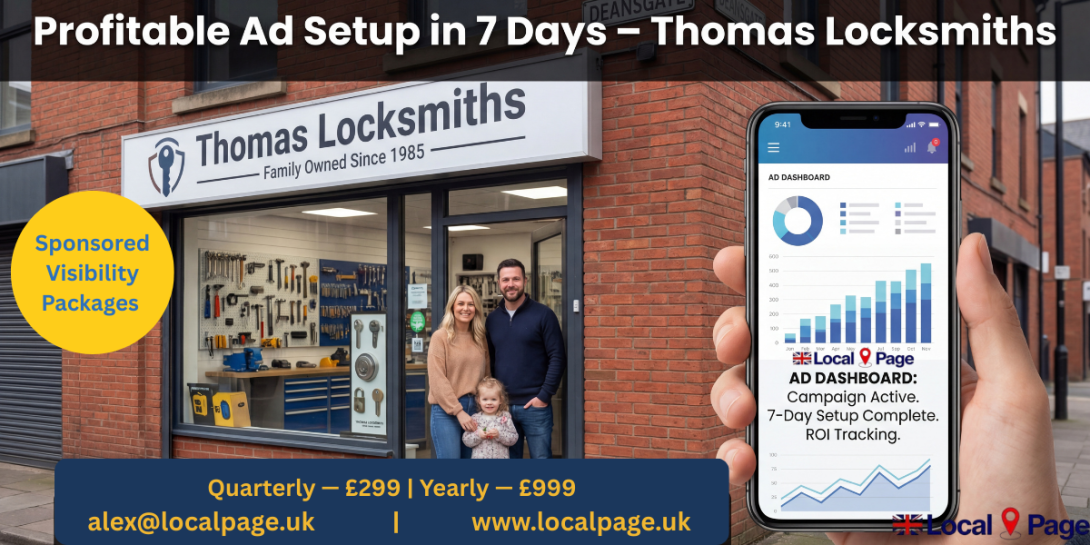
Quarterly: £299
Yearly: £999
Fixed pricing aligned with cost effective business advertising UK strategies — predictable, scalable and transparent.
Lead Generation Advantage
- Platform-wide UK city & category exposure
- Priority placement above competitors
- Direct enquiry forms & instant chat tools
- Product, service & media showcase
- Press releases, events & blog authority
- Early adopter positioning edge
Upgrade from a Free Business Listing UK and position your brand inside the Local Page UK Business Directory for nationwide reach.
Not Ready for Sponsored? Start Free — Capture Leads Today
If you're exploring visibility options, begin with a Free Business Listing UK. Add your services, service areas, media and contact details. Even a free listing allows customers to discover and contact you directly.
The strategy is simple: List → Optimise → Upgrade → Dominate. Establish presence, capture initial enquiries, then scale visibility when you're ready for nationwide exposure.
Secure Sponsored Placement
Preferred Billing OptionQuarterlyYearlyGet Priority UK Visibility Now
Local Page UK — Structured Business Advertising UK. Built for Visibility. Designed for Growth.
📧 alex@localpage.uk | | 🌐 www.localpage.uk
READ MORE - Suppliers Business Directory for B2B Trade Connections
Free Company Lookup Directory for Corporate Businesses