

Autonomous robots are moving beyond controlled environments into warehouses, manufacturing facilities, hospitals, agriculture, retail, and public spaces. To operate safely in these dynamic settings, robots need more than object detection. They must understand where individual objects are located, what their exact boundaries look like, and how different objects relate to their surroundings.
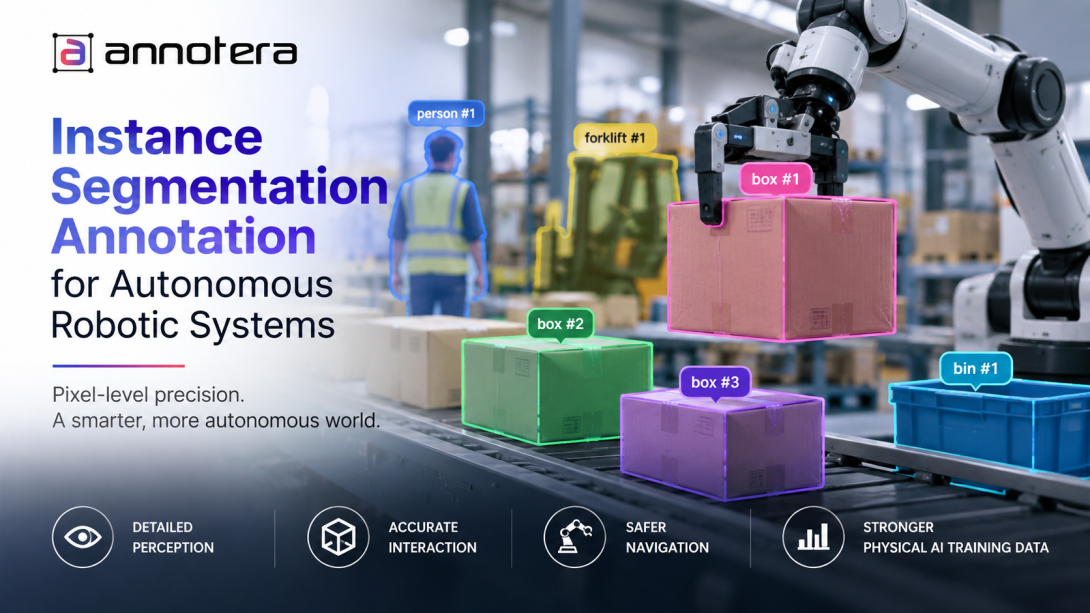
This is where instance segmentation annotation becomes critical. By assigning a unique pixel-level mask to every object instance, instance segmentation creates detailed training data that helps robotic systems develop more precise visual perception and decision-making capabilities.
For companies developing autonomous robots, high-quality annotated datasets can become a strategic advantage. Reliable robotics data annotation services help transform raw camera and sensor data into structured datasets that support perception models, navigation systems, manipulation tasks, and increasingly sophisticated Physical AI training data pipelines.
What Is Instance Segmentation Annotation?
Instance segmentation combines two important computer vision capabilities: object detection and semantic segmentation.
Semantic segmentation identifies the category of each pixel—for example, labeling pixels as "person," "vehicle," or "floor." Instance segmentation goes further by distinguishing between individual objects belonging to the same category.
For example, if a warehouse robot sees five boxes stacked on a pallet, semantic segmentation may identify all five as "boxes." Instance segmentation creates a separate mask for each box.
During annotation, trained annotators outline the precise pixel-level boundaries of each object and assign an individual instance ID and class label. The resulting dataset gives machine learning models detailed information about object identity, shape, position, and boundaries.
This precision is particularly valuable for autonomous robots that must interact with multiple objects simultaneously.
Why Instance Segmentation Matters for Autonomous Robots
Robots operating autonomously need to perceive their environment accurately before they can plan an action. Small perception errors can result in incorrect navigation, failed grasping, collisions, or inefficient task execution.
Instance segmentation supports robotic perception in several important ways.
1. Precise Object Localization
Bounding boxes provide approximate object locations, but they do not describe an object's exact shape. Pixel-level masks provide significantly more detailed spatial information.
A robotic arm, for example, can use segmentation data to distinguish the visible surface of a product from surrounding objects, helping its perception system identify potential grasping areas.
2. Better Obstacle Understanding
Autonomous mobile robots encounter people, equipment, shelves, packages, vehicles, and other obstacles. Instance-level masks help perception systems determine the exact regions occupied by these objects.
This information can improve obstacle avoidance and support more accurate path planning, particularly in crowded or unpredictable environments.
3. Distinguishing Similar Objects
Robotic environments frequently contain multiple objects from the same category. A warehouse robot may encounter dozens of identical packages, while an agricultural robot may see numerous fruits on the same plant.
Instance segmentation enables the model to distinguish each object separately, supporting object counting, tracking, picking, sorting, and manipulation.
4. Supporting Robotic Manipulation
Object manipulation requires more than recognizing an object category. Robots need to understand an object's shape, position, orientation, and relationship to nearby objects.
High-quality segmentation masks can provide training signals for robotic grasping and manipulation models, helping robots identify objects that can be safely picked up or moved.
Applications Across Robotic Systems
Instance segmentation annotation has applications across a broad range of autonomous robotic technologies.
- Warehouse and logistics robots: Robots can identify individual packages, pallets, containers, workers, and equipment while navigating busy facilities.
- Industrial robots: Segmentation supports inspection, component identification, assembly, sorting, and automated material handling.
- Agricultural robots: Robots can distinguish individual fruits, plants, leaves, weeds, and other elements for harvesting and crop monitoring.
- Service robots: Indoor robots can recognize people, furniture, doors, products, and other objects while operating in homes, offices, hospitals, and commercial environments.
- Autonomous vehicles and delivery robots: Segmentation can help systems understand pedestrians, cyclists, vehicles, road infrastructure, and environmental obstacles at a granular level.
These applications demonstrate why detailed visual annotation is becoming an increasingly important component of modern robotic AI development.
Building High-Quality Instance Segmentation Datasets
The effectiveness of an instance segmentation model depends heavily on the quality and diversity of its training data. A dataset should reflect the conditions in which the robot is expected to operate.
Important considerations include:
Accurate Object Boundaries
Masks should follow object contours closely. Excess pixels around an object can introduce noise, while missing pixels can distort the object's actual shape.
Consistent Labeling
Annotation teams need clear guidelines for handling partially visible, overlapping, truncated, or ambiguous objects. Consistency across thousands or millions of annotations is essential for reliable model training.
Occlusion Handling
Robotic environments often contain objects that partially block one another. Annotators should follow predefined rules for representing visible and, where appropriate, inferred object regions.
Environmental Diversity
Training data should cover different lighting conditions, camera angles, backgrounds, object sizes, and environmental configurations. Greater diversity can help models generalize beyond the conditions represented in a limited dataset.
Quality Assurance
Multi-stage quality checks can identify inaccurate masks, missing instances, incorrect classes, and inconsistent labeling. Automated validation combined with human review can improve dataset reliability without unnecessarily slowing production.
Instance Segmentation and Physical AI
The emergence of embodied and Physical AI is increasing the importance of detailed training data. Unlike conventional AI systems that primarily operate on digital information, Physical AI systems must perceive and interact with the physical world.
For robots, perception is connected directly to action. A model may need to identify an object, estimate its boundaries, understand its position relative to other objects, and use that information to determine what action should happen next.
Instance segmentation contributes valuable Physical AI training data by representing physical objects at a fine-grained visual level. When combined with other modalities—such as depth maps, point clouds, pose data, trajectories, and force information—segmented datasets can contribute to richer multimodal learning pipelines.
The result is a more comprehensive representation of the environment that can support perception, reasoning, navigation, and manipulation.
Choosing the Right Annotation Partner
Producing high-quality instance segmentation datasets at scale requires more than basic image labeling. Organizations should evaluate an annotation partner based on its ability to maintain precision, consistency, scalability, and domain expertise.
Annotera helps organizations develop structured training datasets for advanced computer vision and robotic AI applications. Its annotation workflows can be designed around project-specific labeling taxonomies, object categories, segmentation requirements, quality standards, and review processes.
For robotics teams, this means raw visual data can be transformed into carefully structured datasets designed to support the development and refinement of autonomous perception systems.
The Future of Robotic Perception Starts with Better Data
Autonomous robots must understand the physical world at a level of detail that conventional object detection alone cannot provide. Instance segmentation gives AI models a richer understanding of individual objects, their boundaries, and their spatial presence within complex environments.
As robotics expands into increasingly dynamic and human-centered environments, the demand for precise, diverse, and reliable training datasets will continue to grow.
For organizations building the next generation of autonomous systems, investing in high-quality annotation is not simply a data preparation step—it is an essential part of building reliable robotic intelligence.
Annotera combines structured annotation workflows, quality-focused processes, and robotics-focused expertise to help organizations create the training datasets required for advanced autonomous systems. With dependable robotics data annotation services, businesses can turn complex visual data into actionable training resources and accelerate the development of intelligent machines capable of understanding and interacting with the real world.