

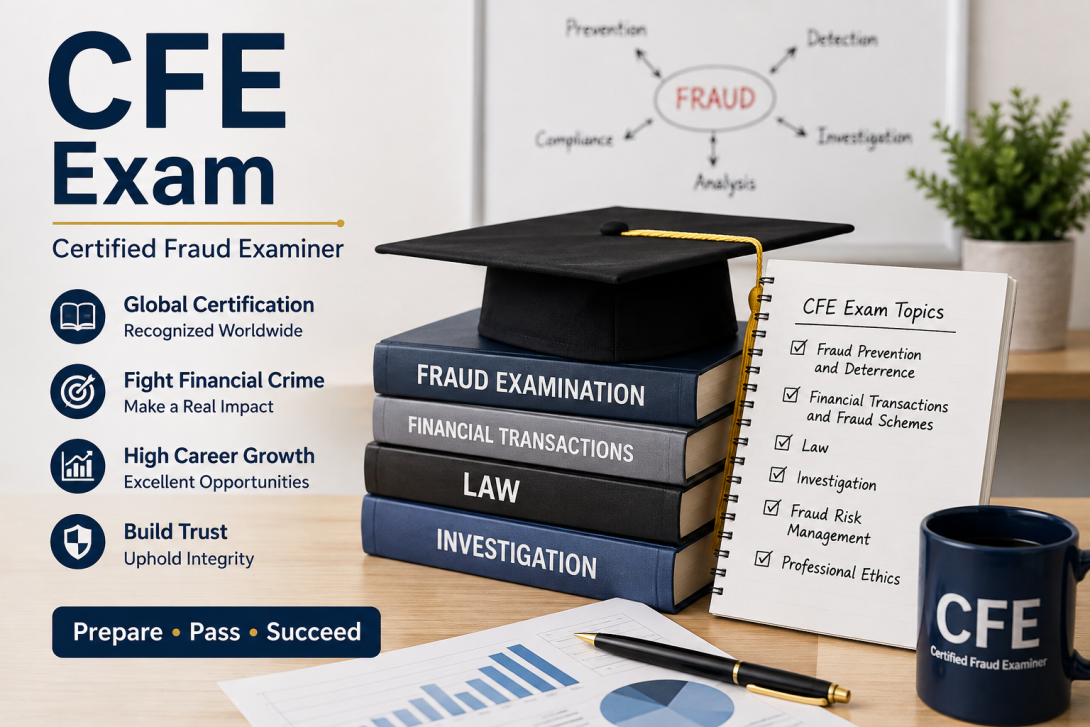
As financial fraud grows more sophisticated and regulatory scrutiny across Indian businesses intensifies, many practising chartered accountants are choosing to add a specialised credential to their qualifications: the Certified Fraud Examiner (CFE) designation, awarded after clearing the CFE exam administered by the Association of Certified Fraud Examiners (ACFE). For chartered accountants already working in audit, forensic accounting, or risk advisory, this certification has become an increasingly valuable addition — one that signals specialised expertise in fraud detection, prevention, and investigation, layered on top of their core CA qualification.
Why Chartered Accountants Pursue the CFE
A Chartered Accountant qualification in India provides a strong foundation in accounting, auditing, and taxation, but it doesn't specifically train practitioners in the investigative techniques, legal elements of fraud, and behavioural red flags that fraud examination requires. The CFE credential fills this gap, and its relevance has grown alongside rising demand for forensic accounting services in India, driven by increased regulatory enforcement, stricter corporate governance norms following major corporate fraud cases, and growing corporate investment in internal fraud risk management.
For CAs already working in statutory audit, internal audit, or advisory roles, the CFE designation often opens doors to specialised forensic accounting engagements, expert witness work in fraud-related litigation, and senior roles within corporate fraud risk and compliance functions — areas that increasingly command a premium over general audit work.
What the CFE Exam Actually Covers
The CFE exam is structured around four core knowledge areas, each tested through a dedicated section of the examination.
Financial Transactions and Fraud Schemes covers the mechanics of how fraud is actually committed — asset misappropriation, corruption schemes, financial statement fraud, and various concealment techniques used to hide fraudulent activity within financial records. For chartered accountants, this section often builds naturally on existing audit knowledge, though it demands a much deeper focus on the specific schemes and patterns fraudsters use.
Law covers the legal framework surrounding fraud examination, including criminal and civil law concepts relevant to fraud, rules of evidence, and the legal rights of the accused during a fraud investigation. This section tends to be the most unfamiliar territory for CAs, since Indian CA training doesn't typically cover legal procedure in this depth, and candidates often need to invest additional preparation time here.
Investigation focuses on the practical techniques of conducting a fraud investigation, including interviewing techniques, evidence gathering, tracing illicit transactions, and using public records and digital forensics tools to build a case. This section draws on investigative skill sets that go beyond conventional audit training.
Fraud Prevention and Deterrence examines the organisational and behavioural aspects of preventing fraud before it occurs, covering internal control design, corporate governance, criminology concepts explaining why people commit fraud, and how organisations can build a culture that discourages fraudulent behaviour. CAs with strong internal audit or risk advisory backgrounds often find this section aligns well with work they may already be doing.
Eligibility for Practising CAs
The ACFE sets eligibility requirements based on a points system that combines education and professional experience. A Chartered Accountant qualification typically satisfies the educational component comfortably, since it is recognised as a professional accounting credential. Candidates also need a minimum number of years of professional experience in a field related to fraud examination — this can include audit, accounting, law enforcement, or related fields — with the exact points threshold determined by the ACFE's qualification criteria at the time of application.
Practising CAs with experience in statutory audit, internal audit, forensic engagements, or risk advisory typically meet the experience requirement without difficulty, particularly those who have been in practice for several years.
How Practising CAs Typically Prepare
Given that most candidates pursuing the CFE are already working full-time, preparation typically has to be structured around existing professional commitments. A common approach involves working through the ACFE's official CFE Exam Prep Course materials, which are organised around the four core knowledge areas and include practice questions modelled closely on the actual exam format.
Many candidates supplement official materials with study groups or informal peer preparation, particularly useful for the Law section, which tends to require more memorisation of specific legal concepts than the other three areas. Given that CAs already bring strong foundational knowledge in the Financial Transactions and Fraud Schemes area from their audit background, many find it efficient to prioritise study time toward Law and Investigation, where the overlap with existing CA training is lower.
Because the exam is computer-based and can typically be scheduled at the candidate's convenience through approved testing centres, many working professionals stagger their preparation and attempt each of the four sections separately over a period of weeks or months rather than sitting for all sections in a single continuous block.
Balancing CFE Preparation With an Active Practice
For practising CAs, the biggest practical challenge isn't the exam content itself but finding consistent study time around client deadlines, audit cycles, and compliance filing seasons. A few strategies tend to work well: scheduling exam attempts during comparatively quieter periods in the CA practice calendar, such as immediately after major filing deadlines rather than in the lead-up to them, dedicating focused blocks of study time — even 30 to 45 minutes daily — rather than relying on occasional long study sessions that are hard to sustain alongside client work, and leveraging existing professional experience actively during preparation, since real audit and advisory engagements often illustrate concepts covered in the exam far more effectively than textbook examples alone.
Value of the CFE Credential for a CA's Practice
Once certified, CAs holding the CFE designation are often better positioned to expand their practice into forensic accounting, fraud risk advisory, and litigation support services — areas that are growing steadily in India as companies face increased regulatory pressure around related-party transactions, financial statement integrity, and internal fraud controls. The credential also carries international recognition, which can be particularly valuable for CAs working with multinational clients or considering cross-border forensic accounting engagements.
Conclusion
For a practising Chartered Accountant in India, the CFE exam represents a meaningful but achievable step toward specialising in fraud examination, forensic accounting, and financial investigation — fields that are seeing sustained demand growth. Success in the exam depends less on raw aptitude, since CAs already bring strong financial and accounting fundamentals, and more on disciplined preparation across the areas — particularly law and investigation — that fall outside standard CA training. With the right preparation strategy built around an already-busy practice schedule, the CFE credential can become a genuine differentiator in an increasingly competitive professional services market.