

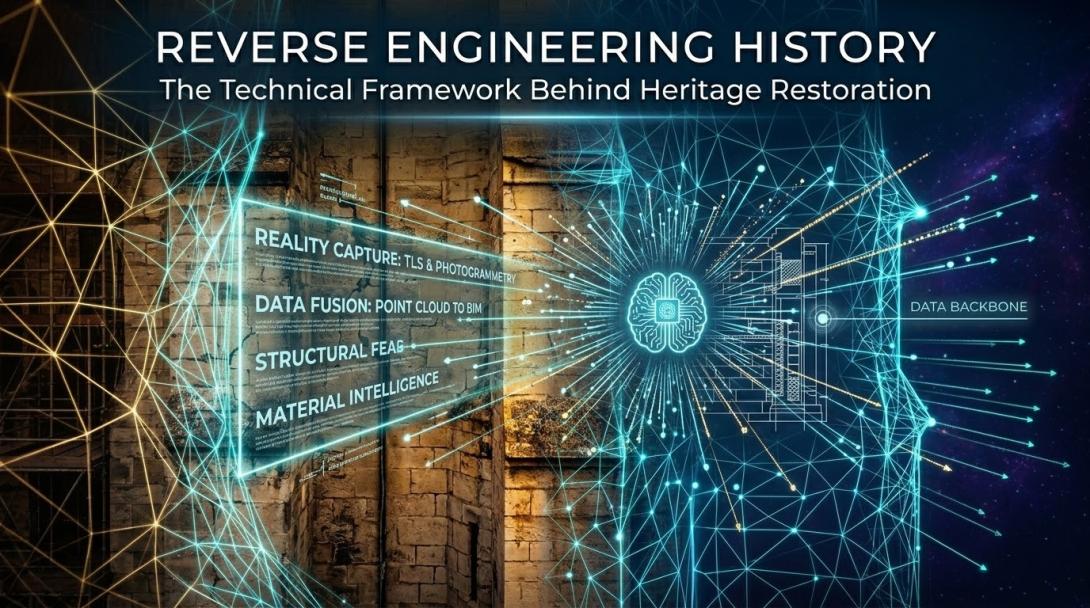
Every year, we lose approximately 3% to 5% of significant global heritage sites to environmental degradation, urban encroachment, or simple structural fatigue. But here is the staggering statistic: according to recent industry benchmarks, projects utilizing High-Definition Surveying (HDS) and Reverse Engineering workflows see a 25% reduction in rework and a 30% improvement in material accuracy compared to traditional restoration methods. We aren't just "fixing" old buildings anymore; we are digitally resurrecting them.
The challenge isn't just about aesthetics; it’s a high-stakes data game. How do you quantify the structural integrity of a 200-year-old load-bearing masonry wall that has no surviving blueprints? The answer lies in the sophisticated intersection of Reality Capture, Computational Design, and BIM.
The Shift from Intuition to Informatics
For decades, heritage restoration relied heavily on "expert intuition" and manual hand-measurements. While the craftsmanship was undeniable, the margin for error was cavernous. Today, the AEC industry is undergoing a paradigm shift. We are moving away from reactive maintenance toward Proactive Digital Preservation.
In the current market, the demand for "Digital Twins" of historical assets has skyrocketed. Governments in the EU and North America are increasingly mandating BIM for publicly funded restoration projects. This isn't just bureaucratic red tape; it’s about creating a permanent, immutable record of our cultural fabric before the next climate event or structural failure occurs.
Phase 1: The Anatomy of Reality Capture (The Input)
The foundation of any reverse engineering framework is the "Point Cloud." To reconstruct the past, we must first capture it with sub-millimeter precision.
Terrestrial Laser Scanning (TLS) vs. SLAM
We no longer rely on tape measures. Terrestrial Laser Scanning (TLS) allows us to capture millions of data points per second. For complex heritage facades—think Gothic cathedrals or ornate Baroque government buildings—TLS provides the density required to map every crack and weathered cornice.
However, for internal structural assessments where GPS is denied, Simultaneous Localization and Mapping (SLAM) technology is becoming the go-to for rapid documentation. By walking through a site with a handheld mobile mapper, engineers can generate a rough spatial framework in a fraction of the time it takes for static setups.
Photogrammetry: The Color of History
While LiDAR gives us the "skeleton," Photogrammetry gives us the "skin." By stitching together thousands of high-resolution drone images, we create a textured mesh that captures the exact patina of the stone, the oxidation of the copper, and the decay of the timber. When these two datasets—LiDAR and Photogrammetry—are fused, we create a Hyper-Realistic Mesh that serves as the single source of truth for the entire restoration team.
Phase 2: From Point Cloud to "Living" BIM (The Processing)
Having a billion points of data is useless if you can’t interact with them. This is where the real "Reverse Engineering" begins. The transition from a raw point cloud to a parametric BIM model is the most technically demanding phase of the framework.
Scan-to-BIM Workflows
In a standard new-build project, you start with clean lines. In restoration, nothing is square. Walls lean, floors sag, and columns are rarely perfectly cylindrical. A professional AEC team uses Scan-to-BIM services to model these "as-built" conditions with "as-is" accuracy.
This is crucial because if you design a modern HVAC system to fit into a historic ceiling void based on "ideal" measurements, it won't fit in reality. We must model the deviations. This level of detail is exactly why many firms are now restoring the past with architecture drafting services, ensuring that the digital representation respects the physical imperfections of the original structure.
Material Intelligence and Forensic Engineering
Reverse engineering isn't just about geometry; it’s about chemistry. Advanced restoration frameworks now integrate Non-Destructive Testing (NDT). Using Ground Penetrating Radar (GPR) and thermography, we can "see" through 18-inch thick stone walls to find hidden iron cramps or voids. This data is then fed into the BIM model as metadata, allowing structural engineers to run Finite Element Analysis (FEA) to simulate how the building will react to modern seismic loads.
Phase 3: The Stakeholder Symphony (The Application)
A restoration project is a multi-disciplinary balancing act. The technical framework must serve five distinct masters:
- The Architect: Needs to maintain historical authenticity while meeting modern building codes (ADA compliance, fire safety).
- The Structural Engineer: Needs to ensure the building doesn't collapse during the intervention.
- The Contractor: Needs precise quantities to order expensive, specialized materials like lime mortar or reclaimed timber.
- The Conservator: Needs to document every chemical treatment applied to the substrate.
- The Facility Manager: Needs a "Digital Twin" to manage the building's health for the next 50 years.
By utilizing a Common Data Environment (CDE), these stakeholders stop working in silos. The stone mason in Italy can look at the same 3D model as the lead architect in London, ensuring that the hand-carved replacement block fits perfectly the first time it arrives on site.
Overcoming the "Heritage Paradox"
One of the biggest challenges in reverse engineering history is the Heritage Paradox: How do we introduce modern technology without erasing the historical "soul" of the building?
Research from the Journal of Cultural Heritage suggests that the most successful projects are those that use Generative Design to fill in the blanks. When a section of a ruin is missing, we can use algorithms to analyze the surrounding patterns and "predict" what the original geometry likely looked like. This isn't guesswork—it's statistical restoration.
However, we must be careful. There is a fine line between restoration and "Disney-fication." The technical framework must prioritize minimal intervention. The goal of reverse engineering is to understand the building so well that we only touch what is absolutely necessary.
Regional Dynamics: A Global Perspective
The approach to heritage restoration varies wildly by geography.
- In Europe (notably Italy and Greece): The focus is on Conservation Science. The technical framework is heavily weighted toward chemical analysis and moisture mapping within the BIM environment.
- In North America: The focus is often on Adaptive Reuse. We take 19th-century industrial warehouses and reverse engineer them into 21st-century tech hubs. Here, the framework prioritizes mechanical integration and energy retrofitting.
- In the Middle East: We are seeing a surge in Giga-Project Heritage. Sites like AlUla in Saudi Arabia are using the world’s most advanced drone-based LiDAR to map thousands of years of history in months, creating a new gold standard for rapid digital documentation.
Actionable Takeaways for AEC Professionals
If you are looking to integrate a reverse engineering framework into your next restoration project, keep these four pillars in mind:
- Specify Your LoD (Level of Detail): Not every stone needs to be modeled to LoD 500. Define where high accuracy is critical (structural connections) and where a "simplified" mesh is sufficient (non-decorative walls) to save on processing costs.
- Prioritize Data Interoperability: Ensure your reality capture data can move seamlessly from the scanner to Revit, ArchiCAD, or Rhino without losing metadata.
- Don't Ignore the "Old-School" Records: Digital scans are powerful, but they don't tell the whole story. Always cross-reference your digital models with local archives, historical photographs, and previous repair logs.
- Build a "Living" Record: Your job isn't done when the scaffolding comes down. Hand over the BIM model to the client as an asset management tool. A "static" restoration is a dying restoration.
The Future: AI and the Autonomous Restorer
As we look toward 2030, the technical framework of heritage restoration will be defined by AI-driven Feature Recognition. Currently, we spend hundreds of man-hours manually "tracing" point clouds to create BIM elements. Soon, machine learning algorithms will automatically recognize a "Corinthian Column" or a "Tudor Arch" within a point cloud and categorize it instantly.
We are also seeing the rise of 3D Concrete and Stone Printing for restoration. Imagine reverse engineering a shattered 15th-century gargoyle, optimizing its internal structure for better drainage via AI, and 3D printing a replacement in a biocompatible material that matches the original stone's porosity.
We aren't just looking back; we are using the most advanced tech of the future to ensure the past has a place in it.
Final Thought: Restoration is no longer a niche craft for the few; it is a data-driven science that requires the best of our engineering minds. When we reverse engineer a building, we aren't just measuring walls—we are decoding the DNA of our civilization.