
Global Shipbuilding Market Poised for Strong Growth: Estimated at USD 162 Billion in 2024, Forecast to Approach USD 229 Billion by 2032
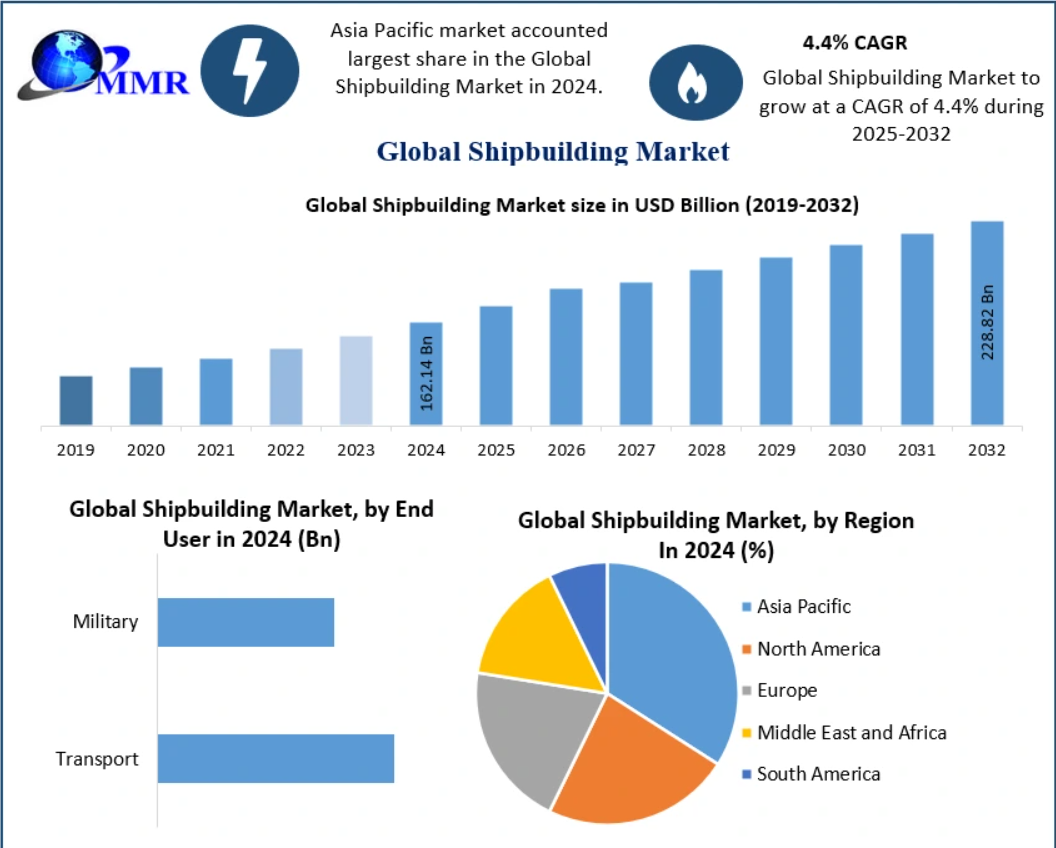
The Global Shipbuilding Market is entering a new era of expansion, supported by rising international trade, increasing demand for advanced vessels, and modernization in defense fleets. The industry was valued at USD 162.14 billion in 2024 and is projected to reach USD 228.82 billion by 2032, growing at a compound annual growth rate (CAGR) of 4.4% from 2025 to 2032.
To know the most attractive segments, click here for a free sample of the report:https://www.maximizemarketresearch.com/request-sample/148775/
Market Estimation & Definition
Shipbuilding refers to the design and construction of ships and other floating vessels. It encompasses a range of vessel types such as cargo ships, tankers, passenger ships, and naval craft, with production typically carried out in specialized shipyards. This sector blends craftsmanship with advanced engineering, covering fields such as hydrodynamics, marine materials, and propulsion systems.
- Market Size (2024): USD 162.14 billion
- Projected Market Size (2032): USD 228.82 billion
- CAGR (2025–2032): 4.4%
Modern shipbuilding plays a critical role in supporting international commerce, global energy distribution, passenger mobility, and national defense.
Market Growth Drivers & Opportunities
Key drivers of growth include:
- Rising Global Trade: A growing share of goods continues to be transported by sea, making maritime shipping essential for global supply chains. The rise in containerized logistics and bulk commodity trade supports strong demand for new cargo and container vessels.
- Technological Innovations: Advanced propulsion systems, energy-efficient engines, and digital technologies such as smart shipyard solutions, automation, and 3D printing are transforming the efficiency and cost structure of the industry.
- Defense Modernization: With global naval fleets undergoing rapid modernization, demand for military ships and patrol vessels is rising. Defense budgets are increasingly allocating funds to strengthen maritime security.
- Digitalization & Industry 4.0: Shipyards are adopting robotics, augmented reality, and digital twin technologies to streamline design, construction, and maintenance processes, enabling higher productivity and reduced risks.
- Sustainability Trends: The push for greener oceans is accelerating the adoption of eco-friendly designs, LNG-fueled ships, and hybrid propulsion systems that meet international environmental standards.
Emerging opportunities:
- Autonomous and AI-enabled vessels offer cost savings and operational efficiency.
- The cruise and passenger vessel market is reviving, fueled by rising tourism and travel demand.
- New opportunities in emerging economies with expanding port infrastructure and growing exports.
Challenges to monitor:
- Volatility in raw material prices and steel costs.
- Stringent emission regulations, which increase design and compliance costs.
Segmentation Analysis
The shipbuilding market can be segmented by ship type and end-user industry.
By Ship Type
- Oil Tankers:
These vessels dominate energy transport, carrying crude oil, LNG, and refined products across continents. Rising global demand for energy security ensures continued investments in oil and LNG tankers. - Bulk Carriers:
Essential for transporting raw materials like iron ore, coal, and grains, bulk carriers form the backbone of industrial trade flows. The steel and agriculture industries heavily depend on them. - Cargo Ships:
Designed to move general goods, cargo ships benefit from the expansion of global supply chains and e-commerce-driven trade. Their versatility makes them indispensable for international logistics. - Container Ships:
Containerization has revolutionized global trade, and modern mega-container ships continue to grow in demand as global ports modernize to handle larger fleets. - Passenger Ships:
Including ferries and luxury cruise liners, this segment is experiencing renewed growth thanks to rising leisure tourism and the resumption of cruise travel post-pandemic.
By End-User
- Transport Sector:
This segment leads the market, supported by cargo transport, tourism-driven passenger demand, and global logistics expansion. Container and bulk carrier orders dominate this category. - Military Sector:
A rapidly growing segment as governments worldwide prioritize naval modernization, maritime policing, and coastal security. Investments in submarines, patrol vessels, and advanced destroyers strengthen this vertical.
To know the most attractive segments, click here for a free sample of the report:https://www.maximizemarketresearch.com/request-sample/148775/
Country-Level Analysis
United States
The United States has historically been a leader in naval engineering, but its share in global commercial shipbuilding has declined sharply over the decades. Today, U.S. shipyards primarily focus on military shipbuilding, producing aircraft carriers, destroyers, submarines, and support vessels.
Government policies are now directed toward reviving domestic shipbuilding capacity to ensure supply chain resilience and national security. Incentives, defense contracts, and public–private partnerships are being introduced to increase competitiveness. The U.S. market is expected to expand steadily, driven mainly by defense projects and specialized vessel production.
Germany
Germany is recognized for its engineering excellence and its strong role in Europe’s shipbuilding sector. German shipyards specialize in high-value vessels such as cruise ships, research vessels, and advanced naval ships. The country contributes significantly to the European cruise ship segment, benefiting from global tourism and the growth of luxury sea travel.
Germany also leads in the integration of green technologies, investing in LNG-powered and hybrid vessels to comply with strict European environmental standards. This focus on innovation positions German shipyards as leaders in sustainable shipbuilding solutions.
Comparator Analysis
When comparing global market studies, projections vary slightly, but they consistently indicate steady growth.
- Some estimates suggest the market will grow from around USD 155–165 billion in the mid-2020s to USD 195–230 billion by 2030–2032, reflecting CAGRs between 3% and 5%.
- The differences across reports typically stem from varying geographic coverage, methodology, and inclusion of defense-related shipbuilding in estimates.
Key insight: Regardless of the dataset, all analyses converge on one outcome—the shipbuilding market is on a strong upward path, fueled by both commercial trade and military modernization.
Press Release Conclusion
The global shipbuilding market stands at the threshold of dynamic change. With a valuation of USD 162 billion in 2024 and projections of nearly USD 229 billion by 2032, the industry is positioned for robust growth. Key factors shaping this trajectory include expanding seaborne trade, surging defense investments, and technological breakthroughs in ship design and construction.
While the Asia-Pacific region continues to dominate, countries such as the United States and Germany are carving out strong niches—one in defense-led shipbuilding and the other in high-value and sustainable vessels. The convergence of digitalization, sustainability, and autonomy marks a new chapter for global shipyards.
As global commerce and maritime security become increasingly intertwined, shipbuilding emerges as not just an economic driver but a strategic industry underpinning the global economy and national interests.