

Did you know that according to FMI Corporation, nearly $31.3 billion is lost annually in the U.S. construction industry alone due to poor project data and miscommunication? It’s a staggering figure that highlights a persistent industry headache: the gap between the digital twin and the physical site. When the Building Information Modeling (BIM) environment isn't perfectly synced with what’s happening in the dirt, "rework" stops being a line item—it becomes a project-killer.
Establishing a Single Source of Truth (SSoT) isn't just a trendy tech phrase; it’s the difference between a project that finishes on time and one that ends in a legal dispute. Let’s dive into how we bridge the gap between high-fidelity BIM models and the reality of on-site execution.
The Digital-to-Field Disconnect: Why Models Fail on Site
In a perfect world, the model is the law. In reality, site conditions change. A sub-surface utility isn't where it was marked, or a structural beam arrives with a slight deviation. If the on-site drawings—often exported as 2D PDFs—aren't updated in real-time, the "Single Source of Truth" becomes a "Multiple Source of Confusion."
Industry research from Dodge Construction Network suggests that high-quality BIM workflows can reduce rework by up to 25%, but this only works if the field team is looking at the same data as the Virtual Design and Construction (VDC) team. To maintain this flow, teams must manage a variety of documentation, ranging from architectural to structural sets. Understanding the different types of drawings used in construction is the first step in ensuring that every stakeholder knows exactly which "truth" they are responsible for.
Leveraging Cloud Common Data Environments (CDE)
The backbone of a modern AEC workflow is the Common Data Environment (CDE). Platforms like Autodesk Construction Cloud, BIM 360, or Procore act as the connective tissue for a project. By hosting the BIM model in the cloud, any revision made by the architect or engineer is instantly reflected in the viewing tools used by the foreman on an iPad.
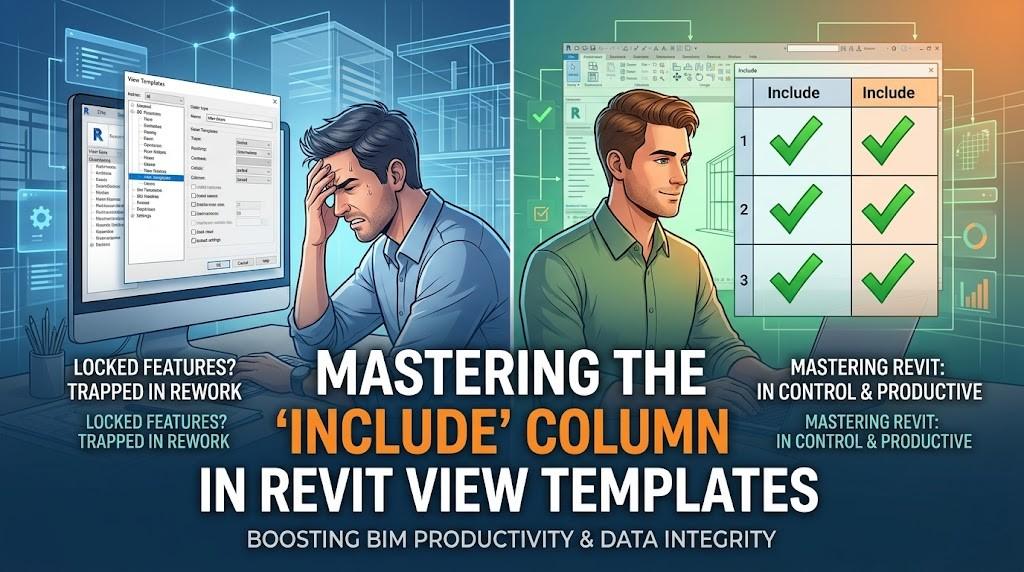
However, syncing isn't just about the "big picture." It's about the details of how that information is displayed. For instance, ensuring that every trade sees the specific data they need requires standardized views. To keep your Revit models organized for these exports, it is essential to understand what is a view template and how to create it in Revit, as this ensures consistency across all issued drawings. Consistency in the office leads to clarity in the field.
Closing the Loop: As-Builts and Reality Capture
The "sync" must be bi-directional. It’s not enough to push data to the site; we must pull data from the site back into the model. This is where Reality Capture comes in. By using laser scanning (LiDAR) or photogrammetry, contractors can compare "as-built" conditions against the "as-designed" BIM model.
- Quantitative Accuracy: Modern scanners can detect deviations as small as 2mm, catching errors before they compound.
- Progress Tracking: Automated software can compare the day’s work against the BIM schedule to provide an objective percentage-complete metric.
- Accountability: Having a timestamped, 3D record of the site reduces finger-pointing during the handover phase to facility managers.
Actionable Takeaways for AEC Leaders
How do you start tightening the loop today? Here are four practical steps to ensure your digital and physical worlds stay aligned:
- Mandate a CDE: Ensure all stakeholders—from MEP subs to the General Contractor—are working within the same cloud-based platform to avoid version control issues.
- Define Your LOD: Be clear about the Level of Development (LOD) required. If the field needs LOD 400 for fabrication, don't give them LOD 300 design models.
- Automate Exports: Use Revit scripts or plugins to automate the creation of 2D documentation from 3D views so the field never waits for "the latest set."
- Hardware Investment: Equip field leads with rugged tablets. A worker shouldn't have to walk back to the trailer to check a revision; the data should be in their hand.
The Future: From Syncing to Living Models
As we move toward Digital Twins and AI-driven site monitoring, the line between the drawing and the building will continue to blur. The goal is a "living model" that breathes with the project. By prioritizing the Single Source of Truth now, you aren't just preventing rework; you’re building a foundation for a more profitable, less stressful, and safer construction environment.