

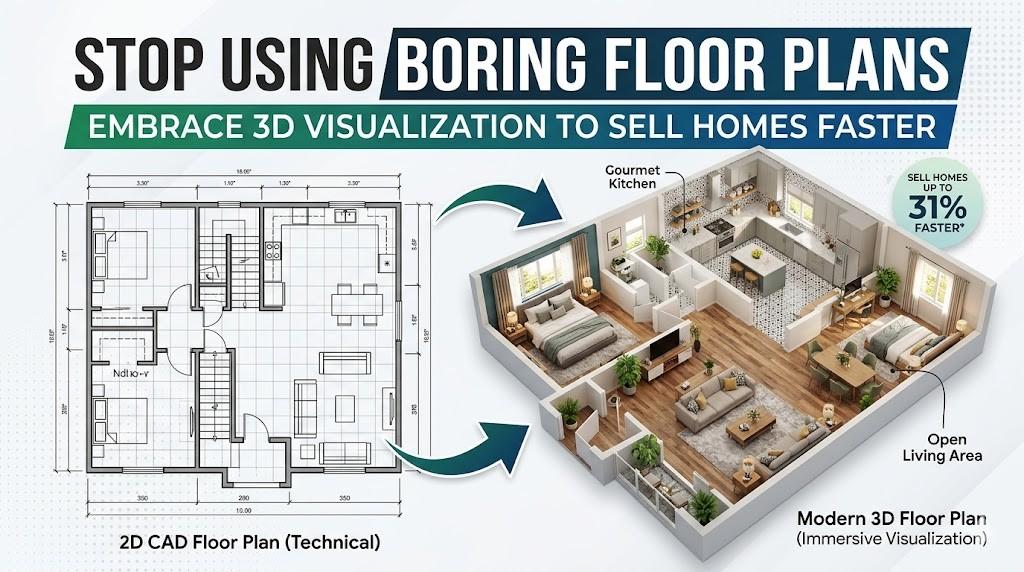
Did you know that 97% of homebuyers now begin their search online, and listings with high-quality visual content receive 403% more inquiries than those without? In an era where the first "showing" happens on a smartphone screen, the traditional, static 2D black-and-white floor plan is no longer a tool—it’s a bottleneck. While 2D blueprints are essential for technical compliance, they fail to trigger the emotional response required to close a sale in a competitive AEC landscape.
The industry is shifting. We are moving away from asking clients to "imagine" a space and toward allowing them to "experience" it before the first brick is laid. If you are still relying on flat lines and technical annotations to sell residential real estate, you are leaving money—and time—on the construction site.
The Cognitive Gap: Why 2D Plans Fail the Modern Buyer
The fundamental challenge in residential sales is the "spatial literacy gap." While architects and engineers are trained to extrude a 2D line into a 3D mental image, the average homebuyer is not. Research indicates that nearly 80% of non-professionals struggle to visualize volume, light, and flow from a standard overhead CAD drawing.
When a potential buyer looks at a boring, technical floor plan, they see constraints: "Is this room too small?" "Where does the couch go?" They don't see a home; they see a puzzle. This cognitive friction leads to hesitation. According to recent National Association of Realtors (NAR) data, the ability to visualize a property is one of the top three most important factors for buyers, yet traditional plans offer the least assistance in this area.
To bridge this gap, the industry is pivoting toward Real-Time Visualization and 3D Floor Plan Rendering. These tools don't just show dimensions; they communicate lifestyle. By adding texture, furniture scaling, and realistic lighting, you remove the "homework" from the buyer’s plate and replace it with an emotional connection.
Beyond the Blueprint: The Rise of High-Fidelity 3D Floor Plans
If the goal is to sell homes faster, the solution lies in Photorealistic 3D Floor Plans. Unlike their 2D predecessors, 3D plans provide a "dollhouse" view of the property. This perspective allows buyers to understand the relationship between rooms, the flow of natural light, and the actual utility of the square footage.
1. The Power of "Spatial Context"
In a 3D rendered plan, a "Bedroom" isn't just a 12'x12' square. It’s a sanctuary featuring a king-sized bed, soft ambient lighting, and hardwood textures. This spatial context helps buyers mentally "move in." When a buyer can see that their existing furniture fits or how the kitchen opens into the living area for entertaining, the perceived value of the home increases instantly.
2. Emotional Resonance Through Materiality
We are emotional creatures. The cold aesthetic of a blueprint evokes a construction site; the warm tones of a 3D render evoke a home. Modern Building Information Modeling (BIM) allows us to bake real-world materials into these visuals. Showing a specific marble countertop or a particular shade of oak flooring isn't just "flavor text"—it’s a strategic sales move that justifies a premium price point.
Read More: To truly understand how these visual assets transform the bottom line, explore How Architectural Rendering Benefits the Real Estate Industry and its impact on marketing ROI.
The Business Case: Metrics That Matter
Transitioning from "boring" plans to immersive visuals isn't just a design choice; it’s a high-yield business strategy. Let’s look at the quantitative impact:
- Reduced "Days on Market" (DOM): Properties utilizing 3D tours and high-end renderings sell up to 31% faster.
- Increased Lead Quality: Visual-heavy listings attract more "serious" inquiries. Buyers who have already "walked through" a 3D plan are further along the sales funnel by the time they contact an agent.
- Pre-Construction Sales: For developers, 3D floor plans are the lifeblood of pre-sales. Selling a concept is difficult; selling a vision is easy. By showcasing a finished look before construction begins, firms can secure financing and "sold" signs much earlier in the project lifecycle.
From a BIM perspective, these assets are often already available within your Revit or ArchiCAD models. The cost of "extracting" a high-quality 3D floor plan from an existing BIM workflow is marginal compared to the massive uptick in marketing engagement.
From Static to Interactive: The Virtual Reality (VR) Edge
If 3D floor plans are the "current standard," then Interactive VR Walkthroughs are the "future standard." We are seeing a massive surge in AEC firms adopting "Digital Twins" for residential sales.
Imagine a buyer in London "walking through" a penthouse in Sydney. They can change the flooring from tile to wood with a click. They can see how the sun sets through the western windows at 6:00 PM. This level of transparency builds immense trust. It moves the conversation from "Trust me, it will look great" to "See for yourself exactly how it looks."
Actionable Takeaways for AEC Professionals
If you’re ready to ditch the boring plans and accelerate your sales cycle, here is your implementation roadmap:
- Audit Your Assets: Don't just export a top-down view of your CAD file. Use rendering software (like Enscape, Lumion, or V-Ray) to apply realistic textures and lighting to your 2D layouts.
- Focus on "The Big Three": If you can't render the whole house, prioritize the Kitchen, Primary Suite, and Outdoor Living Space. These are the rooms that sell homes.
- Standardize Scaling: Ensure your 3D furniture is accurately scaled. There is nothing worse than a buyer realizing a "spacious" bedroom only fits a twin bed in reality.
- Leverage Your BIM Data: Use the "I" in BIM (Information). Export schedules and material finishes directly into your marketing collateral to ensure what the buyer sees is exactly what the contractor builds.
- Multi-Channel Deployment: Don't let these renders sit in a folder. Use them as "scroll-stoppers" on LinkedIn, Instagram, and specialized real estate portals.
The Path Forward: Selling the Dream, Not the Joists
The AEC industry is no longer just about "bricks and mortar"; it is about digital experiences. As we move toward 2030, the line between the physical building and its digital representation will continue to blur.
Continuing to use boring, technical floor plans in a digital-first market is like trying to sell a movie by showing the script. It lacks the soul, the depth, and the invitation that modern buyers crave. By investing in high-fidelity 3D floor plans and immersive rendering, you aren't just "prettying up" a drawing—you are removing the barriers to purchase and inviting your clients to come home.
The question isn't whether you can afford to upgrade your visual assets; it’s whether you can afford the cost of remaining invisible in a 3D world.