

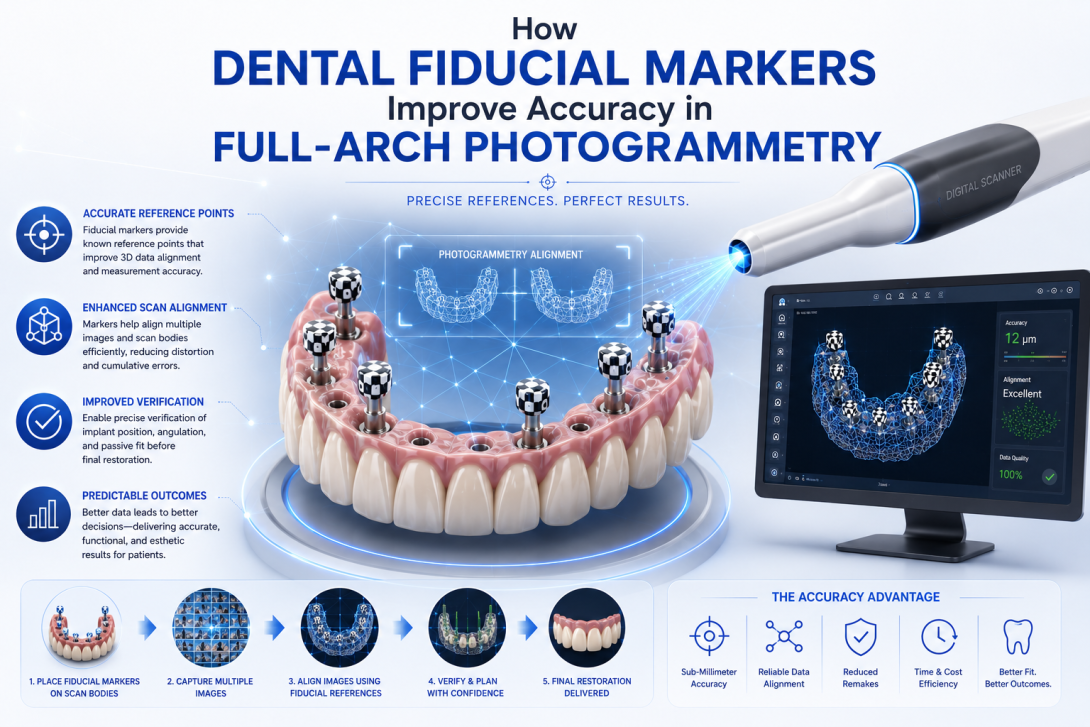
Digital photogrammetry has transformed full-arch implant dentistry by enabling clinicians to capture implant positions with exceptional precision. However, the overall accuracy of a photogrammetry workflow depends on more than the scanning device itself. Stable reference points are essential for correctly registering digital datasets throughout treatment. A fiducial marker dental system provides these reference points, helping clinicians achieve more reliable digital records, improve prosthetic planning, and support predictable full-arch restorations.
Why Accuracy Is Critical in Full-Arch Photogrammetry
Unlike single implant restorations, full-arch cases require several implants to function together as one prosthetic framework. Even small discrepancies in implant position data can affect passive fit, occlusion, and prosthesis delivery.
Digital photogrammetry minimizes many limitations associated with conventional impressions, but the accuracy of the final digital model still depends on proper data registration.
Accurate digital records help clinicians:
- Improve implant position capture
- Support passive prosthetic fit
- Reduce restorative errors
- Enhance laboratory communication
- Increase treatment predictability
According to the National Center for Biotechnology Information (NCBI), digital implant workflows depend on accurate data acquisition and registration to achieve predictable restorative outcomes.
What Is a Dental Fiducial Marker?
A dental fiducial marker is a precision reference device used to establish fixed landmarks during digital implant workflows. These reference points help software align multiple digital datasets, including photogrammetry records, intraoral scans, and CBCT images.
Instead of relying solely on surrounding anatomy, fiducial markers provide consistent geometric references that improve digital registration.
They are commonly used in:
- Full-arch implant rehabilitation
- Digital implant planning
- Photogrammetry workflows
- Guided surgery
- Prosthetic-driven treatment planning
Why Photogrammetry Depends on Reliable Reference Points
Photogrammetry accurately records the spatial relationship between implants, but every digital workflow requires datasets to be merged correctly before prosthetic design begins.
Without dependable reference points, registration errors may occur during data integration.
Possible consequences include:
- Implant position discrepancies
- Framework misfit
- Passive fit challenges
- Prosthetic adjustments
- Additional laboratory revisions
Reliable fiducial markers help minimize these issues by improving the consistency of digital alignment throughout treatment.
Common Sources of Accuracy Errors
Even advanced digital workflows can experience inaccuracies when reference data is incomplete or inconsistent.
Common challenges include:
- Dataset registration errors
- Inaccurate scan alignment
- Missing digital reference points
- Implant position inconsistencies
- Communication gaps between clinics and laboratories
Many of these problems originate before prosthesis fabrication, making accurate digital planning essential.
How Dental Fiducial Markers Improve Digital Registration
Dental fiducial markers provide stable landmarks that help digital software recognize and align multiple datasets with greater precision.
This improves the overall quality of the digital workflow by:
- Supporting accurate dataset registration
- Improving implant position consistency
- Reducing cumulative workflow errors
- Helping laboratories receive more reliable digital records
- Increasing confidence before prosthetic manufacturing
Rather than replacing photogrammetry, fiducial markers strengthen the accuracy of the information generated by the technology.
The Role of ArchTracer™ in Full-Arch Digital Workflows
As digital implant workflows continue to advance, dedicated fiducial marker systems have become increasingly valuable. Solutions such as the ArchTracer™ dental fiducial marker for accurate full-arch photogrammetry workflows are designed to provide stable digital reference points that improve dataset registration and support predictable prosthetic planning.
Developed as part of the Digital Arches ecosystem, ArchTracer™ integrates with modern Scan-to-Surgery workflows, helping clinicians and dental laboratories work from consistent digital information throughout treatment.
Better Communication Between Clinics and Dental Laboratories
Accurate digital records benefit both the clinical and laboratory teams. When implant positions are captured and registered consistently, prosthetic designers can work with greater confidence during CAD planning.
This helps reduce:
- Design revisions
- Laboratory remakes
- Communication errors
- Delivery delays
- Chairside adjustments
Improved collaboration contributes to a more efficient restorative workflow from planning through final prosthesis delivery.
For clinicians interested in broader digital implant workflows, the Digital Arches Blog provides educational resources covering photogrammetry, verification, AOX workflows, and digital treatment planning.
Benefits of Using Fiducial Markers in Photogrammetry
Digital reference systems provide advantages throughout the implant workflow.
Key benefits include:
- Improved digital accuracy
- Better implant position registration
- More predictable prosthetic planning
- Enhanced clinic-laboratory collaboration
- Reduced restorative adjustments
- Greater workflow consistency
As case complexity increases, dependable reference points become even more valuable.
The American Academy of Implant Dentistry (AAID) recognizes digital technologies as an important component of modern implant diagnosis, planning, and restorative care.
Why Fiducial Markers Will Continue to Grow in Importance
Digital dentistry continues to evolve through photogrammetry, intraoral scanning, CBCT integration, CAD/CAM manufacturing, and AI-assisted treatment planning. As these technologies become increasingly interconnected, accurate dataset registration becomes even more critical.
Reliable fiducial markers provide the digital foundation needed to connect these technologies into one coordinated workflow.
Future digital workflows are expected to place even greater emphasis on:
- Digital accuracy
- Data integration
- Prosthetic-driven planning
- Predictable implant rehabilitation
- Workflow standardization
Frequently Asked Questions
What is a dental fiducial marker?
A dental fiducial marker is a reference device used during digital implant workflows to improve the alignment of photogrammetry, CBCT, and intraoral scan datasets.
Why are fiducial markers important in full-arch photogrammetry?
They provide stable reference points that improve digital registration, helping clinicians achieve more accurate implant positioning and prosthetic planning.
Can photogrammetry work without fiducial markers?
Photogrammetry can accurately capture implant positions, but dependable reference points improve dataset alignment and overall workflow predictability, particularly in complex full-arch cases.
How does ArchTracer™ support digital implant dentistry?
ArchTracer™ functions as a dental fiducial marker that helps improve digital registration, supports communication between clinics and dental laboratories, and contributes to more predictable full-arch restorative workflows.
Final Insight
The success of digital full-arch implant treatment depends not only on advanced scanning technologies but also on the accuracy of the digital information flowing through every stage of the workflow. Photogrammetry captures implant positions with remarkable precision, but reliable reference points remain essential for transforming that data into predictable restorative outcomes.
Dedicated solutions such as ArchTracer™ demonstrate how dental fiducial markers strengthen digital registration, improve collaboration between clinicians and laboratories, and support more accurate full-arch photogrammetry workflows. As digital implant dentistry continues to advance, dependable reference systems will remain a fundamental part of achieving consistent, high-quality restorations.