

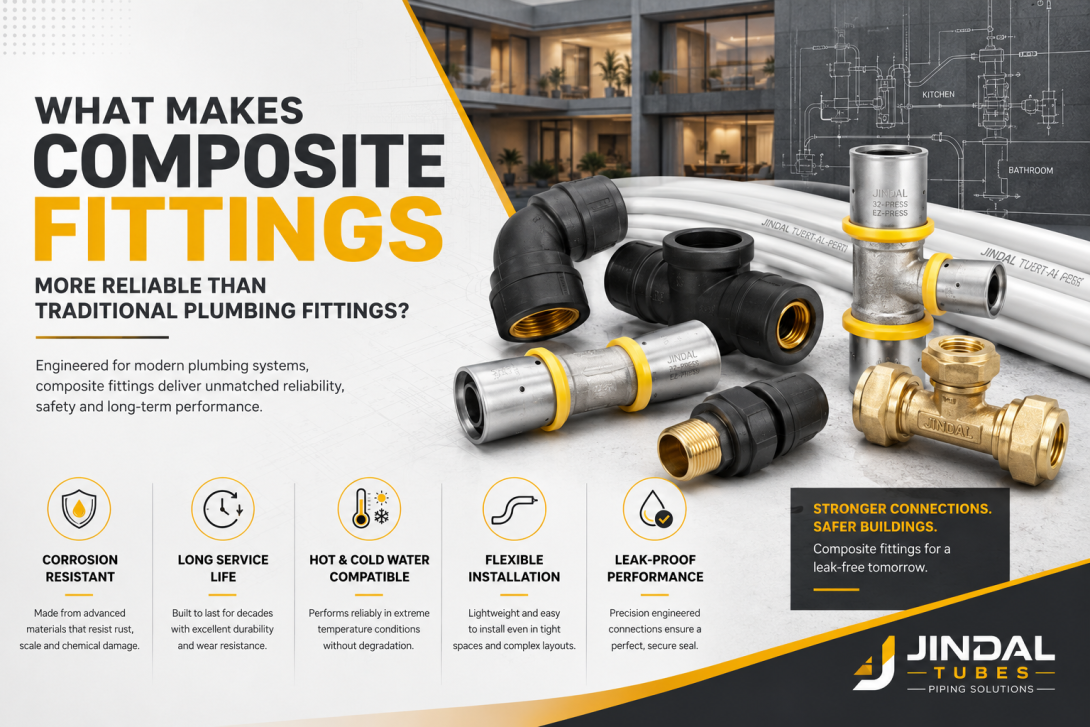
Yes while no plumbing component can completely eliminate the possibility of leaks, properly designed and correctly installed composite fittings can significantly reduce the risk. Because most plumbing failures occur at connection points rather than along the pipe itself, high-quality press-fit composite fittings play an important role in improving joint integrity, maintaining pressure, and supporting long-term plumbing reliability in modern buildings.
Why Water Leaks Remain a Major Challenge
Water leaks are among the most common causes of property damage in residential and commercial buildings. Even a small leak can lead to structural deterioration, mould growth, costly repairs, and service interruptions if left undetected.
Common causes of plumbing leaks include:
- Poor-quality pipe connections
- Incorrect installation practices
- Pressure fluctuations
- Thermal expansion and contraction
- Corroded fittings
- Ageing sealing components
According to the U.S. Environmental Protection Agency (EPA), household leaks can waste thousands of gallons of water annually, highlighting the importance of reliable plumbing systems and timely leak prevention.
Why Connection Points Are Often the Weakest Part of a Plumbing System
Straight pipe sections generally experience fewer failures than pipe joints.
Every plumbing system contains numerous fittings used to:
- Join pipe sections
- Change pipe direction
- Connect valves
- Supply fixtures
- Branch water distribution lines
Each connection becomes a potential leak point if incompatible fittings, poor installation methods, or low-quality materials are used.
The International Code Council (ICC) recognizes press-connect systems as approved mechanical joining methods that provide durable and reliable plumbing connections when installed according to applicable standards.
How Composite Fittings Reduce Leak Risks
Composite fittings are specifically engineered for multilayer composite piping systems.
Unlike traditional threaded joints that rely heavily on manual tightening, press-fit composite fittings create a uniform mechanical connection around the pipe.
This design helps:
- Maintain consistent sealing pressure
- Reduce installation variability
- Improve joint strength
- Resist movement caused by pressure changes
- Minimize long-term leakage risks
When paired with compatible multilayer pipes, these fittings provide a more reliable connection than many conventional joining methods.
Readers interested in the complete system can explore How PE-AL-PE Multi-Layer Pipes Work to better understand how multilayer pipes and fittings function together.
Pressure Changes Can Affect Connection Performance
Modern plumbing systems rarely operate under constant pressure.
Daily fluctuations occur due to:
- Water demand
- Booster pumps
- High-rise water distribution
- Valve operation
Composite fittings are designed to maintain secure mechanical joints under changing operating conditions.
Benefits include:
- Better pressure stability
- Lower risk of joint separation
- Improved connection reliability
- Consistent plumbing performance
Thermal Expansion Is Another Cause of Plumbing Leaks
Hot and cold water systems continuously experience temperature changes.
Repeated expansion and contraction may gradually weaken poorly designed joints.
Composite fittings developed for multilayer piping systems help maintain reliable sealing despite these thermal movements.
This contributes to:
- Stable pipe connections
- Reduced stress on fittings
- Longer service life
- Lower maintenance requirements
The Plastic Pipe Institute (PPI) notes that properly designed plastic and multilayer piping systems offer excellent resistance to corrosion and are well suited for modern hot and cold water distribution applications.
Installation Quality Still Matters
Even the most advanced fitting cannot compensate for poor installation.
Reliable plumbing systems depend on:
- Compatible pipes and fittings
- Proper pressing tools
- Correct installation procedures
- Compliance with plumbing standards
- Qualified installers
The American Society of Plumbing Engineers (ASPE) emphasizes that proper product selection and installation practices are fundamental to achieving long-term plumbing reliability.
Composite Fittings Help Lower Long-Term Maintenance Costs
Reducing leaks does more than conserve water.
It also helps lower:
- Emergency repair costs
- Water damage restoration expenses
- Building downtime
- Maintenance frequency
- Total ownership costs
This is one reason builders increasingly specify integrated multilayer piping systems instead of mixing different pipe and fitting technologies.
For projects using multilayer plumbing systems, EZ-PRESS composite fittings are designed to provide secure press-fit connections that support long-term plumbing reliability while working alongside compatible composite piping systems.
Composite Fittings vs Traditional Plumbing Connections
Feature
Composite Press Fittings
Traditional Threaded Fittings
Leak Resistance
Excellent
Moderate
Pressure Performance
High
Moderate
Thermal Stability
High
Moderate
Corrosion Resistance
Excellent
Varies
Installation Consistency
High
Depends on workmanship
Maintenance Requirements
Low
Higher
Why Modern Buildings Are Choosing Composite Fittings
Today's construction projects increasingly prioritize durability, efficiency, and lifecycle value rather than simply reducing initial installation costs.
Composite fittings support these goals by providing:
- Reliable leak-resistant joints
- Faster installation
- Lower maintenance
- Better compatibility with multilayer pipes
- Improved long-term plumbing performance
Manufacturers such as Jindal Tubes have contributed to the wider adoption of integrated multilayer plumbing systems by developing compatible press-fit fitting technologies that help improve connection reliability in modern residential and commercial buildings.
Frequently Asked Questions
Can composite fittings completely prevent plumbing leaks?
No. No fitting can guarantee a leak-free system under all conditions. However, properly selected and correctly installed composite fittings significantly reduce the likelihood of leaks by creating secure and durable mechanical joints.
Why do most plumbing leaks occur at fittings?
Connection points experience continuous pressure changes, thermal movement, and mechanical stress, making them more vulnerable than straight pipe sections.
Are press-fit composite fittings suitable for hot and cold water systems?
Yes. They are commonly used with multilayer composite pipes in hot water, cold water, heating, and cooling applications when installed according to manufacturer recommendations and applicable plumbing standards.
Why are builders switching to composite fittings?
Builders increasingly choose composite fittings because they improve installation consistency, reduce maintenance requirements, and support the long-term reliability of modern plumbing systems.
Final Insight
Preventing water leaks begins with designing reliable plumbing connections rather than simply selecting durable pipes. Since most plumbing failures originate at joints, the quality and compatibility of fittings have a direct impact on system performance over decades of service.
Composite press-fit fittings help address this challenge by providing secure, consistent, and durable connections that withstand pressure fluctuations, thermal movement, and daily operation. As modern construction continues to emphasize lifecycle performance and maintenance reduction, these fittings are becoming a key component of dependable plumbing infrastructure.