

The Chevy K5 Blazer left the factory with steering that was perfectly adequate for a stock-height SUV on 235/75R15 tires. Most K5s haven't been stock for decades. Lift kits, 35-inch mud terrains, and front lockers have pushed the factory inverted-Y linkage far beyond its design envelope. A 1 Ton Steering Upgrade Chevy K5 addresses every weakness in the original system simultaneously: it corrects the bump steer geometry, swaps fragile half-ton rod ends for massive metal-to-metal joints, and relocates the tie rod above the leaf springs where rocks can't fold it like a pretzel.
We're detailing exactly what makes this upgrade essential for any K5 that sees trail time. You'll understand the component-by-component transformation from a sloppy, vague steering system to a crossover high-steer setup that tracks arrow-straight on the highway and refuses to break when the going gets rough.
The K5's Factory Steering Weak Links
The GM Squarebody platform, including the K5 Blazer and Suburban, uses a push-pull steering arrangement. The drag link runs from the pitman arm on the steering box to a mounting point on the driver's side knuckle. The tie rod connects the driver's side to the passenger side, completing the linkage. This configuration has two fatal flaws on a lifted rig.
First, the drag link angle steepens dramatically with suspension lift. As the axle cycles through bumps, the drag link arc diverges from the track bar arc. The resulting toe change manifests as bump steer—the steering wheel jerks in your hands over every pothole and rut. Second, the factory rod ends use nylon races that cold-flow under the increased leverage of larger tires. Once those races deform, internal clearance develops, and that clearance becomes the oscillation that triggers death wobble.
Adding a heavy steering stabilizer masks the symptoms temporarily. It does nothing to fix the root causes. To permanently Fix Bump Steer Lifted Chevy and GM trucks, you need a complete architecture change.
Crossover Steering: The Geometry Revolution
A Dana 44 Crossover Steering Kit adapted for the K5's 10-bolt axle solves the geometry problem at its source. Instead of the drag link pushing on the driver's side knuckle, it now runs directly from the pitman arm to a steering arm bolted onto the passenger side knuckle. The tie rod spans across the axle, connecting both knuckles and maintaining toe independently.
This configuration synchronizes the drag link arc with the track bar arc. Both swing in near-perfect unison as the suspension cycles, canceling out the lateral displacement that causes bump steer. The tie rod no longer gets shoved sideways during articulation; it simply keeps the tires pointed in the same direction. The result is a K5 that drives like a modern truck, with predictable steering response regardless of what the terrain is doing under the tires.
Taking this to high steer elevates both the tie rod and drag link mounting points above the leaf springs. This flattens the drag link angle to near-horizontal, maximizing the bump steer cancellation. It also tucks the linkage out of the rocks, a feature any Blazer owner who's winched off a bent tie rod will appreciate immediately.
The East West Off Road 1-Ton Solution
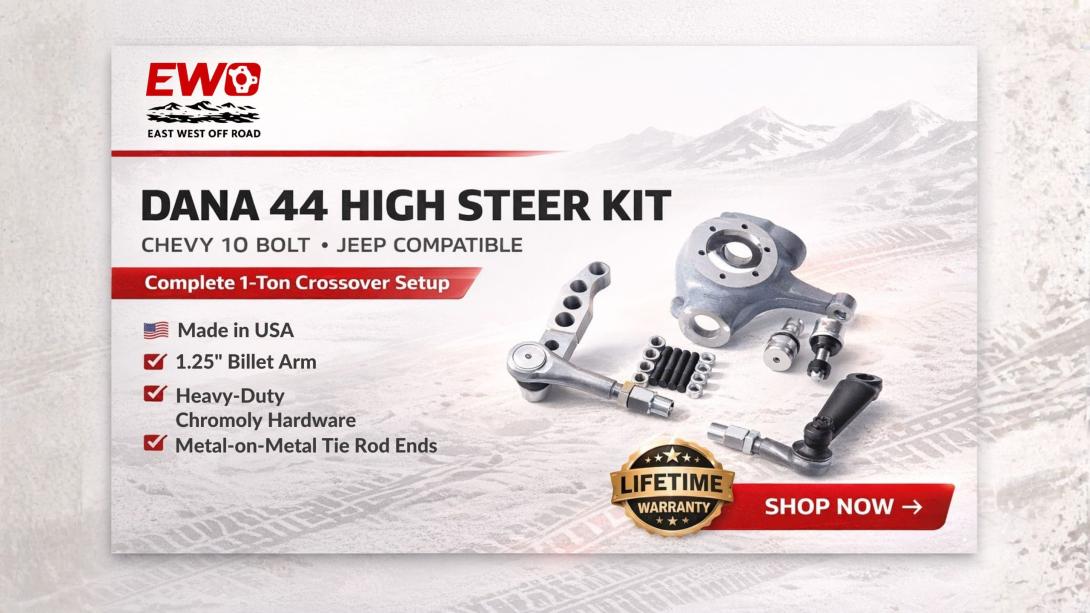
The EWO complete 1-ton crossover high steer kit bundles every precision component required for this conversion into a single package. Each piece is engineered to handle the specific loads a full-size K5 generates on technical terrain.
The Knuckle: A Fresh US-Made Foundation
The conversion starts by replacing the factory passenger side knuckle with a Dana 44 Flat Top Knuckle. This is a brand-new US Made Dana 44 Knuckle cast in a domestic foundry from certified ductile iron. The deck is CNC-machined perfectly flat and perpendicular to the kingpin axis, providing the precision clamping surface that a billet steering arm demands.
This knuckle features a Chevy 10 bolt bottom up taper knuckle design. The rod end studs insert from underneath the steering arm. When the K5's weight settles on the suspension and when impacts drive the axle upward, the force vectors wedge the tapered stud deeper into the arm. The castle nut and cotter pin become a secondary retention system rather than the sole thing keeping your steering connected. This bottom-up orientation is standard engineering practice on heavy trucks and off-road equipment for a reason.
The knuckle is also designed around metal to metal tie rod ends style ball joints. Instead of a nylon race that cold-flows and develops play, a hardened steel ball rides directly in a polished bore with a spring-loaded cup maintaining zero clearance automatically. The knuckle tracks true on the inner C for the life of the joint.
The Steering Arm: 1.25 Inches of Domestic Billet
The steering arm is the lever that channels steering box force into turning the tires. Any deflection here equals toe change, which equals unpredictable steering. The 1.25 inch thick billet steering arms from EWO are CNC-carved from a solid block of domestically rolled steel plate. The billet grain structure is uniform and directional, lacking the internal porosity and stress risers that plague cast arms.
At 1.25 inches thick, the cross-section resists the bending moment created by the high-steer leverage advantage. Even with a hydro-assist ram pushing 37-inch tires against a rock ledge, the arm maintains its precise geometry. The arm secures to the knuckle deck with Chromoly 9/16 studs Dana 44 hardware and conical washers. Chromoly is selected for its combination of high tensile strength and excellent elongation—it stretches under peak impact and returns, absorbing energy that would shear a brittle Grade 8 fastener.
The Rod Ends: ES2026R and ES2027L 1-Ton Joints
Here is where the "1-ton" in the upgrade name earns its meaning. The kit specifies ES2026R ES2027L drag link ends—massive, greaseable joints with spring-loaded metal-to-metal internals. Inside each joint, a polished steel ball rides directly against a hardened steel cup. A heavy coil spring behind the cup maintains constant preload, automatically taking up any microscopic wear that occurs over thousands of miles.
Unlike the nylon-lined joints that came from the factory, there's no plastic to crack in sub-zero temperatures, extrude under desert heat, or wear into an oval that triggers the oscillating feedback loop of death wobble. The joint stays zero-lash for its entire service life. Steering inputs translate to tire movement instantly, and that immediacy of response is what keeps the K5 tracking straight and true.
The Pitman Arm and Tubing Strategy
The 3 inch drop forged pitman arm 32 spline matches the steering box side to the raised knuckle height, keeping the drag link parallel to the track bar. It's fully indexable, allowing precise steering wheel centering regardless of how the steering box is clocked on the frame.
This is also a crossover steering kit without DOM tubing. You get precision 7/8-18 threaded weld-in bungs and jam nuts. You buy 1.5-inch OD, .25-inch wall DOM tubing from a local steel supplier, cut it to your Blazer's exact track width, and weld it up. This DIY Dana 44 Steering Kit approach saves substantial freight cost and allows perfect customization for narrowed axles or custom steering arm placement.
Installing the Upgrade on Your K5
Begin by removing the factory passenger knuckle. Clean the inner C bore thoroughly. Press the included metal-to-metal ball joints into the new EWO flat top knuckle and install it onto the inner C. Set the ball joint preload to specification. Bolt the billet steering arm to the machined deck using the chromoly studs and conical washers, torquing in a star pattern with a calibrated wrench.
For the linkage fabrication, cut your DOM tubing to the measured length with perfectly square ends. Bevel the edges for full weld penetration. Weld the threaded bungs in with short, alternating passes to minimize heat distortion. Allow the welds to air-cool completely—quenching steering linkage welds creates a brittle heat-affected zone that will crack under cyclic bending loads. Chase the threads if needed, assemble the rod ends, set toe to 1/16-inch toe-in, and torque the jam nuts. Retorque all fasteners after the first 100 miles as the machined surfaces bed in.
Frequently Asked Questions (FAQs)
Is a 1-ton steering upgrade safe for highway driving?
Absolutely. Properly installed crossover steering with quality 1-ton components exceeds the strength and safety of the factory system. The corrected geometry actually makes the K5 more stable and predictable at highway speeds. The 1 Ton Steering Upgrade Chevy K5 isn't just a trail mod—it's a complete street safety improvement.
Do I need a high-steer or just crossover?
Crossover alone fixes the geometry. High steer adds ground clearance and flattens the drag link angle further by moving the tie rod above the leaf springs. For a K5 on 4-6 inches of lift, a high steer configuration like the Chevy 10 Bolt High Steer Conversion maximizes both bump steer correction and linkage protection.
Can I reuse my factory pitman arm?
No. The factory pitman arm has insufficient drop and the wrong taper size for 1-ton rod ends. The included 3 inch drop forged pitman arm 32 spline is engineered to match the raised knuckle height and accepts the larger ES2026R/ES2027L tapered studs.
What makes the rod ends "1-ton"?
The ES2026R and ES2027L part numbers reference rod ends rated for 1-ton truck steering loads. They feature a larger ball stud shank diameter and a metal-to-metal internal construction that maintains zero lash, unlike the nylon-lined half-ton ends from the factory. These ES2026R ES2027L drag link ends are the industry standard for HD crossover conversions.
Will this kit work with my existing lift height?
Typically, 4 inches of suspension lift is the minimum for high steer clearance above the leaf springs at full compression. The kit's Squarebody Crossover Steering Kit compatibility covers the majority of lifted K5 Blazers and Squarebody pickups running 4-6 inches of lift with standard or custom leaf spring configurations.