

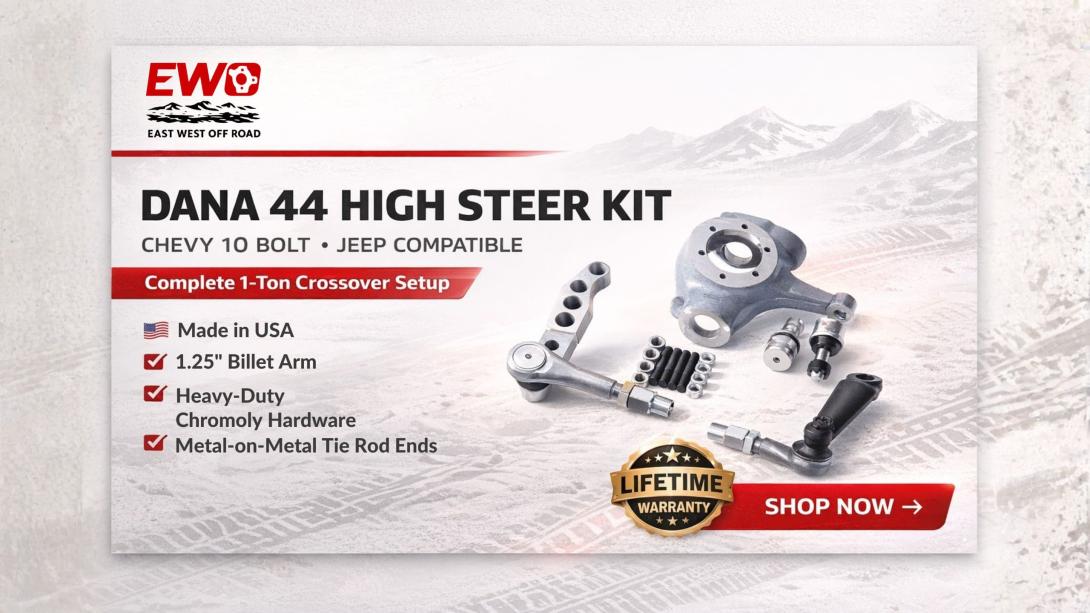
If you've lifted your Squarebody, K5 Blazer, or Jeep and introduced a terrifying case of death wobble or bump steer, the root cause almost always points to your steering geometry. The inverted "Y" factory linkage on the GM 10-bolt was never designed for tall springs and oversized tires. A Chevy 10 bolt high steer conversion isn't just an upgrade; it's a complete geometry correction that moves your tie rod and drag link to the top of the knuckles, getting them out of harm's way and restoring predictable handling.
We're going deep into the engineering behind why the Dana 44 Crossover Steering Kit architecture is the gold standard for solid-axle rigs. You’ll learn why flat top knuckles matter, how to properly set up heavy-duty steering links, and why domestic manufacturing makes a tangible difference when you’re wedged between rocks on a remote trail.
Understanding Crossover Steering vs. High Steer
Before you buy parts, you need to understand the mechanics. A common mistake is using "high steer" and "crossover steer" interchangeably, but they are distinct configurations. A pure crossover setup, typically found in a Squarebody Crossover Steering Kit, connects the steering box directly to the passenger side knuckle via the drag link, then uses a separate tie rod to connect both knuckles. This eliminates the push-pull arc of the factory steering, synchronizing axle movement with the frame.
A high steer conversion takes this a step further by relocating both the tie rod and drag link mounting points above the leaf springs. This flips the angles, granting massive ground clearance and drastically reducing the leverage that causes wheel shimmy. For the Chevrolet 10-bolt, this requires swapping the passenger side knuckle for a machined Dana 44 Flat Top Knuckle. Without this flat, machined surface, you simply can't bolt on a steering arm.
Why the Chevy 10 Bolt Needs a Geometry Overhaul
The GM 10-bolt axle is an underrated workhorse, but its factory steering leaves much to be desired. The stock push-pull configuration creates a significant toe-change arc when the suspension cycles. As the leaf springs compress, the effective length of the drag link changes relative to the tie rod, literally forcing your tires to steer themselves without input from the steering wheel. This is the primary source of "bump steer" in a lifted Chevy. Moving the mounting points skyward flattens this angle, keeping the drag link parallel with the tie rod and the axle housing.
Material Science: Why 1-Ton Components Matter
When we talk about a 1 Ton Steering Upgrade Chevy K5, we aren't just throwing around a buzzword. Factory half-ton joints have internal slop and small tapered studs. A true 1-ton conversion uses components like ES2026R ES2027L drag link ends. These are massive, greaseable joints with a spring-loaded metal-to-metal design. Unlike cheap nylon-lined sockets that crush and deform under severe impact, metal to metal tie rod ends maintain zero clearance without squish, providing perpetual tightness. This is critical for running oversized tires that act as giant levers against your steering system.
Breaking Down the East West Off Road 1 Ton Steering Solution
Building a reliable system means eliminating weak points. The EWO complete 1-ton crossover high steer kit is engineered specifically to solve the Chevy 10-bolt compatibility puzzle. While many shops can sell you generic steering arms, East West Off Road focuses on the knuckle interface, which is where most failures occur.
The Foundation: US Made Dana 44 Knuckle
The cornerstone is the US Made Dana 44 Knuckle, a brand-new iron casting machined in-house. It’s designed specifically as a Dana 44 passenger side flat top knuckle replacement for the GM 10-bolt. The critical feature here is the precision-machined deck and the Chevy 10 bolt bottom up taper knuckle configuration. By running a bottom-up taper, the steering forces pull the rod end deeper into the arm under load, utilizing the castle nut as a safety backup rather than the sole retention method. This orientation change is facilitated by a slit tapered insert, ensuring perfect mechanical wedging.
The Muscle: 1.25 Inch Thick Billet Steering Arms
Attached to that knuckle is the heavy lifter. Forget forged steel arms that bend; East West Off Road uses 1.25 inch thick billet steering arms carved from a solid domestic block. This allows for grain structure consistency that you just don't get with forged units. They are secured with Chromoly 9/16 studs Dana 44 class hardware and conical washers that eliminate shear loading on the fasteners. When you are on the trail, the leverage exerted by 37-inch or larger tires wants to snap the studs. Standard Grade 8 bolts will fatigue. Chromoly studs provide the ductility to absorb shock without cracking, keeping your steering arm firmly planted.
The Pitman Arm Interface
Geometry correction is a top-to-bottom affair. You must match the flatter steering link angle with the steering box. This kit includes a 3 inch drop forged pitman arm 32 spline unit. Crucially, this pitman arm is fully indexable. If you’ve swapped a steering box in a different position or are dealing with a custom frame rail, you aren't stuck with a fixed master spline location. This adjustability lets you perfectly center your steering box before locking the drag link in place.
Fixing Bump Steer on Your Lifted Chevy or Jeep
We hear the phrase "Fix Bump Steer Lifted Chevy" daily. There are two distinct methods to diagnose and fix this. First, visually check the angle of your drag link compared to your tie rod. If they diverge sharply, you have an angular velocity mismatch. Second, you need a true crossover setup. By transitioning to a Chevy 10 bolt Jeep crossover steering style, the drag link no longer tries to turn the driver's side wheel independently. The drag link rotates the passenger knuckle, which pushes the tie rod, and the tie rod moves the driver’s side wheel. This mirror-imaging cancels out bump-induced steering.
Why Ship Without DOM Tubing?
You’ll notice this is a crossover steering kit without DOM tubing. This is a deliberate, builder-friendly decision by EWO. DOM tubing is heavy, bulky, and expensive to ship. Weld-in threaded tube adapters (7/8-18) are included. You can source 1.5" OD DOM with a .25" wall thickness from any local steel supplier, cut it exactly to your custom track width, and weld it up locally. This cuts your shipping cost dramatically and allows you to replace a damaged tie rod with scrap metal in any small town, without waiting for a proprietary factory link.
Install Guide: Setting Up Your High Steer Kit
While we always recommend professional alignment, installing this DIY Dana 44 Steering Kit is a major milestone. Follow these critical assembly steps to ensure safety and proper function.
Prepping the Axle and Knuckle Swap
- Suspension Unloading: Support the truck frame securely. The axle must droop to remove the old steering.
- Disassembly: Pull the calipers, hubs, and spindles. Remove the factory passenger knuckle. Clean the inner C mounting surface until it’s bare metal.
- Ball Joint Magic: This is where the Metal-to-Metal Upper Ball Joint and Metal-to-Metal Lower Ball Joint shine. Traditional poly liners deflect. These joints use a hardened slug that polishes itself against the housing as it moves, creating a zero-maintenance interface that never develops lateral slop, even when pounding washboards.
- Knuckle Installation: Press the new ball joints into the EWO flat top knuckle and install it onto the inner C. Set the preload sleeve to spec.
Final Assembly and Torque
With the high steer arms bolted to the top of the passenger knuckle and the driver’s side stock location, you can measure for your DOM tie rod. Remember, the Bottom-Up Taper must be oriented correctly. The rod ends feed from the bottom, ensuring the weight of the rig rests on the joint body, not the nut. Torque the chromoly studs in a star pattern to ensure even clamping across the billet arm.
Frequently Asked Questions (FAQs)
Can I use this high steer kit with my Jeep Dana 44?
Absolutely. This kit is specifically machined to function as a Jeep Dana 44 high steer conversion as well as a GM 10-bolt conversion. The casting specs match the Jeep inner C perfectly, though you must verify caliper bracket clearance on your specific axle vintage.
Do I really need chromoly studs for a trail truck?
Yes. If you’ve ever sheared the studs off a steering arm on a rock face, you’ll understand the value. Chromoly 9/16” studs have a tensile strength far superior to standard steel. They stretch before they snap, giving you an audible warning and a fighting chance to stop before a catastrophic disconnect.
Why is the tie rod kit not pre-cut with DOM?
Shipping a 6-foot bar of ¼” wall DOM turns a small box into a freight shipment, tripling the cost. This hd crossover steering kit provides the precision adapters (7/8-18 thread) so you can utilize a local steel supplier. It saves you money and allows you to customize the exact length for wide-track axles.
Will a 3-inch drop pitman arm clear my leaf springs?
The included 3 inch drop forged pitman arm is designed to pair with vehicles running roughly 4 to 6 inches of suspension lift. Since it’s fully indexable, you can fine-tune the mechanical advantage and clocking. Always check for spring pack interference at full compression; a slightly longer bump stop may be necessary.
Is this kit weld-on or bolt-on?
It's both. The knuckle is a bolt-on replacement. The steering links are a weld-on setup for the threaded bungs. You purchase 1.5” DOM locally, cut to length, and weld the included adapters. This hybrid approach gives you a bulletproof, custom-fitted DIY Dana 44 Steering Kit without the prohibitive shipping of a full-length steel bar.