

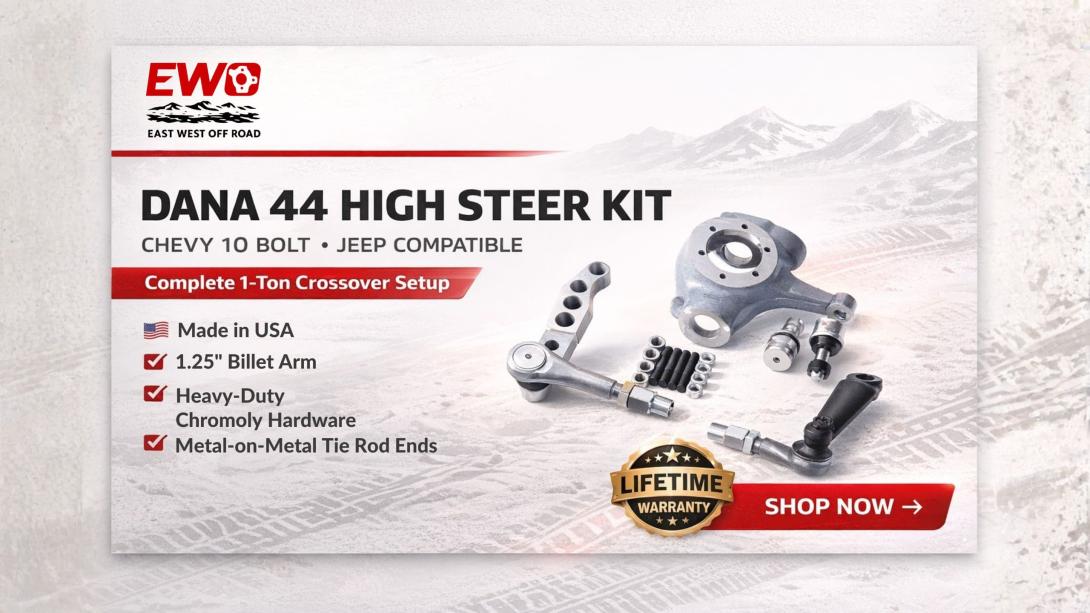
You can bolt on the heaviest steering linkage money can buy, but if the foundation is sloppy, your steering will never be tight. That foundation is the knuckle. For serious off-road builders upgrading a solid axle, the Dana 44 Flat Top Knuckle represents the single most important piece of cast iron on the front end. This specific passenger-side casting is the gateway to eliminating bump steer and moving your tie rod up above the leaf springs. It’s the non-negotiable hardware required to transition from a fragile factory inverted-Y steering system to a bulletproof, crossover architecture.
We’re going to strip down the metallurgy, the machining, and the geometry that separates a genuine, machined steering knuckle from a junkyard gamble. If you are piecing together a DIY Dana 44 Steering Kit or buying a complete solution, understanding the interface between the knuckle deck and the steering arm is what keeps you off the trail repair list and on the crawl line.
Why a Flat Top Knuckle is Non-Negotiable for High Steer
Let’s cut through the confusion. A standard Dana 44 knuckle has a sloped, as-cast top surface. You cannot safely bolt a steering arm to this uneven slope; the tapered studs would side-load, crack the casting, and shear. A true Dana 44 passenger side flat top knuckle is a specific piece. It features a precision-machined, level platform with drilled and tapered holes. This flat deck creates a perfect clamping surface for a steering arm. When you’re trying to Fix Bump Steer Lifted Chevy rigs, this machined platform moves the tie rod above the leaf springs, flattening the drag link angle and synchronizing the axle movement with the steering box.
The Geometry of Bump Steer Elimination
Bump steer happens when the arc of the suspension cycle pulls the steering linkage into a different arc. By mounting the steering links high, the effective length of the drag link no longer changes drastically in relation to the tie rod. The flat top knuckle isn't just a mounting point; it's a geometry correction tool. When combined with a Dana 44 Crossover Steering Kit, the drag link now drives the passenger knuckle directly, wiping out the factory push-pull slop that plagues Squarebody trucks.
East West Off Road’s US Made Knuckle: A Closer Look
Not all flat tops are equal. Many builders hunt for 1970s "Ford" knuckles in scrap yards, only to find wallowed-out tie rod holes, stress cracks, or badly worn trunnion bearings. The US Made Dana 44 Knuckle from East West Off Road solves the core problem with a fresh, domestic casting. This Chevy 10 bolt bottom up taper knuckle is machined specifically for the 1-ton crossover environment.
Bottom-Up Taper: Flipping the Forces
Traditional knuckles taper from the top down, meaning the nut is the only thing holding the rod end in place. Under severe articulation or steering bind, you rely entirely on that castle nut. EWO flipped the script. Their Dana 44 passenger side flat top knuckle features a bottom-up taper. The ES2026R ES2027L drag link ends feed in from the bottom, meaning the weight of the vehicle and the steering forces actively wedge the rod end deeper into the taper. This "fail-safe" orientation means if you ever lose a nut (which shouldn't happen with a cotter pin), gravity and physics keep the linkage seated, giving you a chance to crawl off the trail.
The Strength of Metal-to-Metal Ball Joints
A high-steer knuckle is only as stable as its pivot points. This casting is designed to accept metal to metal tie rod ends and ball joint technology. Unlike plastic-lined ball joints that cold-flow and develop slop under the heat of hard braking and steering, a metal-to-metal lower and upper ball joint uses a hardened pin riding directly in a polished bore. This provides extreme longevity and zero deflection, keeping the expensive billet steering arm from flopping around under load.
Integrating High Steer Arms and HD Linkage
The knuckle alone won't fix your steering; it's the anchor for the leverage points. Mating the right Dana 44 High Steer Arms to the flat deck is critical for load transfer.
1.25 Inch Thick Billet Steering Arms: The Clamping Force
Forget cast arms. The shock loads transmitted through a rock crawling rig require a grain structure that only billet provides. The 1.25 inch thick billet steering arms included in the EWO kit are carved from a single block of domestic steel. This solid chunk eliminates the porosity and hidden voids of a cast arm. Secured by Chromoly 9/16 studs Dana 44 spec hardware, the arm clamps onto the flat top surface with a predictable, even load. The chromoly studs stretch slightly under load, absorbing shock rather than snapping, a common failure point on standard grade-8 hardware trying to hold a steering arm.
Why You Want a Crossover Kit Without DOM Tubing
Off-road fabrication is rarely one-size-fits-all. When you buy a hd crossover steering kit, shipping a 6-foot steel bar often costs more than the tubing itself. The Chevy 10 Bolt High Steer Conversion strategy from EWO embraces the shop environment. This is a crossover steering kit without DOM tubing, meaning you get precision weld-in bungs (7/8-18 thread), jam nuts, and adapters. You supply the 1.5-inch DOM. You cut it. You weld it. This not only saves massive shipping costs but allows you to customize the tie rod length for your specific WMS (Wheel Mount Surface) width, whether it's a narrowed rock buggy or a full-width Super Duty swap.
The Full System: From Pitman Arm to Knuckle
A properly engineered steering system accounts for every pivot. The 3 inch drop forged pitman arm 32 spline unit mates the steering box output to the linkage. Because the flat top knuckle raises the mounting points at the axle, the pitman arm must drop the mounting point at the frame. This parallelism keeps the track bar and drag link moving in sync, the true secret to a death-wobble-free ride. This fully indexable arm ensures you can perfectly center the steering wheel without running out of adjustment on your drag link ends.
Frequently Asked Questions (FAQs)
Can I just machine my existing knuckle flat?
While technically possible, it's a dangerous gamble. You need to add material, weld, and then mill the surface perfectly perpendicular to the kingpin axis. Most stock knuckles lack the material thickness on the deck to safely hold a tapered stud. Buying a properly cast and machined Dana 44 Flat Top Knuckle ensures the taper depth and deck thickness are designed from the start for steering forces.
Does this flat top knuckle work for a Jeep Dana 44 high steer conversion?
Yes. The geometry of the Dana 44 inner "C" is shared across the platform. If you are doing a Jeep Dana 44 high steer conversion, this knuckle is a bolt-on solution, though you must ensure your spindle, caliper bracket, and axle shaft clearances match the knuckle's physical offset.
How strong are chromoly studs compared to standard bolts?
Exponentially stronger under shear and tension. A standard grade-8 bolt has a tensile strength around 150,000 psi. Chromoly significantly exceeds this while offering superior elongation (ductility). This means the Chromoly 9/16” studs will stretch to absorb an impact that would cleanly shear a hardened bolt, preventing your steering arm from detaching.
What makes the East West Offroad 1 ton steering kit better than drilling my own knuckle?
The East West Offroad 1 ton steering approach integrates the knuckle, steering arm, and joints as a system. The bottom-up taper, the specific slit tapered insert for orientation changes, and the US-made casting ensure an assembly that withstands cyclical fatigue. Drilling introduces stress risers and often results in tapered holes that don't match the rod end's locking angle, leading to accelerated wear.
Is the bottom-up taper safe for highway driving?
Absolutely. As long as the castle nut is torqued to spec and the cotter pin is installed, the joint cannot physically separate. The bottom-up taper in a Chevy 10 bolt bottom up taper knuckle serves as a secondary safety mechanism, keeping the joint seated via vehicle weight rather than trying to pull it out of the arm during a violent suspension compression.