

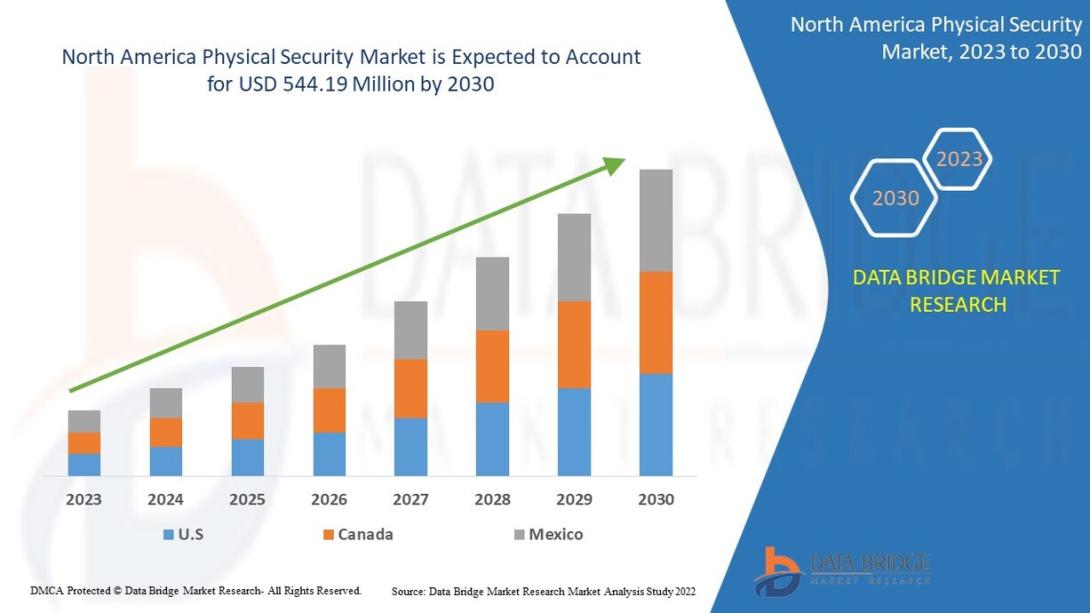
As threats to infrastructure, assets, and public safety evolve, the demand for robust physical security solutions in North America is escalating. The North America Physical Security Market—encompassing surveillance systems, access control, perimeter defense, and emergency response technologies—is vital in protecting people, property, and operations across sectors.
From corporate offices and government buildings to airports, healthcare centers, and critical infrastructure, organizations across the U.S. and Canada are adopting AI-powered surveillance, biometric authentication, and integrated command-and-control systems to enhance physical security and compliance.
Get More Details: https://www.databridgemarketresearch.com/reports/north-america-physical-security-market
Market Overview
The North America Physical Security Market was valued at over USD 40 billion in 2023 and is expected to surpass USD 65 billion by 2030, growing at a CAGR of 7.2%. This growth is driven by rising security concerns, technological advancements, urbanization, and regulatory mandates.
Key Market Segments
- Surveillance Systems: CCTV, IP cameras, thermal cameras, drones
- Access Control Systems: Biometric readers, smart cards, facial recognition
- Perimeter Security: Fencing, sensors, radar, and video analytics
- Intrusion Detection Systems: Motion sensors, alarms, and smart locks
- Emergency & Incident Management: Mass notification systems, lockdown automation
Market Drivers
🔐 Growing Threat of Crime and Terrorism
- Heightened concerns around mass shootings, data center intrusions, and terrorist attacks have led to significant investments in video surveillance and access control.
🧠 AI and Smart Surveillance Integration
- Use of facial recognition, behavior analytics, and real-time alerts powered by AI and machine learning is revolutionizing surveillance.
🏙 Urbanization and Smart Cities Initiatives
- Development of smart cities and IoT-based infrastructure demands high-level security integration to ensure urban safety.
🏥 Rising Demand from Healthcare and Education Sectors
- Hospitals and universities are deploying multi-layered security systems to ensure patient and student safety and meet compliance requirements.
🏛 Government Regulations and Compliance
- Policies such as FISMA (Federal Information Security Management Act) and HIPAA encourage strong physical security infrastructure in public and private sectors.
Regional Insights
🇺🇸 United States
- The U.S. dominates the regional market due to technological leadership, widespread infrastructure, and homeland security investments.
- Major cities like New York, Los Angeles, and Chicago are leading smart surveillance and access control deployment.
🇨🇦 Canada
- Growth driven by rising cyber-physical threats and national initiatives to protect critical assets.
- Focus on transportation hubs, financial institutions, and municipal buildings.
Technological Innovations
- Cloud-Based Surveillance – Offers scalability and remote access to video feeds.
- AI-Driven Video Analytics – Enables proactive threat detection and behavioral monitoring.
- Integrated Security Platforms – Unified platforms that connect cameras, alarms, access points, and incident response in a single dashboard.
- Biometric Authentication – Iris and facial recognition replacing traditional badges and PINs.
Key Industry Players
- Honeywell International Inc.
- Johnson Controls
- Bosch Security Systems
- ADT Inc.
- Genetec Inc.
- Axis Communications
- Cisco Systems Inc.
- Stanley Black & Decker
These companies are investing in cloud solutions, AI, and cybersecurity integration to strengthen their portfolios.
Challenges in the Market
⚠ Cybersecurity Concerns
- As physical security devices connect to the internet, cyber-physical threats like hacking of surveillance feeds and data breaches are rising.
⚠ High Implementation Costs
- Integrating AI-powered and IoT-enabled security systems involves substantial initial investments.
⚠ Privacy and Data Regulation Issues
- Widespread use of facial recognition and surveillance raises ethical and legal questions, especially in public areas.
Future Outlook
The future of North America's physical security market is intelligent, integrated, and data-driven. With increased investments in AI, cloud computing, and 5G, physical security is evolving from reactive to predictive and preventive.
Innovations like drone-based surveillance, digital twins for buildings, and autonomous patrolling robots are set to redefine physical protection strategies.
FAQs
1. What is physical security?
Physical security involves the protection of personnel, assets, and physical infrastructure using surveillance, access control, and emergency response systems.
2. What are the major components of a physical security system?
Key components include video surveillance, access control, perimeter protection, intrusion detection, and emergency management systems.
3. Which industries are the largest adopters of physical security in North America?
Government, commercial buildings, critical infrastructure, healthcare, transportation, education, and data centers are the largest adopters.
4. What technologies are driving market growth?
AI, cloud-based platforms, facial recognition, IoT-enabled sensors, and biometric access control are driving innovation in the market.
5. What are the key challenges in the North America physical security market?
Cybersecurity threats, high upfront costs, system integration complexities, and privacy regulations are key market challenges.