

Introduction
The self-healing material market represents a transformative segment within advanced materials technology, offering the capability to autonomously repair damages without external intervention. These materials, inspired by biological systems, have the potential to extend the lifespan, reliability, and safety of products across various industries such as aerospace, automotive, electronics, construction, and healthcare.
Self-healing materials respond to damages such as cracks, scratches, or microfractures by initiating intrinsic or extrinsic repair mechanisms. The market for these innovative materials has witnessed rapid growth, driven by technological advancements, increasing demand for durable products, and sustainability trends focused on reducing maintenance costs and material waste.
Market Overview
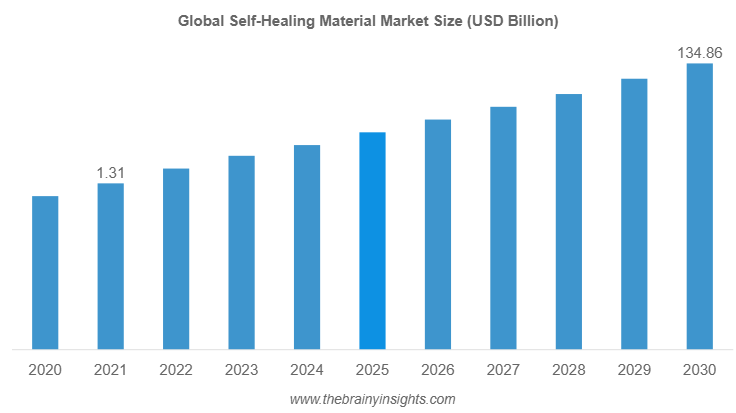
The global self-healing material market has seen significant momentum over the last decade and is projected to continue its upward trajectory. The global self-healing material market is projected to surge to USD 134.86 billion by 2030, expanding at an impressive CAGR of 67.35% between 2022 and 2030.
Key Market Segments
- Polymer-Based Self-Healing Materials: The largest segment due to their wide application and versatility, particularly in coatings, adhesives, and composites.
- Concrete and Cement-Based Materials: Used extensively in construction, these materials help prolong infrastructure life and reduce costly repairs.
- Metals and Alloys: Self-healing metals are emerging, targeting aerospace and automotive sectors for crack repair and corrosion resistance.
- Ceramics and Composites: Important for high-performance applications demanding resistance to wear and environmental factors.
Market Dynamics
Drivers
- Increasing Demand for Durability and Longevity: Industries are seeking materials that reduce downtime and extend product life, thus lowering maintenance costs.
- Sustainability and Environmental Regulations: Self-healing materials help reduce waste and the carbon footprint associated with repairs and replacements.
- Technological Advancements: Innovations in nanotechnology, microcapsules, and polymer chemistry have enabled more efficient self-healing mechanisms.
- Rising Applications in Automotive and Aerospace: Lightweight, durable materials with self-healing capabilities improve safety and performance.
- Growing Construction Sector: Infrastructure resilience is vital, especially in regions with harsh environmental conditions.
Restraints
- High Cost of Raw Materials and Manufacturing: Advanced self-healing materials remain expensive compared to traditional materials.
- Technical Challenges: Some self-healing mechanisms are limited to specific damage types or environmental conditions.
- Lack of Awareness and Adoption: Some industries remain hesitant to adopt new materials without proven long-term benefits.
Regional Insights
- North America: A leading market driven by strong aerospace, automotive, and defense industries, along with extensive research and development initiatives.
- Europe: Significant growth due to stringent environmental regulations and investments in smart infrastructure.
- Asia-Pacific: The fastest-growing region, fueled by booming construction, automotive, and electronics manufacturing sectors in countries like China, India, and Japan.
- Rest of the World: Emerging opportunities in Latin America and the Middle East with increasing infrastructure development.
Technological Trends
- Microcapsule-Based Healing: Incorporation of microcapsules containing healing agents that release upon damage to repair cracks.
- Intrinsic Self-Healing Polymers: Polymers with reversible chemical bonds that enable multiple healing cycles.
- Vascular Networks: Materials designed with embedded microchannels to deliver healing agents where damage occurs.
- Bio-Inspired Approaches: Mimicking natural healing processes found in living organisms to develop smarter materials.
Applications Across Industries
- Automotive: Self-healing coatings and composites improve scratch resistance and structural integrity.
- Aerospace: Lightweight self-healing composites enhance safety by repairing micro-cracks in aircraft components.
- Electronics: Self-healing conductive materials help maintain performance and extend device lifespan.
- Construction: Concrete with self-healing capabilities reduces repair frequency and improves durability.
- Healthcare: Smart biomaterials that promote tissue regeneration and wound healing.
Request PDF Brochure: https://www.thebrainyinsights.com/enquiry/sample-request/12886
Competitive Landscape
The market is moderately fragmented with key players including:
- Autonomic Materials, Inc.
- Arkema Group
- BASF SE
- 3M Company
- Dow Inc.
- Evonik Industries AG
- Sika AG
- Xiaomi Huanyu Advanced Materials
- Teijin Limited
These companies focus on innovation, strategic partnerships, and expanding production capabilities to capture growing market demand.
Challenges and Future Outlook
Despite promising prospects, the self-healing material market faces challenges such as high costs and the need for standardized testing to prove long-term effectiveness. Continued research is essential to develop cost-efficient and versatile self-healing systems.
Looking ahead, the integration of artificial intelligence and advanced sensors with self-healing materials could lead to "smart" materials capable of real-time damage detection and autonomous repair, revolutionizing industries.
Conclusion
The self-healing material market is poised for remarkable growth driven by the increasing demand for durable, sustainable, and cost-effective solutions across multiple sectors. With ongoing advancements and rising adoption, these materials are set to become a cornerstone of next-generation manufacturing and infrastructure development.
Companies investing in innovation and collaborative partnerships will likely lead the market, tapping into emerging applications and regional growth opportunities.
For Further Information: