

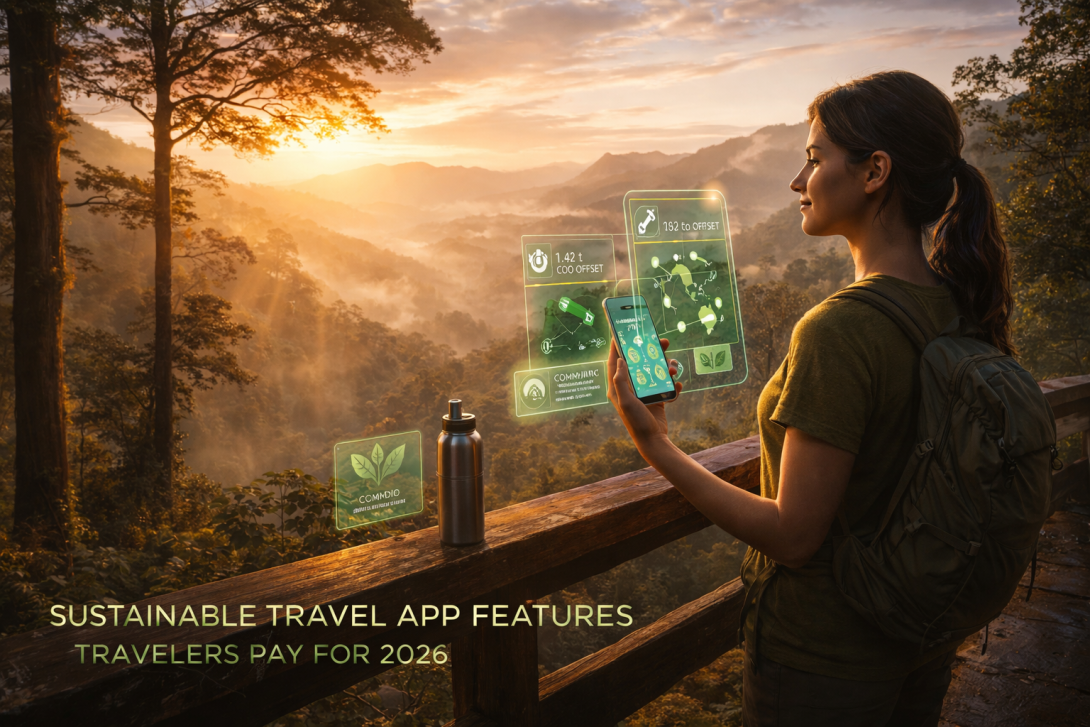
Sustainable travel has transitioned from a niche preference to a primary driver of the global tourism economy. In 2026, travelers are no longer satisfied with vague "eco-friendly" labels; they demand transparency, utility, and verifiable impact. As the industry matures, the focus has shifted from free information to premium, high-integrity tools that simplify the complexities of responsible exploration.
This guide is designed for app developers, travel tech stakeholders, and hospitality brands. We will examine the specific sustainable travel app features travelers pay for 2026, moving beyond basic discovery to functional, high-value implementations that justify subscription or transactional costs.
The 2026 Context: Why "Green" Now Requires "Gold" Standards
The travel landscape in 2026 is defined by "Value-Based Navigation." According to recent 2025 industry reports from organizations like Skift and the World Travel & Tourism Council (WTTC), over 60% of Gen Z and Millennial travelers express a willingness to pay a premium for travel services that provide documented sustainability data.
The problem previously was "greenwashing" fatigue. In 2026, the market has corrected this through standardized carbon accounting and blockchain-verified supply chains. Travelers are paying for the peace of mind that their financial contribution actually reaches the conservation projects or local communities promised by the platform.
High-Value Features Driving Revenue in 2026
1. Hyper-Local "Impact" Itinerary Builders
Generic city guides are obsolete. Modern travelers pay for AI-driven itineraries that prioritize "hidden gem" businesses with high social impact scores. These features use real-time data to steer foot traffic away from over-touristed zones toward communities that actually benefit from the economic injection.
2. Verified Tier-1 Carbon Offset Integration
In 2026, basic carbon calculators are free, but high-fidelity, "Tier-1" offset integrations are a paid feature. These systems don't just estimate emissions; they provide a direct, fractional ownership receipt of a carbon-removal project, such as a specific reforestation plot in the Amazon or a carbon-capture facility in Iceland.
3. Real-Time "Green-Route" Navigation
Similar to how drivers pay for premium traffic data, travelers now subscribe to "Green-Route" features. These modules calculate the lowest-carbon path between destinations, integrating electric rail schedules, EV-sharing availability, and walking-friendly corridors.
4. Direct-to-Community Micro-Payment Hubs
Travelers are increasingly wary of platform fees eating into local profits. Premium apps now offer "zero-fee" payment gateways for local artisans and guides, funded by a user subscription rather than a commission on the sale. This ensures that 100% of the traveler’s spend reaches the local host.
Implementing These Features in Your Tech Stack
For businesses looking to capture this market, the technical execution is as important as the concept. Building these high-integrity systems requires specialized expertise in data privacy, real-time API integration, and localized UX design.
If you are looking to build or scale a travel platform with these capabilities, partnering with experts in Mobile App Development in St. Louis can provide the foundational architecture needed to handle complex data sets like real-time carbon tracking and multi-currency community payments. Localized development expertise ensures that the app remains compliant with both regional regulations and global security standards.
Real-World Application: The "Eco-Verified" Tier
Consider a hypothetical travel app, TerraNavigate, launched in early 2026. While the base app is free, their "Guardian Tier" ($9.99/month) includes:
- The Feature: A "Transparency Lens" that uses AR to show the sustainability rating of a hotel or restaurant simply by pointing the phone camera at the building.
- The Outcome: Within six months of launch, the app saw a 40% conversion rate from free to paid users in the European market, where environmental disclosure laws are strictest.
- The Lesson: Value is found in the validation of claims, not just the claims themselves.
AI Tools and Resources
EarthTrack API — Provides real-time carbon emission data for flights, rail, and sea travel.
- Best for: Integrating precise carbon calculators into travel booking flows.
- Why it matters: It moves away from "averages" to specific aircraft/engine model emission data.
- Who should skip it: Small blogs or static guides that don't facilitate direct bookings.
- 2026 status: Current industry standard for ISO-compliant carbon reporting.
ImpactRecruit — An AI tool that audits local businesses for social and environmental compliance.
- Best for: Populating "Impact Itineraries" with vetted, non-greenwashed vendors.
- Why it matters: Automates the vetting process that previously required manual site visits.
- Who should skip it: General-interest travel apps that do not market themselves on sustainability.
- 2026 status: Widely used by "B-Corp" certified travel platforms.
Risks, Trade-offs, and Limitations
While the demand is high, implementing paid sustainable features is not without risk. The most common pitfall is the "Data Integrity Gap."
When Sustainable Features Fail: The "Outdated Impact" Scenario
A traveler pays for a "Green Hotel" recommendation, only to find the hotel lost its certification six months ago due to a change in waste management policy.
Warning signs: High user complaint rates regarding accuracy; stagnant data refresh timestamps.
Why it happens: The app relies on annual certifications rather than real-time data feeds.
Alternative approach: Implement a "User-Verified" feedback loop where premium members can report discrepancies in exchange for platform credits, keeping the data dynamic.
Key Takeaways
- Trust is the Currency: In 2026, travelers pay for verification and transparency, not just "eco-friendly" suggestions.
- Utility over Labels: Features like green-route navigation provide tangible time and carbon savings, making them easier to monetize.
- Localization Matters: Effective sustainable travel apps must bridge the gap between global technology and local community impact.
- Data Integrity: Success depends on the ability to provide real-time, accurate environmental data that withstands scrutiny.